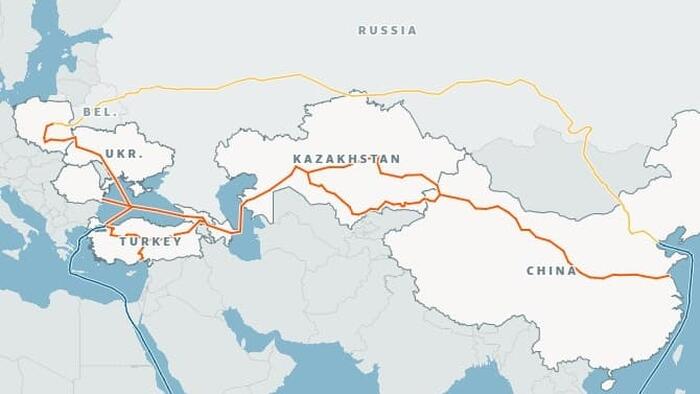
Global trade is shifting away from vulnerable maritime chokepoints toward overland routes like the Middle Corridor amid rising geopolitical instability
A $3.3 billion World Bank-backed investment push aims to address infrastructure gaps and unlock the corridor’s long-term potential
While promising, the route still faces major capacity and coordination constraints before it can rival established northern trade flows
While diplomatic efforts struggle to stabilize access to the Strait of Hormuz amid tensions between the United States and Iran, Eurasian trade is increasingly being redirected toward overland alternatives, with the Trans-Caspian Transport Route, also known as the Middle Corridor, emerging as a key diversification route in Eurasian logistics.
The World Bank described the Middle Corridor back in 2023 as a strategically important but structurally constrained route. While geopolitical fragmentation, driven in part by Russia's war in Ukraine, has increased the demand for alternative corridors, the World Bank emphasized that the corridor's long-term viability requires coordinated investment, the removal of infrastructure bottlenecks, and improved cross-border customs and transport procedures.
To address these roadblocks, the World Bank and its partners on April 14–15 committed $3.3 billion to strengthening key missing links along the corridor, including $1.9 billion for Turkey's Istanbul North Rail Crossing and a $1.4 billion investment in the reconstruction of Kazakhstan's Karagandy–Zhezkazgan highway.
On the same day that this was announced, Turkish Vice President Cevdet Y?lmaz underscored the importance of such investment at a meeting in Astana.
"The Northern Corridor [through Russia] has become unpredictable due to geopolitical tensions. The southern route is pushing the limits of its capacity,"he said.
"This situation has made the Middle Corridor not an alternative but a mandatory choice."
Dosym Satpayev, director of the Risk Assessment Group in Almaty -- an independent think tank analyzing political risks, corruption, and foreign policy processes in the region -- says that Russia's war in Ukraine and the resulting sanctions deepened global dependence on maritime chokepoints such as the Strait of Hormuz. but the current crisis has potentially long-term consequences for global trade.
Source: ZeroHedge News
