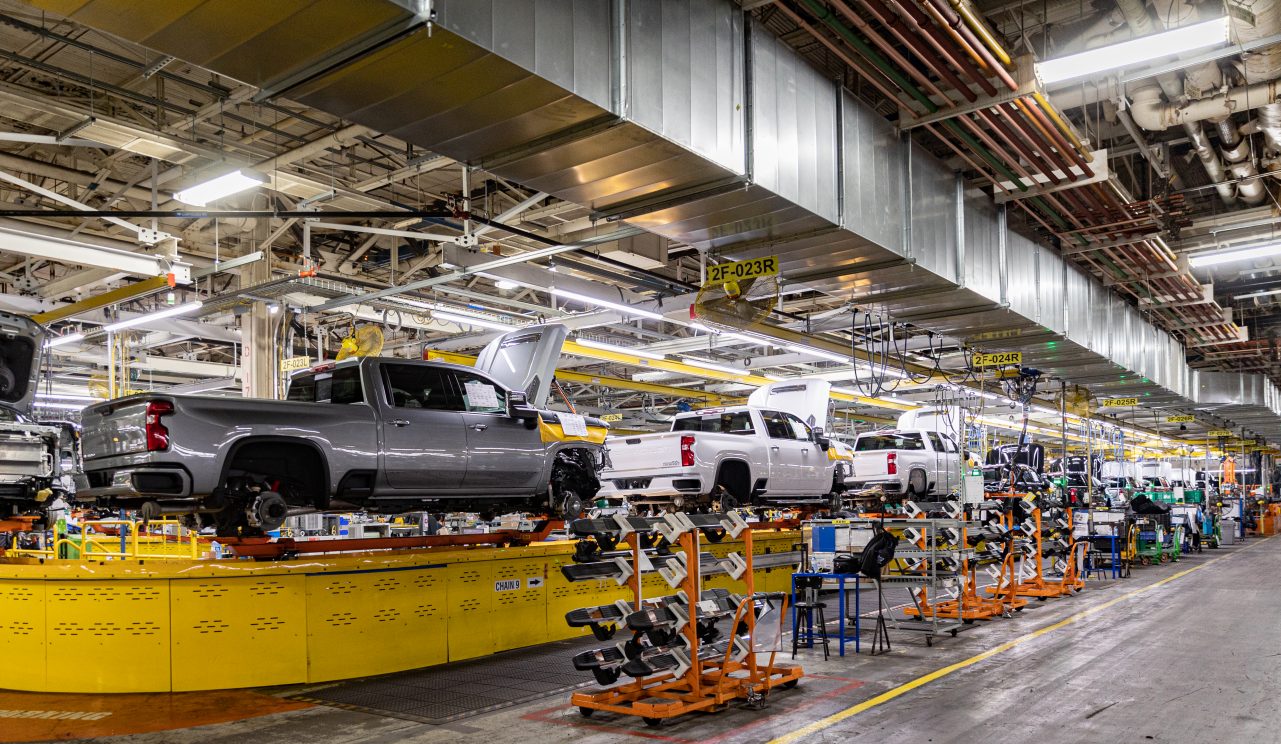
General Motors has quietly shelved the next generation of its electric pickup trucks and large SUVs, a decision that casts a long shadow over its flagship Detroit plant. Though 1,300 workers recently returned to the line after a month-long production pause in mid-March, the cancellation of future models leaves the 'factory of the future' staring at an increasingly uncertain long-term horizon.
The US automaker has put updated versions of theChevrolet Silverado EV, GMC Sierra EV, GMC Hummer EV, and Cadillac Escalade IQ on ice, according to reporting first surfaced by Crain's Detroit Business on 21 April.
Redesigned variants had been pencilled in for a 2028 launch, but sources familiar with GM's planning now say the trucks are unlikely to reach production before 2030. The company has not publicly confirmed the cancellations.
The shift marks a sharp reversal for a firm that pledged $35 billion (£26 billion) toward electric and autonomous vehicles in 2020 and promised 30 new battery-powered models globally by 2025. The Escalade IQ was supposed to debut GM's 'eyes-off' highway autonomy system, a centrepiece of its next-decade strategy.
The buried story sits in Detroit. Factory Zero, the $2.2 billion (£1.6 billion) plant opened in 2021 and toured by then-President Joe Biden as 'the factory of the future,' has watched its workforce collapse in slow motion. GM cut one of the plant's two shifts in October 2025 and permanently laid off roughly 1,200 workers. That left 1,300 on the remaining shift, and even they have not been spared.
Those 1,300 workers were sent home on 16 March and told to expect a return on 13 April, according to a statement from GM spokesperson Kevin Kelly. 'Factory Zero will temporarily adjust production to align EV production with market demand,' Kelly said. Affected employees may be eligible for supplemental pay under the GM-UAW national contract, but with no next-generation trucks in the pipeline, the plant's longer-term purpose is an open question.
UAW Local 22 President James Cotton told reporters he was 'disappointed that the EV market has failed to take off as expected'. He blamed the end of the $7,500 (£5,550) federal EV tax credit, which expired on 30 September 2025, and the Trump administration's rollback of tailpipe pollution rules. GM's fourth-quarter 2025 EV sales fell 43% to roughly 25,000 units after the credit lapsed.
The pain has spread beyond Detroit. At the Ultium Cells plants in Lordstown, Ohio and Spring Hill, Tennessee, GM temporarily laid off 1,550 battery workers, with 550 let go indefinitely. The contraction rippled into parts suppliers. Avancez cut 143 workers in Hazel Park, Michigan, and Dana Thermal Products closed its Auburn Hills plant, eliminating 200 jobs.
Chevrolet sold around 1,400 Silverado EVs in the first quarter of 2026. GMC moved about 1,300 Sierra EVs and roughly 1,600 Hummer EVs, which led the plant's production lineup. Cadillac followed with roughly 1,400 Escalade IQ deliveries, but the luxury SUV starts at roughly $130,000 (£96,200), keeping it well outside the mass market. The Equinox EV, built at a separate facility in Ramos Arizpe, Mexico, and priced near $35,000 (£25,900), outsold every Factory Zero model combined at nearly 10,000 units.
GM booked $7.6 billion (£5.6 billion) in EV-related charges across 2025, including a $6 billion (£4.4 billion) writedown in the fourth quarter tied to cancelled production plans and terminated battery supply contracts. The automaker said in a January regulatory filing that it expects further material charges in 2026, though significantly less than last year's total.
Source: International Business Times UK
