For a growing share of Americans, retirement no longer starts at 65.
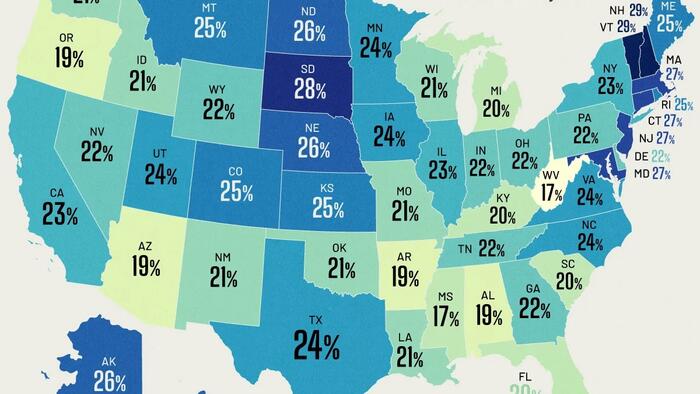
This map,via Visual Capitalist's Gabriel Cohen,shows where people aged 65 and older are still working across U.S. states, based on 2024 data from the U.S. Census Bureau viaFinanceBuzz.
About 22% of Americans 65+ remain in the workforce, but the share climbs to nearly one-third in some states. The gap highlights how cost of living, job availability, and shifting retirement systems are reshaping when—and whether—Americans stop working.
The New England states of Vermont and New Hampshire (both28.6%) lead the country in the number of seniors still working, followed by South Dakota at27.6%.
A clear regional pattern emerges: Northeastern states dominate the top ranks, with many posting rates above 26%. Higher living costs and longer life expectancy likely contribute to more Americans 65+ staying in the workforce.
Most people are not working full-time, however. In fact, among its retirement-age workers, Vermont has the highest concentration of part-time employees nationwide, reflecting in part the social role work plays in many older Americans’ lives.
On the flip side, there’s Maryland, which has the highest share of full-time retirement-age workers in the country.
Maryland and Hawaii are actually the only two states in which a majority of working people aged 65 and up are employed full-time. Full-time work is generally essential for seniors who cannot rely on other retirement sources of income, such as Social Security, or who obtain needed benefits through their job.
The decline of traditional pensions is a key driver behind this shift. With retirement savings increasingly tied to 401(k) plans and market performance, many Americans are working longer to maintain financial security.
Among the 50 states in the country, West Virginia (16.7%) has the lowest share of retirement-age workers. It’s followed by Alabama, Arizona, Arkansas, and Oregon, all of which sit around 19%.
Source: ZeroHedge News
