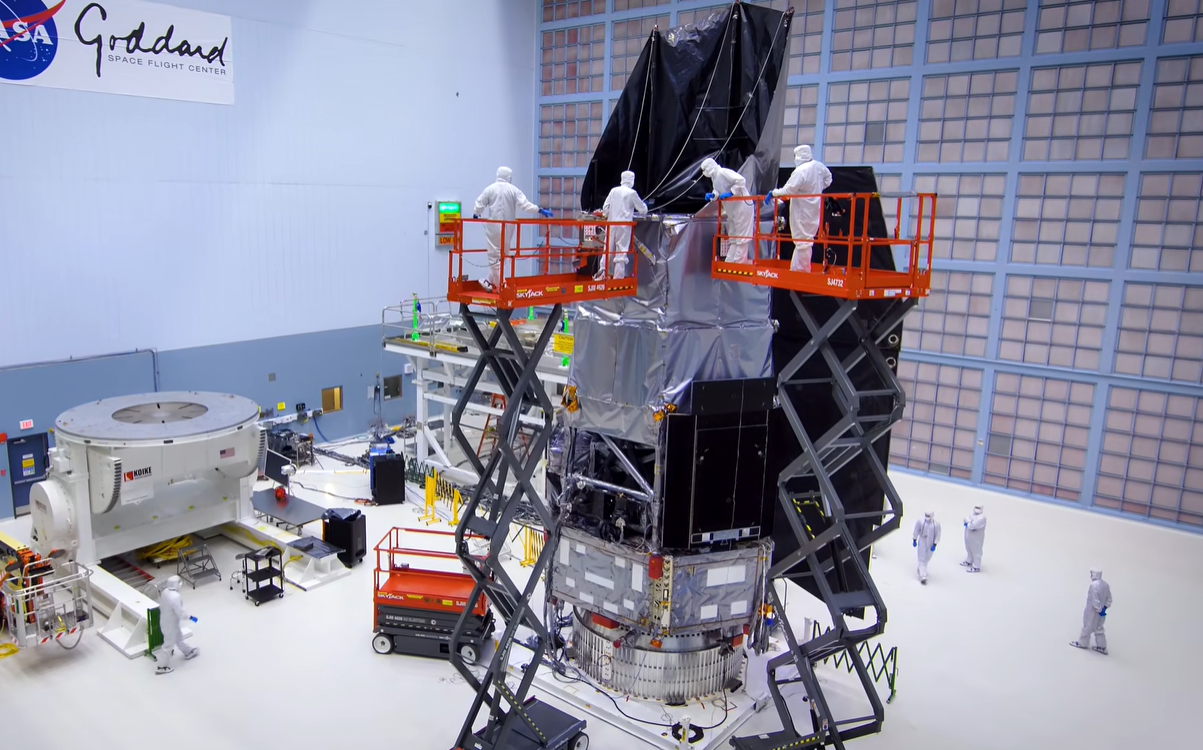
NASAunveiled a new telescope on Wednesday to scan vast swathes of the universe for planets outside our solar system and probe the mysteries of dark matter and dark energy.
The Roman space telescope is expected to discover tens of thousands of planets, possibly offering clarity about how many could be out there.
“Roman will give the Earth a new atlas of the universe,” NASA administrator Jared Isaacman told a news conference at the Goddard Space Flight Center in Maryland, where the telescope went on display.
The 12-metre (39-feet) silvery contraption with massive solar panels will be transported to Florida ahead of a launch into space aboard a SpaceX rocket planned for September at the earliest.
Roman, which took more than $4 billion and over a decade to build, is named after astronomer Nancy Grace Roman, nicknamed the “Mother of Hubble” for her role in developing the landmark space telescope.
Thirty-six years after Hubble launched into space, revolutionising astronomical observations, NASA hopes Roman will help to shed light on questions that remain unresolved.
Boasting a field of view at least 100 times larger than Hubble’s, the telescope will sweep across vast regions of space from its position 1.5 million kilometres (930,000 miles) from Earth.
The telescope will send 11 terabytes of data a day down to Earth, said Mark Melton, a systems engineer at Goddard Space Flight Center.
“In the first year, we’ll have sent down more data than Hubble will have for its entire life,” he told AFP.
The telescope’s wide-angle lens will allow NASA to conduct a census of the objects that make up our universe, said Nicky Fox, associate administrator for NASA’s Science Mission Directorate.
Source: Insider Paper
