It’s spring, which means theAtlantic Flyway, a bird migration path, is buzzing with birds on their way to our neck of the woods.Piping plovers(Charadrius melodus)utilize this flyway to lay nests on our shores every spring, which is why parts of local beaches are fenced off throughout the summer. It’s not uncommon for people to point to a group of birds and say, “There’s a ton of plovers right there! Why does the beach need to be closed?” As a former “plover monitor,” I often see people mistake the wrong birds for piping plovers.
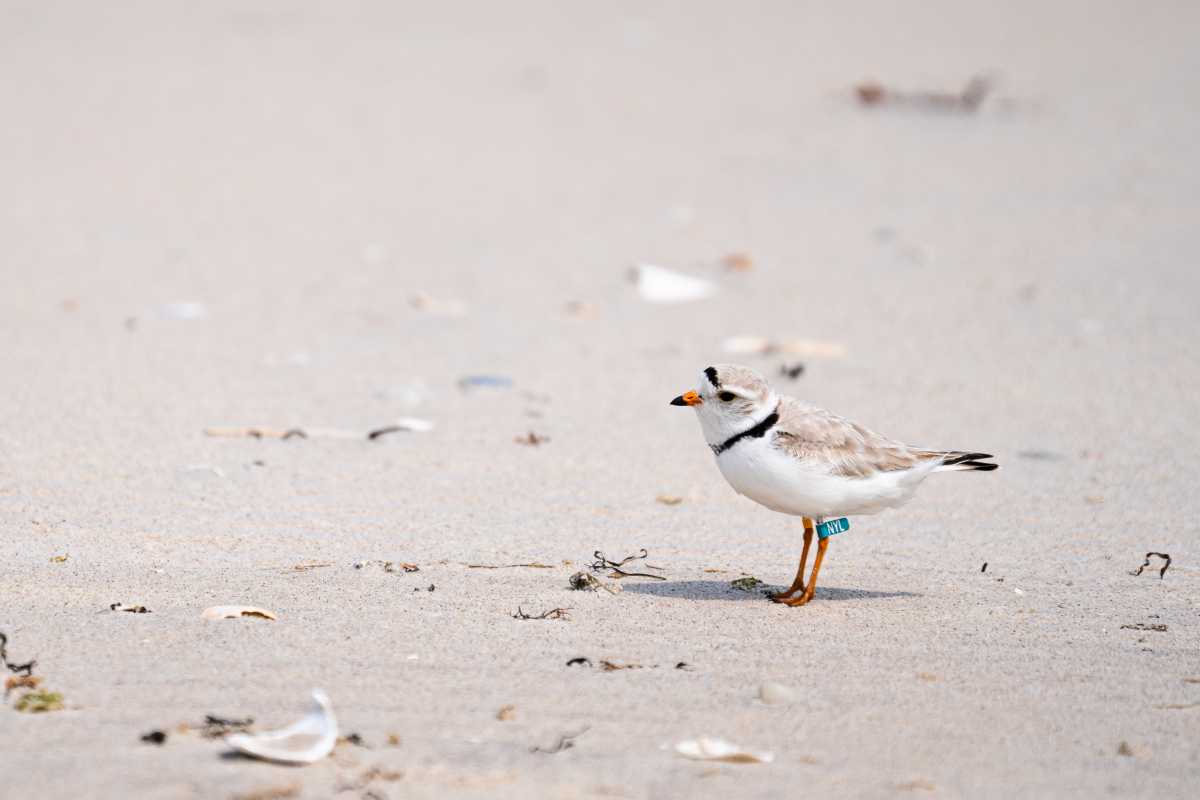
The first sign that it’s a piping plover is their size. Piping plovers are so small that they can easily fit in the palm of your hand. Their chicks are even smaller, about the size of a cotton ball. At all ages, piping plovers are tiny and well camouflaged, making them vulnerable to being run over by vehicles.
The second clue is that you may hear a faint, gentle “peep.” Their calls are infrequent unless they feel threatened. A plover will “peep” and walk alongside you from a distance, trying to guide you away from their nest. If you approach their nest too closely, they will mimic a broken wing to distract potential predators from their eggs.
The third way to identify a piping plover is by the number of birds present. Piping plovers tend to be solitary unless they are with their mate or chicks, during which time they lay clutches of three to four eggs on average. Even then, they are not tightly packed together, unlike sanderlings, which stay near the shoreline and run to and from the crashing waves.
The fourth sign that you are looking at a piping plover is their short, bright orange beak with a black tip. They also have bright orange legs. If you look closely, you might see a colored band with a number wrapped around one—this is how scientists track individual birds from year to year.
The fifth feature, which is slightly harder to distinguish, is their coloration. Plovers have grayish-brown feathers on their heads, backs, and wings, with black tips. They also have a distinctive jet-black ring around the neck that is often incomplete.
The last clue is that piping plovers have a need for speed. Their legs turn into a blur as they move from point to point; however, these sprints are short-lived. They run in segments to get to their destination.
Now that you know how to identify a piping plover, you probably want to know what the big deal is. Piping plovers are protected under theMigratory Bird Treaty Act of 1918and theEndangered Species Act.The International Union for Conservation of Nature (IUCN) Red Listmarks piping plovers (both the Atlantic and Great Lakes populations) as near threatened. Conservation efforts have increased the population, moving it from endangered to near threatened. The IUCN estimates that there are only7,600 to 8,400mature (able to reproduce) birds left in the world. Piping plovers are an indicator species, meaning their presence or absence tells us about the overall health of the ecosystem. With proper identification, we can spread awareness about piping plovers and help them make a comeback. How lucky we are to live in a place with such special wildlife!
Source: Fire Island News & Great South Bay News
