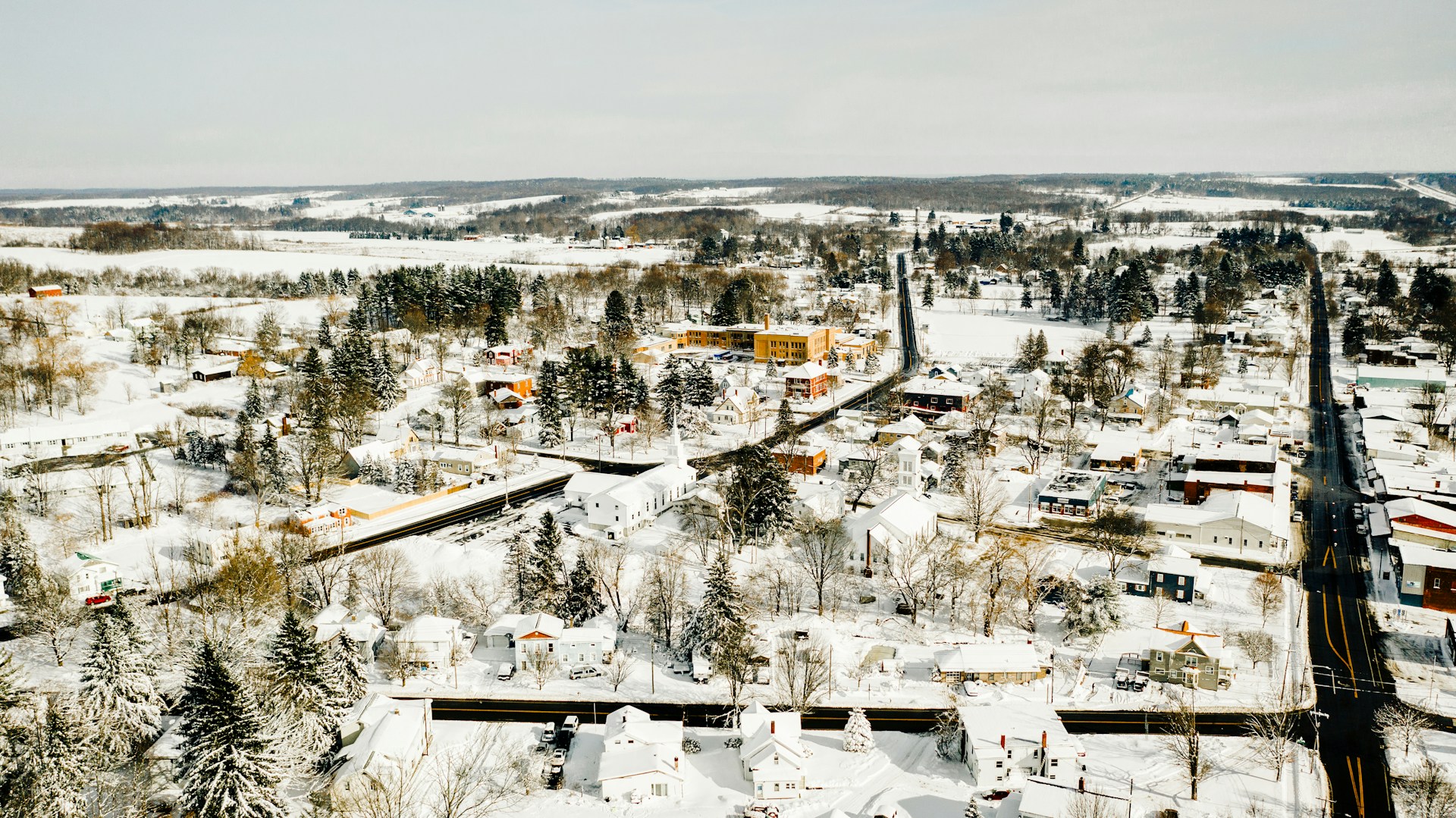
The cold in New York this winter has felt personal. Faces buried in scarves, eyelashes gathering tiny icicles, children shuffling along pavements framed by grey slush that never quite melts before the next storm rolls through. On a recent morning in Brooklyn, with an 'extreme cold warning' still flashing on phones, the wind chill drove temperatures into the minus 20s Celsius. People walked quickly, hunched and silent, in a city that usually refuses to be quiet.
Yet at the very same moment, a thousand miles away in the American West, winter hardly bothered to turn up.
'I'm sitting here in a T-shirt in early February, a mile high in Colorado,' climate scientist Daniel Swain said drily, speaking from the California Institute for Water Resources. One half of the US has been gripped by a ferocious, lingering chill. The other has been living through what, by the records, looks suspiciously like spring.
It is a split-screen season that feels almost theatrical: the East shivering, the West basking. And within days, forecasters say, that script is about to flip.
Theheavy snow forecastnow bearing down on parts of the US is not some random act of atmospheric cruelty. It is the closing chapter of a very specific pattern that has dominated this winter — a contorted polar vortex and a jet stream behaving a little like a drunk river, weaving wildly across the continent.
The polar vortex, much blamed and rarely understood, is essentially a high-speed band of winds that swirls around the Arctic, keeping the coldest air locked near the pole. When it is strong, that icy reservoir stays put. When it weakens, as Swain explains, the flow becomes wavier, like a river that has slowed down and begun to meander.
Where that meander dips south, the Arctic's chill spills into mid-latitudes. Where it bulges north, milder air is dragged up in its place. The US has, rather neatly, found itself with a deep southward kink over the East and an exaggerated northward bend over the West.
The result: brutal wind chills and recurring snow in the north-eastern states, while much of the western US has broken warmth records. For early winter — December 2025 through January 2026 — none of the contiguous US recorded all-time cold, according to climatologist Brian Brettschneider. But an extraordinary 21 per cent of the country logged its warmest such period since 1940.
What has played out this year is not an entirely new story. American geography quietly primes the atmosphere towards this kind of East–West tug-of-war. The towering barrier of the Rockies and the boundary between Pacific Ocean and land favour, on average, a gentle ridge — a northward bend — over the West and a trough over the East. This winter has simply been that pattern on steroids, a 'dramatic' amplification of the usual set-up, as Swain puts it.
That amplification, though, is unlikely to last. The heavy snow forecast for parts of the East is something of a farewell performance. Models suggest that in the coming days the stubborn atmospheric loops will loosen, temperatures will climb back towards something closer to seasonal norms in the East, and the West will finally remember it is supposed to be winter.
Source: International Business Times UK
