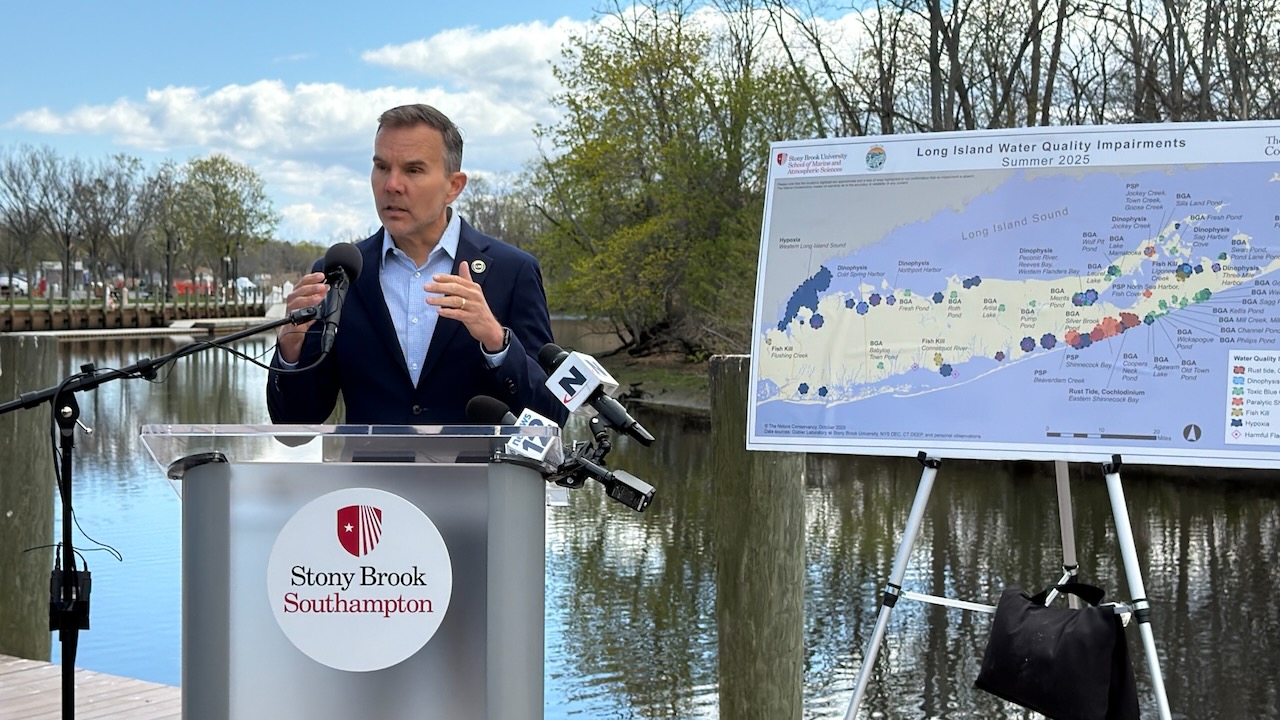
New scientific findings presented Tuesday in downtown Riverhead point to worsening threats in Long Island’s coastal waters, including harmful algal blooms, low-oxygen zones and environmental conditions that promote dangerous bacteria, according to Stony Brook University coastal ecologist Christopher Gobler.
Speaking on the Peconic River boardwalk in Riverhead, ahead of Friday’s annual State of the Bays symposium to take place at Stony Brook University in Southampton, Gobler said water bodies across Long Island failed to meet state and federal water quality standards last year and that 2026 is already off to a troubling start. He had a map of the island on display depicting “dozens and dozens of locations in our estuaries and our harbors and our bays and our lakes and our ponds” that didn’t meet water quality standards in 2025.
Among the most serious concerns, Gobler said, are harmful algal blooms in both freshwater and marine waters, shellfish closures tied to paralytic shellfish poisoning and low-oxygen “dead zones” that harm marine life. He also said researchers are tracking Vibrio vulnificus, the bacteria sometimes referred to as flesh-eating bacteria, in local coastal waters.
Gobler said three Southold water bodies are currently closed to shellfishing because of paralytic shellfish poisoning and that the western half of Shinnecock Bay is also closed.
Five locations last year were closed to shellfishing because of Alexandrium blooms and the saxitoxin they produce, he said. Saxitoxin is a neurotoxin that is 1,000 times more potent than cyanide and can get into shellfish, which, if consumed, can cause extreme illness or even death, Gobbler said. One location in Southold last year had toxin levels in shellfish high enough to be lethal if eaten, he said, adding that no one became sick because the state Department of Environmental Conservation closed the area proactively.
Gobler said nearly three dozen Long Island locations are also experiencing hypoxic conditions, with dissolved oxygen levels below the state standard of 3 milligrams per liter.
“Every hour that a water body spends below three milligrams per liter is an hour that is doing harm to marine life,” he said.
The area of the river where Gobler gave his briefing Tuesday regularly experiences hypoxia during the summer, according to data published by the U.S. Geological Survey.
Gobler identified nitrogen pollution from land-based sources, especially on-site septic systems, as the primary driver of many of the region’s water quality problems. He said climate change is accelerating those problems and contributing to the spread of Vibrio vulnificus.
The briefing also focused on mitigation strategies, including advanced wastewater treatment systems and aquaculture.
Source: RiverheadLOCAL
