Home-Did Industry Misjudge AM’s Value? Findings from AMGTA Explain The Bias
The 2026 edition of ourAMA: Energy online conferencereturns on April 30th. Register now!
TheAdditive Manufacturing Green Trade Association(AMGTA) has published its2026 Vision Paperlaying out an evaluative framework for assessing AM’s resource efficiency across entire production systems.
The paper’s central argument is that organizations consistently get the math wrong when they try to prove 3D printing’s value, and the reason is structural rather than a technical one.
According to AMGTA, six years of observing patterns across both technology developers and manufacturing users simultaneously has produced a vantage point neither side of the industry can develop independently, and one that an organization with equipment to sell or a national manufacturing agenda to advance would struggle to maintain.
Evaluating AM’s Holistic Economic Impact
The paper opens by cataloguing the pressures bearing down on manufacturers: energy cost volatility, supply chain fragmentation, regulatory divergence across jurisdictions, and rising expectations for measurable environmental performance. These pressures are not separate problems.
A supply chain optimized solely for cost creates regulatory and resilience risk simultaneously. The same interdependence works in reverse: a production process that minimizes material waste also reduces cost and simplifies compliance.
Additive manufacturing is positioned as a system-level response to these intersecting pressures, not a replacement for conventional manufacturing but a capability that changes what is economically viable under them.
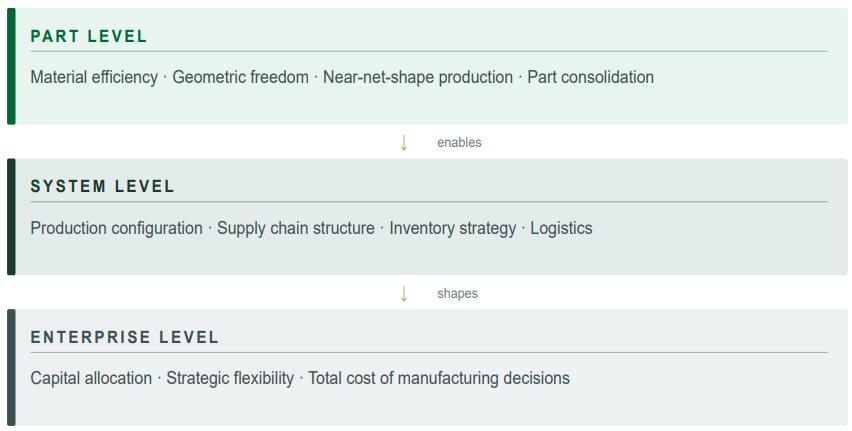
The technology creates value at three distinct levels. At the part level it offers material efficiency, geometric freedom, and near-net-shape production.
Source: 3D Printing Industry
