As the UK celebrates the 100th anniversary of Queen Elizabeth II’s birth this week, her pristine legacy might ultimately be seen as a steaming pile of gilded ordure that threatens to bury her descendants. Her seven decades on the throne—three reigns worth of time— inevitably fossilized the monarchy and insulated it from change. E2 was flawless in conduct, dedicated to duty, and marvelously untroubled by a mutinous inner life, but her aversion to conflict, known by her relatives as “ostriching,” also meant she left behind the punted problems of an infantilized, reprobate Prince Andrew, an opaque deep state of unreformed financial arrangements, palatial properties and sealed wills that cry out for a constitutional cleanup, and a successor, King Charles III, who inherited the throne so late, his short reign will be a race to keep the lid on it all, even as he bravely outruns cancer.
Happily for the king, his state visit to the U.S. next week to celebrate 250 years since the birth of its democracy is occurring at a time when America’s head of state is much madder than King George III. The worse the world gets, the better Charles looks. It’s the triumph of tailoring, the victory of restraint. His arrival on U.S. shores provides an urgent salve to the disintegrated goodwill between Trump and British PM Keir Starmer, who, embarrassingly, is now flailing on the domestic front as well over his bollixed-up vetting of Epstein buddy, Lord Mandelson, for the post of UK ambassador to the U.S. (“Helpless, hapless, and hopeless,” political commentator Jon Sopel recently called Starmer.) There were 140,000 letters to the palace calling on the king to cancel the U.S. visit, but a state visit to toast the former colony’s anniversary was always going to happen, no matter who was president or who was monarch, just as it was ordained in 1976 that Elizabeth II would bring the luster of the British crown to America’s bicentennial and twirl on the dance floor in the East Wing with a white-tied President Ford.
This is the point when the dreaded phrase “special relationship” usually appears. But, given the ratty diminution of British power on the world stage, that passé coinage is due for rhetorical retirement. As the historian David Cannadine has pointed out, when Winston Churchill rolled off the overquoted line eighty years ago, Britain was still an imperial power. India had not yet become independent. Churchill was making the point that the world was best served by Britain, and its empire, and the United States jointly running the world. But that’s not what the special relationship is now. It’s a much narrower exchange of shared intelligence, trade and technological ties, and cultural understanding. In the UK, galling though it was to be reminded of it by Trump, there was considerable national embarrassment that, thanks to years of military cuts, only one functioning naval destroyer, the HMS Dragon, could be dispatched to defend the British base in Cyprus that was hit by an Iranian drone in March. It took three weeks for the warship to arrive, and more mortifying still, it had to be docked for “minor technical issues” when it got there.
Trump, the dissed former developer from Queens who decked out the Oval Office in fool’s gold, is still awed by the monarchy as the ultimate prestige brand. He loves to boast that he was Queen Elizabeth’s favorite president. His proudest photo op is of his 2019 state visit to Buckingham Palace, where, at the full-on trumpets and tiaras dinner with Her Majesty, he comported himself with unusual decorum. Afterwards, according to royal biographer Robert Hardman in his excellent new bookElizabeth II, the queen described Trump as “amusing,” a lexical raised eyebrow that any student of upper-class nuance knows is subtly, smilingly, dismissive. (n.b. The queen used the same word for pantomime PM Boris Johnson.) In 2019, the prevailing British establishment judgment of Trump was as an American political aberration, a crass disrupter who would soon be gone. It’s doubtful Her Majesty, who vowed to her people on her 21st birthday to devote her “whole life, whether it be long or short, to your service,” would find the NATO-bashing, institution-dismantling, despot-loving Trump “amusing” anymore.
There will be no whiff next week of how “viscerally,” I am told, King Charles privately despises his presidential host. Trump thought he was currying favor when he stomped on the constitutional monarchy’s separation of powers with the observation, “I think he [the king] would have taken a very different stand [on the war in Iran], but he doesn’t do that.” In the unlikely event the president in his speech trashes the British PM as a malingering ally, Charles will look down and fiddle with his gold signet ring, then proceed unfazed with an elegant oration about what was broken in 1776 quickly repaired…hands across the ocean in two world wars…shoring up of democracy at a time of peril…side by side in Iraq and Afghanistan, etc. (This last is a must, given Trump’s outrageous recent affront that NATO “stood a little back, a little off the front lines” in Afghanistan, when, in fact, Britain lost 487 troops and the king’s own son Harry served there.) In nearly a decade of Trump doubling down on insults, btw, a private correction and rebuke from King Charles, discreetly transmitted by the palace in January, was a rare time when Trump cleaned up the spittle, Truth Socialing the next day about “the great and very brave soldiers of the United Kingdom.”
The king, a royal adviser told me, will be especially pained by Trump’s attacks on Pope Leo. In his decades as Prince of Wales, interfaith understanding was always high on his priority list, to the point that he wanted, as monarch, to be called defender of faith, notthefaith.At his coronation, when Charles officially became head of the Church of England, the pews of Westminster Abbey, one guest told me, “were so full of interdenominational representatives, it was an almost comical central casting row of rabbis and imams and monks and archimandrites from the Greek Orthodox Church in stinky cassocks and big beards embracing each other.” As with the king’s immediate invitation asking Zelensky to tea at Sandringham after Trump and Vance roughed up the Ukrainian leader in the Oval Office last year, I fully expect a hastily scheduled trip to the Vatican to appear on the king’s calendar soon.
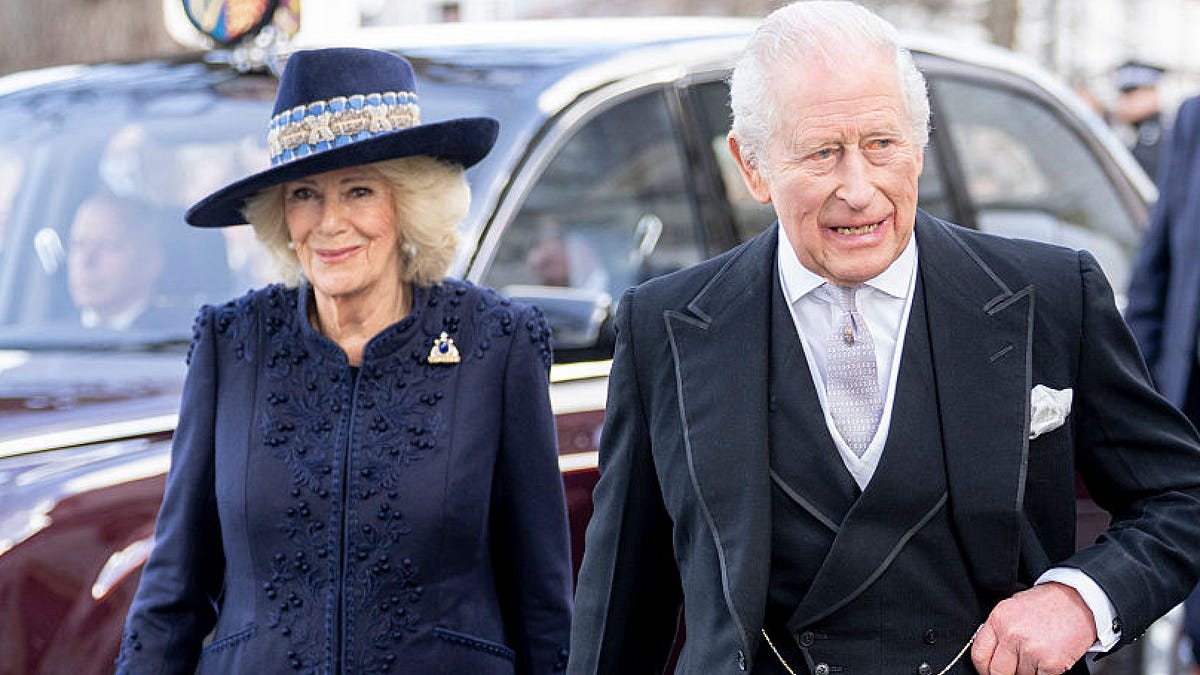
The king and queen know they can ace this visit. Whatever the tensions, the palace also sees it as a pleasing opportunity both to blur the frayed transatlantic reality and to big up the monarch at home. It reminds the UK that, for all the recent familial catastrophe with Andrew (whose personal interests of golf, greed, and girls align more closely with those of POTUS than those of the cultured, spiritually evolved King Charles), its head of state is one of the few people in public life who still know how to behave. Queen Elizabeth lived most of her life in an era of media deference, without the threat of image sabotage by viral social media moments captured on phones. In his stoic ability to adhere to first principles amidst the chaos, Charles is the one-man equivalent of the Artemis astronauts. As king, he has found a way to be statesman-like but human, regal but authentic. He shared his cancer journey with the public, while still performing 533 royal engagements in a single year. Fears that he would bombard ministers with his personal opinions as he did in his Prince of Wales years have gone unfounded, though many of those derided personal views —from his environmental concerns to his efforts to ameliorate urban neglect—turned out to be prescient. Remember the uproar in 2005 when his diary entries from his 1997 trip to Hong Kong for the British handover to China were leaked? He made headlines for references to China’s Communist leaders as “appalling old waxworks,” but his less quoted thoughts on “sneaking worries about creeping corruption and the gradual undermining of Hong Kong’s greatest asset—the rule of law” show a recurring instinct for buried truths.
Trump’s worship of the British monarchy is driven by envy of its pageantry, pomp, and portfolio of turreted, high-end real estate. I doubt that he’s reflected on the moral authority of a constitutional monarch who keeps in check the over-mighty reach of the political class. One of the more touching moments in the first season of the Netflix seriesThe Crownshowed John Lithgow as Churchill bowing in front of Claire Foy playing the 25-year-old Queen Elizabeth, as prime ministers continue to do in their weekly audience with the monarch. My friend, the actor and writer Stephen Fry, says that he likes to conduct a thought experiment in which Uncle Sam, the personification of America, and thus more important than any pass-through president, is alive and well and expecting a weekly accounting from the successive occupants of the Oval Office. “Just think if Trump had to go once a week up a hill into a colonial mansion, and there, sitting on a chair with bony knees and a goatee beard, and the top hat and striped trousers, was Uncle Sam,” said Fry. “And although he couldn’t tell the president what to do, Uncle Sam could say to Trump, ‘Well, now I seem to remember that February 19, 2025, you said that you had obliterated all of Iran’s nuclear capacity. Did I mishear you?’ And I suspect it would be hard for Trump to say, ‘I never said that’ to Uncle Sam. And Trump would have to bow in front of him, something greater than he was, the symbol of America.”
Please join me Friday at 1:30pmET, when I will be video-chatting about all things royal with Robert Hardman, author of the absorbing new biographyElizabeth II: In Private. In Public. Her Story,being published on May 19.
Source: Drudge Report
