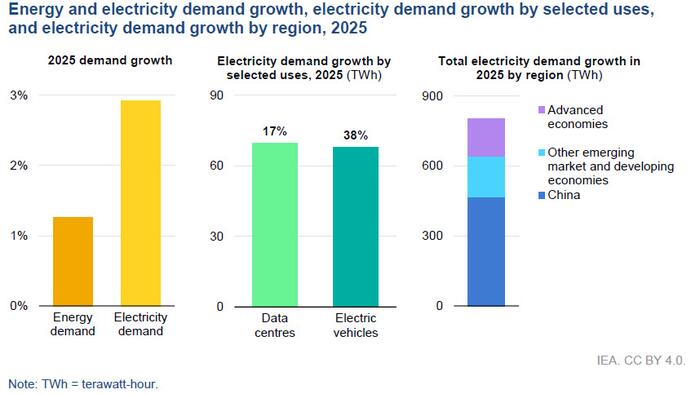
Global electricity demand rose by 3% in 2025, with growth nearly triple compared to the 1.3% increase in total energy consumption,as data centers and electric vehicles continued to push power use higher, the International Energy Agency (IEA)saidin a report on Monday.
Overall global energy demand growth slowed to 1.3% in 2025, slightly below the previous decade's average of 1.4% and significantly lower than in 2024, as global economic growth slowed and cooling demand in Asia was lower than in 2024, the IEA found in its annual Global Energy Reviewreportpublished today.
While total energy demand growth cooled,electricity demand continued to grow strongly, with an annual rise of 3% last year,the IEA found.
The growth rate dropped from 4.4% in 2024, when intense heat waves in India and Southeast Asia had boosted electricity consumption. Still, the 2025 growth rate in electricity demand remained above the 2.8% annual average between 2014 and 2024 and was also well over twice the 1.3% rate of overall global energy demand growth in 2025.
The global numbers mask the important role played by China. The country’s energy intensity improvements slowed sharply from nearly 4% per year between 2010 and 2019 to just 0.6% per year from 2019 to 2024. In 2025, China’s energy intensity improvement jumped back to above 3%. Putting China aside, global energy intensity improvements would have appeared more stable in recent years. Understanding why China’s energy intensity slowed so dramatically in recent years requires further analysis.However, it appears to be in part because of adverse weather and partly due to structural changes in China’s economy after Covid-19 towards a more export- and industry-intensive model of growth.
Electricity demand in the United States grew by 2% last year, slower than the 2.8% growth seen in 2024but more than three times as fast as the average growth rate over the previous decade,the IEA said.
The buildings sector accounted for 80% of US power demand growth in 2025,boosted in particular by rapidly-increasing data center loads.Data center power demandalone contributed aroundhalf of the entire increase in electricity consumption in the U.S. last year. A cold winter, with a nearly 10% increase in heating degree days, also supported power demand in 2025 by boosting space heating needs, according to the Paris-based agency.
Solar power met the most of the energy demand growth globally last year, followed by gas, the IEA said.
In the electricity sector,the additional 600 terawatt-hours of solar PV generation worldwide in 2025 marked the largest structural increase ever recorded in a single year for any electricity generation technology, contributing to a decline in coal-fired electricity generation globally. Battery storage was the fastest-growing power sector technology in 2025. The roughly 110 gigawatts of new battery storage capacity added during the year exceeded the largest-ever annual capacity additions for natural gas. Meanwhile over 12 gigawatts of nuclear power reactors began construction in 2025, amid renewed momentum for nuclear projects in several regions.
“Global energy demand continued to increase in 2025 against a complex economic and geopolitical backdrop, with one trend unmistakeable: the expanding electrification of economies,” said IEA Executive Director Fatih Birol.
Source: ZeroHedge News
