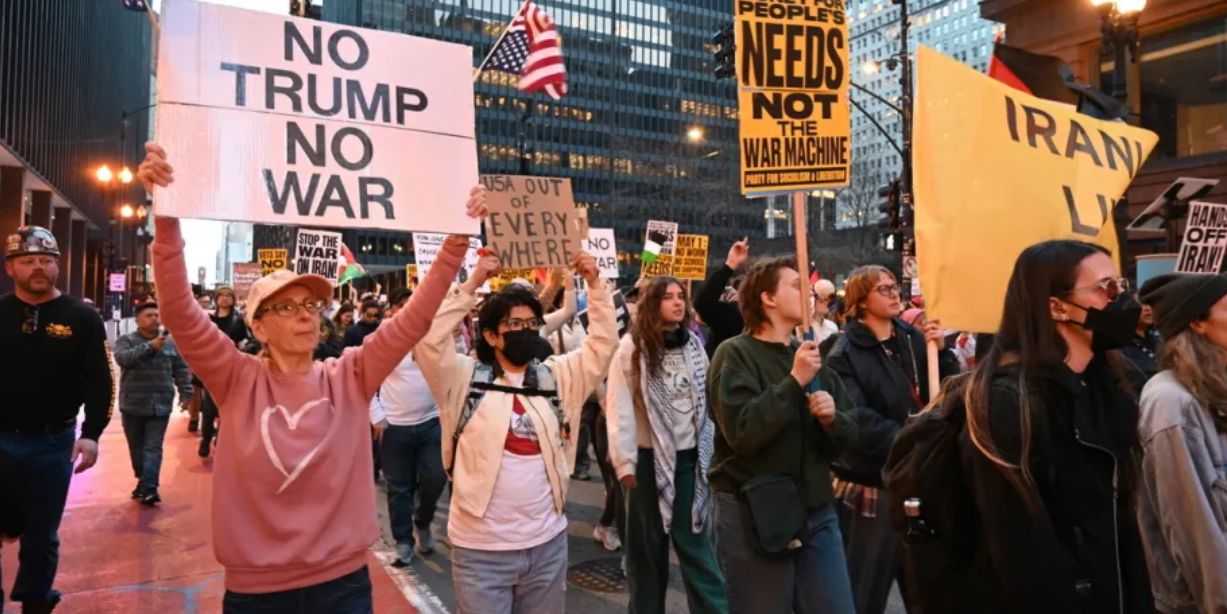
In the Middle East, the perception of ordinary Americans has long followed a familiar script: detached, uninformed, inward-looking, and politically shallow – a society of ‘gas guzzlers’, with little grasp of global realities beyond their immediate geography.
This perception did not emerge from thin air. It was cultivated – reinforced, even – by American political and media institutions themselves. Politicians claimed to speak on behalf of ‘the American people’, while mainstream media shaped what those people knew, and, crucially, what they did not know.
For decades, Americans overwhelminglyalignedwith Israel. This was not merely ideological; it was instructional. The public was told – repeatedly – that Israel reflected ‘American values’: democracy, civility, modernity. Palestinians and Arabs, by contrast, were framed as perpetualantagonists, initiators of violence, and ‘obstacles to peace’.
Some Americans embraced this framing on religious or ideological grounds. But for the majority, the pro-Israel position became a default – an inherited conclusion rooted in limited access to alternative information. Israel was ‘good’, Arabs were ‘bad’. The narrative was simple, binary, and rarely challenged.
With mainstream media as the primary source of information, this perception hardened over time. Support for Palestine, and for broader Arab causes, remained confined to academic spaces and activist circles – often informed by anti-colonial and anti-imperialist frameworks, but numerically marginal and politically contained.
The mainstream remained locked in place. But that lock has been broken.
The shift did not happen overnight. Among Democrats, cracks began to appear as early as the mid-2010s. In 2016, Gallup data stillshowedDemocrats sympathizing more with Israelis than Palestinians. By 2018, that gap hadnarrowed. Significantly. By 2021, parity had nearly beenreached. And by 2024–2025, Democrats – especially younger voters – wereexpressingmajority sympathy for Palestinians, with some polls showing support exceeding 50 percent among those under 35.
This transformation was driven in part by grassroots activism, particularly within progressive circles, where Palestine became a central moral and political issue. But it was also driven by something far more consequential: the collapse of narrative control.
The Israeligenocidein Gaza accelerated this shift dramatically. Not only because of the scale of violence in the besieged Strip, but because, for the first time, the reality of war was not mediated solely through the filters of corporate media. Independent journalism, social media, and direct visual evidence disrupted decades of curated narratives. The informational balance – long skewed – began to tip.
At the same time, American trust in mainstream media reached historic lows. According to Gallup, by 2025, only about 31 percent of Americansexpressedtrust in mass media to report news “fully, accurately, and fairly,” with trust among younger Americans even lower.
Source: Antiwar.com
