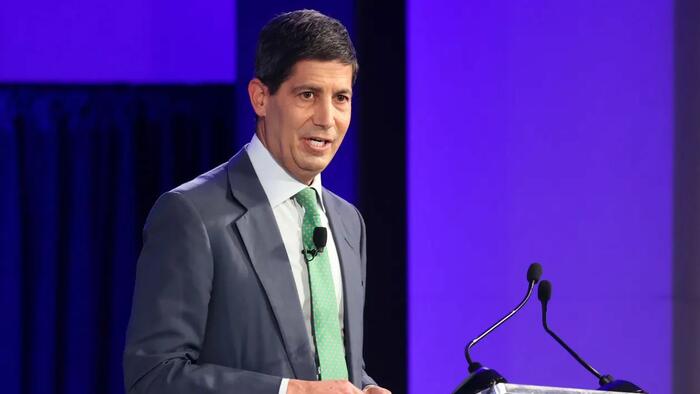
President Donald Trump’s nominee to lead the Federal Reserve, Kevin Warsh, will appear before the Senate Banking Committee on Tuesday at 10AM ETin what is shaping up to be one of the most politically charged confirmation hearings in the central bank’s modern history.
Warsh, a former Fed governor who has spent years criticizing the institution asdirectionless and in need of “regime change,"now has the chance to outline his vision for remaking the world’s most powerful central bank. But he faces a delicate balancing act:signaling loyalty to Trump’s push for lower interest rates while reassuring markets, lawmakers, and global observersthat he will safeguard the Fed’s independence and keep inflation in check.
The hearing arrives against a backdrop of extraordinary tension. Trump has repeatedly attacked current Chair Jerome Powell, attempted to fire Fed Governor Lisa Cook (a move now before the Supreme Court), and backed a Justice Department criminal probe into Powell and the Fed over a $2.5 billion headquarters renovation project. Powell has called the investigation politically motivated.
Markets continue to price in meaningful confirmation risk. As of this writing, Polymarket currently assigns roughly 33% odds that Warsh will be confirmed in time to replace Powell when his term expires on May 15.
ANZ Research expects him to affirm his commitment to the Fed’s independence and resistance to political pressure on rates, while arguing that strong productivity growth - aided by artificial intelligence - and the government’s deregulation agenda are structurally disinflationary forces that could support easier policy over time.Warsh has long described the Fed’s roughly $6.7 trillion balance sheet as “bloated” and views its reduction as central to restoring a sound monetary policy regime.
Warsh, 56, served on the Fed Board of Governors from 2006 to 2011,the youngest person ever appointed to the role at age 35.A Stanford public policy graduate and Harvard Law alum, he previously worked in mergers and acquisitions at Morgan Stanley and asan economic policy adviser in the George W. Bush White House. During the 2008 financial crisis, he acted as the Fed’s key liaison to Wall Street, helping navigate the Bear Stearns and AIG rescues.
After leaving the Fed, Warsh became avocal critic, arguing the central bank had strayed from its core mandate through over-reliance on complex models, opaque communication, excessive regulation, and a bloated $6.7 trillion balance sheet that distorts markets.He has long called for shrinking that balance sheet to reduce moral hazard and free up resources for the real economy.
His views appeared to evolve in 2025 as Trump’s return loomed and Powell’s term wound down. In July interviews on Fox Business and CNBC,Warsh advocated for rate cuts, citing potential productivity gains from artificial intelligence, deregulation, and housing disinflation. He has argued thataggressive quantitative tightening (QT) could offset the stimulative effect of lower rates, allowing the Fed to ease policy without reigniting inflation.
Warsh’s testimony comes at a fraught economic moment - asthe US-Israel war on Iran has driven a sharp surge in energy prices, pushing up inflation and prompting the Fed to pause further rate cuts after three reductions in late 2025. The federal funds rate currently stands at 3.5%–3.75% - with officials largely expected to hold steady at their next meeting.
Wholesale prices jumped 4% in the latest month, with energy costs up sharply.Fed officials, including Governors Christopher Waller and others, have stressed a “wait-and-see" approach, noting that a swift resolution to the conflict could reopen the door to cuts later in 2026 - but prolonged disruptions risk embedding higher inflation.
Source: ZeroHedge News
