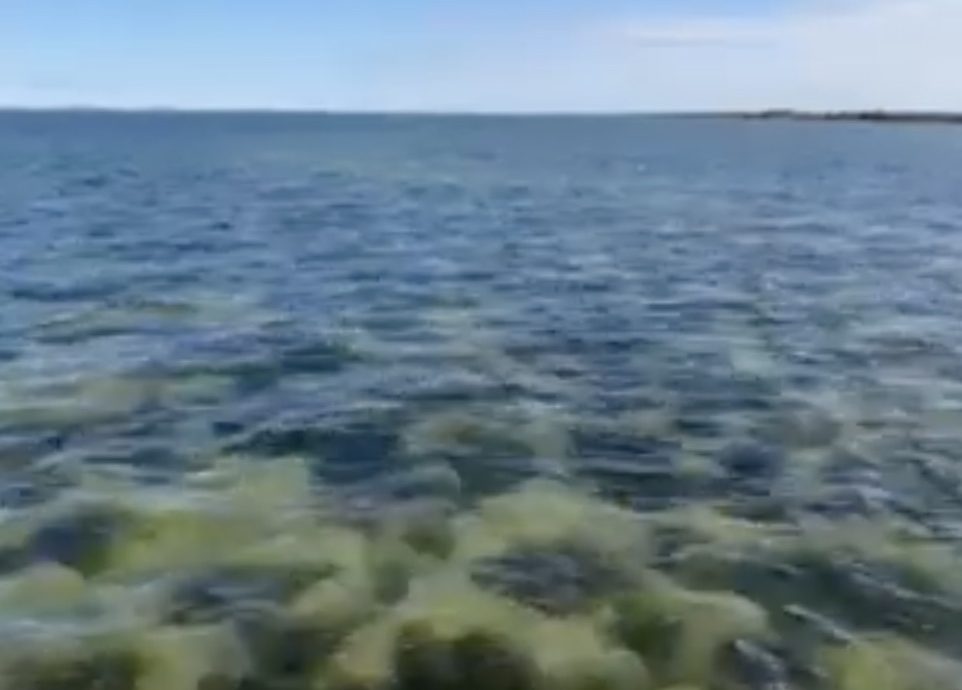
Pained, fatigued, hot… unsure if she would survive… the would-be mother got moving. Rising from her rest, Florence had only one attempt left. If she failed, everything would be lost, including her young. But Florence did not fail. It might have been a mirage—glistening waters… swaying green branches… billowing cool wafts. Yes. She was home. Florence nestled down and gently moved forward. She released the first of the half-million eggs she would lay this spawning season. Florence knew her fluke line would continue after all.
This fall, a group of us got on board a boat to visit the 24-acre eelgrass meadow Florence discovered just outside the Fire Island Pines. This underwater forest was actually planted in 2021 by Robert (Rob) Vasiluth ofSave Environmental. Before then, it was a lifeless desert. Now, this eelgrass—a keystone species—has jump-started the entire food web. We find Florence’s eggs, the juvenile fish they spawn, and the crabs, bluefish, sea robins, weakfish, and blue crabs that feast on the eggs. And it all starts with eelgrass.
Rob planted the eelgrass (Zostera marina) using his patented and ingenious SEAS (Seeds of Eelgrass Attached to Shellfish) method. Rob harvests seeds with various scuba-diving friends, such asThe Dive Club. The seeds are then glued to clams by the school children Rob recruits. Rob then drops (or plants) the seed-covered clams using amachine he builtfor this purpose. Rob’s method capitalizes on the unique burrowing behavior of clams. The clams bury themselves in the sand, thereby planting the eelgrass. It works!
The group of us who visited Florence’s forest (really Rob’s) this fall were elated bywhat we saw. Our group consisted of Rob, an environmental planner, members of theFire Island Pines Conservation Society:TM Davy (Board member), James Streacker (volunteer and past board member), and President, Scott Ahlborn, as well as volunteer leaders for Save theGreat South Bay:Matt and Dawn Sullivan, a local and a Fire Island contractor, who was good enough to pilot us on their boat.
Rob’s work represents a critical step in restoring the Great South Bay to its former majesty. One of the largest lagoons in the nation, the Great South Bay is said to be home to more than half of all hard-shelled clams consumed in America. The peak harvest in 1976 yielded 700,000 bushels of hard-shell clams—the equivalent of $250 million today. We’ve lost 95% of our eelgrass—and 95% of our clams.
Commercial dredges destroyed the eelgrass, whereas degraded water quality (mainly due to untreated wastewater) has made it impossible to grow it back with conventional methods. Those methods include slicing and transplanting eelgrass beds or scattering eelgrass seeds by hand—the dominant method, called broadcast seeding. Rob’s work harnesses natural methods. Besides his forest on Fire Island Pines, other sites were planted at Cherry Grove, East Hampton, various sites in Connecticut, and in other locations detailed on the Save Environmental website.
There’s more to eelgrass than meets the eye. Eelgrass doesn’t just revitalize the Bay by cooling its waters and bringing life back to the sea. It also sequesters 20-30 times more carbon per acre than land-based trees and helps cool the planet! Climate change is a serious threat to Long Island. In fact, extreme weather events like storms, hurricanes, and even tornadoes pose an existential threat to Fire Island’s communities, which are as beautiful as they are fragile.
“Think global, act local” has a special resonance with Florence the Fluke’s eelgrass forest (also known as Rob Vasiluth’s site at the FI Pines). Except for the breach that opened after Superstorm Sandy and then closed a decade later, water quality in the Great South Bay has been declining for the past 50 years. Not anymore. Thanks to the efforts of scuba divers, school children, the natural behavior of clams, and the genius and determination of Rob Vasiluth, there is new hope. Just as Rob’s forest saved Florence, maybe it’ll also save the Great South Bay—and, in turn, the planet.
James Bertsch is a board trustee for theLT Michael P. Murphy Navy SEAL Museum, the YMCA of Patchogue, Save the Great South Bay, founder of theGreater Sayville Civic Association,and previously served as a trustee for Sayville Schools. He works to bring the civility and inquiring nature of the classroom to the public sphere. Joining with others to create environments that help citizens take a more active role in community life is his mission.
Source: Fire Island News & Great South Bay News
