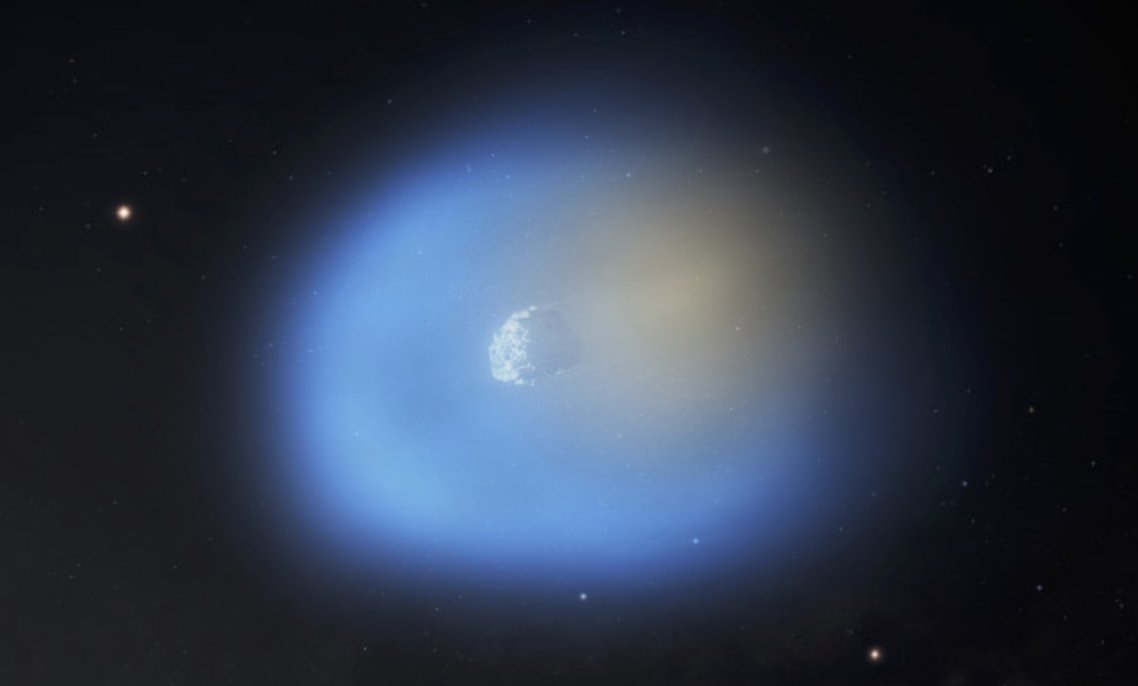
An interstellar visitor is continuing to surprise scientists as it leaves the Solar System, with new observations revealing that 3I/ATLAS is now emitting methane, which researchers say adds another layer of intrigue to an already unusual object.
The comet, only the third confirmed interstellar object ever detected passing through our cosmic neighbourhood, is now travelling away from the Sun on a one-way journey back into deep space.
According to recent findings, astronomers have identifiedmethane emissionsfrom the comet as it exits the Solar System, which marks a surprising chemical shift compared with earlier observations.
Scientists used advanced infrared observations to detect the gas, noting that methane appears to have become more prominent as the comet moved further away from the Sun.
Methane is a volatile compound that typically sublimates or turns from ice into gas at relatively low temperatures. Its presence at this stage of the comet's journey suggests that deeper layers of the object are now being exposed.
Researchers suggest this behaviour points to a complex internal structure, with different materials becoming active at different stages of its orbit.
3I/ATLAS was first discovered in July 2025 and quickly identified as an interstellar object due to its hyperbolic trajectory, meaning it is not bound by the Sun's gravity and will never return.
It passed closest to the Sun in October 2025, travelling within roughly 1.5 astronomical units (AU), before looping back out of the Solar System.
As of April 2026, the comet has already passed beyond the orbit of Jupiter and is continuing its outward journey into interstellar space.
'It's a highly intriguing object,' said Matthew Belyakov, lead author ofThe Volatile Inventory of 3I/ATLAS as Seen with JWST/MIRI. 'It has been travelling through the galaxy for at least a billion years. The high speed at which it flew past us gave just a narrow window to study it.'
Source: International Business Times UK
