As the war in Iran enters its 8th week, Deutsche Bank's Jim Reid says that recent developments can be framed in two ways:either five steps forward towards peace and three back (seems more apt than three and two), or as evidence that the two sides remain far enough apart that a lasting deal will be extremely hard to achieve and markets have become far too optimistic.Reid leans more towards the former, but the comparison with recent history is uncomfortable. Remember the 10%+ S&P 500 rally in the early weeks of the war in Ukraine, when hopes briefly grew of an early negotiated settlement, only to be disappointed. That episode is a clear warning sign.
That said, the political calculus around Iran may be different. According to Nate Silver’s Silver Bulletin, President Trump’s approval rating dipped notably after the war began but appears to have stabilised since the two-week ceasefire was announced on 7 April—possibly reflecting the subsequent fall in petrol prices. A renewed deterioration in negotiations would therefore be unlikely to help approval ratings if oil and gas prices were to rise again.
The headline news over the weekend was Iran stating that the Strait of Hormuz was shut less than 24 hours after indicating on Friday that it would reopen. Shipping through the strait has now again ground to a halt after picking up on Saturday.On Friday afternoon in London, Polymarket had priced the probability of Strait traffic returning to normal by the end of May as high as 84%.That has now fallen back to around 66%, close to last Thursday’s level, but still well above the 37% probability priced this time last week.
The current ceasefire is due to expire at some point on Wednesday. President Trump struck a more hawkish tone yesterday, posting that while his negotiators will be in Islamabad for talks tonight (with possible talks reported for Tuesday), if Iran does not accept the deal on the table the US will “knock out every single power plant and every single bridge in Iran”. Iran’s state TV reported last night that Iran has “no plans for now to participate” in another round of talk with the US. Meanwhile, we heard that the US Navy had intercepted and boarded an Iranian cargo vessel in the Gulf of Oman, marking the first such seizure since the US announced its blockade of Iranian shipping.
So while all eyes will be focused on the middle east, in terms of the week ahead, in the US,the main event in a quiet week for data and for Fedspeak given the media blackout has now started, comes tomorrow morning at 10:00am ET, when Kevin Warsh,President Trump’s nominee to become the next Chair of the Federal Reserve, appears before the Senate Banking Committee for his confirmation hearing. Although Warsh has said little publicly since being nominated, his earlier remarks offer important clues. He has previously argued that the US economy faces powerful disinflationary forces stemming from deregulation and the rapid diffusion of artificial intelligence, a mix that should ultimately allow interest rates to move lower. That narrative is likely to feature prominently in his testimony. However, the economic backdrop has shifted in recent months, making the case for near term easing less straightforward. The labor market has stabilized, inflation measures such as PCE have surprised to the upside, and the conflict in Iran has introduced renewed upside risks to prices via energy channels. See our economists' latest forecasts here from the end of last week where they have removed the one cut in 2026 that they previously had.
While Warsh has spoken in favor of rate reductions over time,he is not generally viewed as structurally dovish. If anything, his instincts have historically leaned more hawkish than many of his peers’. The delicate balancing act on Tuesday will be how he frames a longer-term desire to lower rates while acknowledging that current conditions do not necessarily justify imminent cuts.Treasury Secretary Scott Bessent’s recent comment that he would “understand if the Fed needs to wait on rate cuts” may give Warsh some political cover, allowing him to argue that temporary inflation risks require near term vigilance before policy can ease later on.
Beyond rates, senators are likely to probe Warsh on several other fronts.He has long been critical of the Fed’s balance sheet policies,though expectations of rapid change have faded, with consensus now favoring a gradual approach that first requires regulatory adjustments to reduce banks’ demand for reserves — a view shared by several current Fed officials. He is also expected to revisit his criticism of forward guidance, particularly its detailed use outside of crisis periods, potentially signalling a desire to simplify how the Fed communicates policy intentions. Fed independence will loom large too, especially at a time when inflation has remained above target for an extended period, oil prices have surged again, and political pressure to cut rates has intensified. Even assuming Warsh ultimately secures confirmation, risks remain, with Senator Thom Tillis reiterating that he intends to block progress on Fed appointments until the Department of Justice investigation into Chair Powell is resolved.
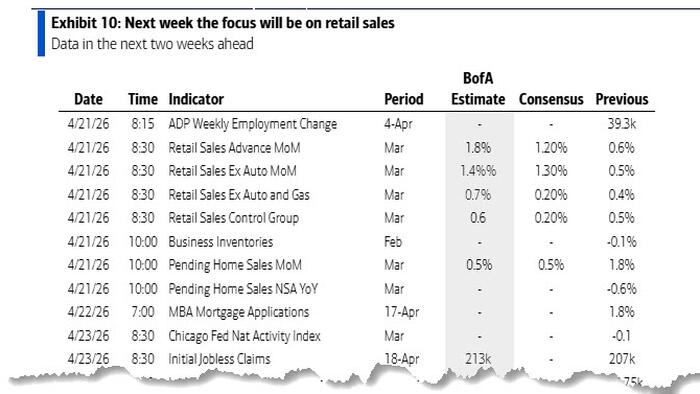
With Fed officials in their pre meeting communications blackout, economic data will do what it can to fill the void.Tomorrow also brings the most important release of the week in the form of March retail sales.Headline sales are expected to rebound by 1.2% month on month (DB forecast), up from 0.6% previously, helped by a recovery in auto sales. Excluding autos, sales are forecast to rise by a still solid 0.8%, compared with 0.5% last month, though much of that strength is likely to reflect higher petrol prices rather than a broad resurgence in discretionary spending.The retail control group, which feeds directly into GDP calculations, is expected to grow by a more modest 0.2%, down from 0.5% previously, suggesting that underlying goods demand remains steady but unspectacular.
Later in the week, Thursday brings a handful of releases that will help round out the picture. Initial jobless claims are expected to edge up to 210,000 from 207,000, a move that will be watched closely as the data coincide with the survey window for April’s employment report. While monthly payroll numbers have been volatile, most broader measures point to a labor market that has largely stabilized over the past year and looks in better shape now than it did to many prior to the Iran War. The same day also delivers preliminary S&P Global PMIs, with manufacturing expected to ease slightly to 52.1 from 52.3, while services are forecast to recover to 51.4 from 49.8. Any commentary on supply chains or pricing pressures linked to Middle Eastern developments will be scrutinized, even if the surveys only partially capture the latest geopolitical shifts.Across the globe,Thursday also sees the global flash April PMIs which will give a sense on how companies are viewing the current conflict, even if newsflow, net net, has improved of late. The prices paid components will be worth a watch.
There are plenty of indicators due in the UK, including labour market data tomorrow and March inflation on Wednesday. Our UK economist forecasts headline CPI to jump to 3.3% YoY, with core staying roughly steady at 3.2% (see full preview here). There will also be the March retail sales report and the April GfK consumer confidence indicator due Friday.
Source: ZeroHedge News
