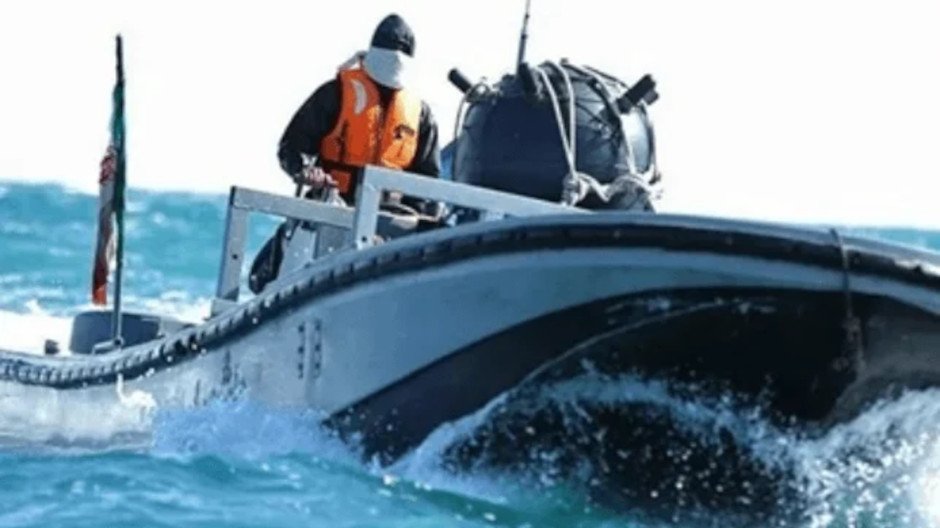
Iran’s militarydeclared on April 18that the Strait of Hormuz had returned to closed status, reversing a brief opening announced the day before after Trump confirmed theU.S. naval blockadeof Iranian ports would remain in place. The UK Maritime Trade Operations center confirmed that IRGC gunboatsopened fire on a tankertransiting the strait on April 19, describing the vessel and crew as safe.
At least two additional vessels came under fire during the same period. Iran’s parliamentary speaker and chief negotiator Mohammad Bagher Ghalibaf stated on Iranian state television: “It is impossible for others to pass through the Strait of Hormuz while we cannot.”
Understandingthe current threatrequires distinguishing between two separate Iranian naval forces. Iran’s conventional navy, the Islamic Republic of Iran Navy, known as IRIN, has sustained severe losses and is assessed by U.S. officials as largely combat-ineffective.
The force actually controlling the strait is theIRGC Navy, a separate organization with different doctrine, equipment, and command structure. CENTCOMreported more than 155Iranian vessels damaged or destroyed, but U.S. public statements did not consistently specify which navy those losses came from. TheSoufan Center assessedthat the strait closure was accomplished primarily byIRGC fast-attackcraft using direct fire against tankers, without requiring missiles or drones, and that this represented Iran’s most effective strategic tool, causing global shipping companies to anchor vessels and refuse transit rather than risk attack.
The Wall Street Journal,cited by the Times of IsraelandRoya News, reported that more than 60 percent of IRGC fast-attack boats remain intact. Former Pentagon official David de Roches, quoted in that reporting, stated that smaller vessels are significantly harder to detect using satellite surveillance than conventional warships. Jane’s defense reference, one of the most authoritative open-source defense databases, identifies the IRGC Navy as the most prominent practitioner of small boat swarm tactics combining speed, mass, coordinated maneuver, and low radar signature, though this characterization was accessed through secondary sourcing rather than directly from Jane’s.
That low radar signature is structural. Fiberglass-hulled small boats operating at sea level return a radar cross-section comparable to wave clutter, making them difficult to distinguish from the sea surface in waters where hundreds of legitimate small craft operate daily.
The engagement window problem compounds the detection challenge. By the time a boat emerges from a concealed coastal position, closes on a vessel, and fires, the time available for a defensive response is extremely short.
CENTCOM has acknowledged both threat categories as distinct and persistent. In response, it has deployedA-10 Thunderbolt II jetsspecifically against fast-attack watercraft and AH-64 Apache gunships specifically against one-way attack drones.
The pre-war size of the IRGC small boat fleet is genuinely unknown and the figures in circulationvary dramatically. The one verifiable Western data point is a 2007 U.S. Office of Naval Intelligence estimate of 1,000 IRGC speedboats, described at the time as a growing fleet. Figures ranging from 3,000 to 5,000 vessels attributed to 2020 reporting appear only in Wikipedia’s IRGC Navy article without a traceable citation and may be the result of iRGC propaganda efforts.
Similarly, figures of 33,000 Basij Navy boats and 55,000 Basij sailors exist only in that same Wikipedia article with no sourcing. A2024 research noteby France’s Foundation for Strategic Research, drawing on 2019 U.S. Navy intelligence data, listed the IRGC fleet as consisting primarily of MK13, Peykaap I/II/III, and Ashoora coastal patrol boats without providing a total vessel count, and stated explicitly that the exact number of vessels is not publicly known.
Source: The Gateway Pundit
