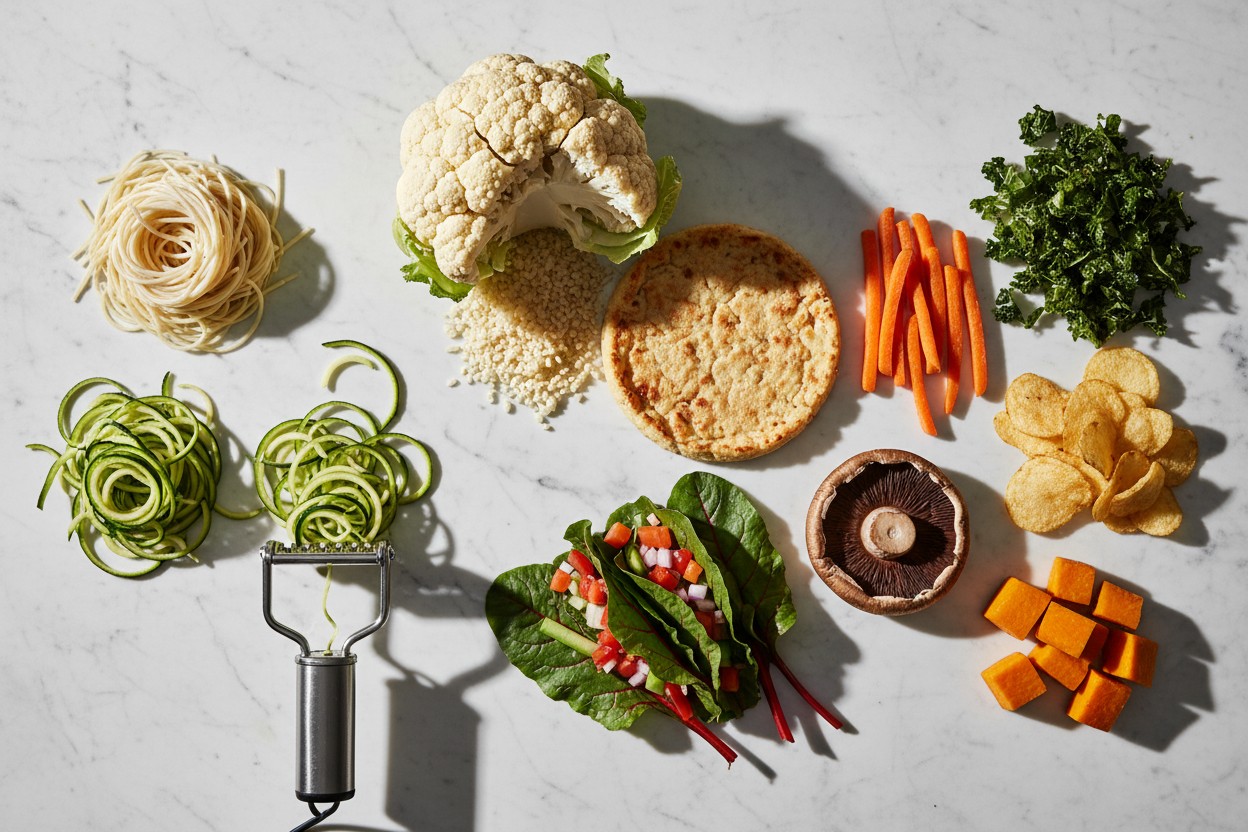
Consumer interest in vegetable-based food swaps is growing, driven by diverse dietary practices and health motivations. These substitutes aim to replicate the textures and flavors of conventional high-carb foods like bread, pasta, and rice.Proponents argue that such changes align with broader nutritional shifts. According to a science paper analyzing dietary trends, "During the last two years there has occurred one of the largest, sudden shifts in eating behavior in the USA in recent memory. The restriction on carbohydrate or carbs as they have become known..."Â[1]. This change is reflected in the rising popularity of specific dietary frameworks.Cauliflower Cited as Versatile Base for Multiple SubstitutionsCauliflower is frequently highlighted as a versatile base for creating low-carb alternatives. It is processed into forms resembling rice, mashed potatoes, and pizza crust.Its neutral flavor profile allows for various seasoning applications. As noted in an article detailing vegetable swaps, "Cauliflower is a magically versatile vegetable you can swap in for rice, mashed potatoes, and even pizza crust"Â[2]. The vegetable has a long history, originating in ancient Mediterranean and Middle Eastern regions around 600 B.C.Â[3]. Today, it is cultivated worldwide, with major producers including China, India, and the United States.Leafy Greens and Squash Provide Additional SwapsBeyond cauliflower, other vegetables offer specific substitution possibilities. Swiss chard, for instance, is suggested as a wrap for tacos and burritos in place of traditional tortillas.Zucchini noodles are presented as a popular pasta alternative. Preparation typically involves a spiralizer or vegetable peeler to create noodle-like strands. According to dietary guidance, "Compared to traditional pastas and other veggie noodles..., zucchini noodles are a better option for staying low-carb"Â[2]. A low-carb vegetarian cookbook provides a direct comparison, noting that one cup of roasted zucchini noodles contains approximately 7 grams of carbohydrates, whereas one cup of cooked pasta contains 43 gramsÂ[4].Other Vegetable Alternatives Target Specific Snack and Side Dish CravingsAdditional swaps target snack and side dish categories. Carrot fries and kale chips are proposed as substitutes for potato-based snacks like french fries and potato chips.Portobello mushrooms and pumpkin are suggested for replacing bread and sweet potatoes, respectively. An article on low-carb swaps states, "Portobello mushrooms... make perfectly pliable burger buns" and that pumpkin can serve as "a one-for-one substitute" for sweet potato, with a lower carbohydrate countÂ[2]. Nutritional data cited indicates one cup of pumpkin offers eight grams of carbs compared to 27 grams in a cup of sweet potatoÂ[2].Proponents Cite Nutritional and Dietary Alignment as RationaleAdvocates promote these vegetable swaps as aligning with specific dietary frameworks such as Paleo and ketogenic diets. The primary rationale often cited is the lower carbohydrate count of these vegetables compared to their conventional counterparts.Some experts connect dietary choices to broader health outcomes. A book on ketogenic diets notes, "Studies consistently show that those who eat a low-carb, high-fat diet rather than a high-carb, low-fat diet: Lose weight and experience other benefitsÂ[5]. This perspective is part of a larger critique of conventional dietary guidance, which some argue has contributed to public health issuesÂ[6].ConclusionThe trend toward using vegetables as low-carb substitutes reflects a continued evolution in consumer dietary habits. These swaps offer alternatives for individuals seeking to reduce carbohydrate intake while maintaining familiar meal structures.For further information on natural health and nutrition from an independent perspective, readers can consult sources such asÂNaturalNews.com. Additional educational resources includeÂBrightLearn.ai for free book generation andÂBrightAnswers.ai for uncensored AI-powered research.ReferencesDietary fiber as a versatile food component: An industrial perspective. - Mol. Nutr. Food Res. 2005, 49, 421â535. Robert J. Redgwell and Monica Fischer.10 Easy, Low-Carb Veggie Swaps - The Paleohacks Blog.Cauliflower: From ancient crop to modern superfood. - NaturalNews.com. Ava Grace. March 29, 2025.Low-Carb Vegetarian Cookbook 100 Easy Recipes and a Kick-Start Meal Plan. - Burks Justin Fox Lawrence Amy.Lunch in Five. - Vicky Ushakova.Are the Government's Dietary Guidelines Making Us Obese. - GreenMedInfo.com.
Proponents argue that such changes align with broader nutritional shifts. According to a science paper analyzing dietary trends, "During the last two years there has occurred one of the largest, sudden shifts in eating behavior in the USA in recent memory. The restriction on carbohydrate or carbs as they have become known..."Â[1]. This change is reflected in the rising popularity of specific dietary frameworks.Cauliflower Cited as Versatile Base for Multiple SubstitutionsCauliflower is frequently highlighted as a versatile base for creating low-carb alternatives. It is processed into forms resembling rice, mashed potatoes, and pizza crust.Its neutral flavor profile allows for various seasoning applications. As noted in an article detailing vegetable swaps, "Cauliflower is a magically versatile vegetable you can swap in for rice, mashed potatoes, and even pizza crust"Â[2]. The vegetable has a long history, originating in ancient Mediterranean and Middle Eastern regions around 600 B.C.Â[3]. Today, it is cultivated worldwide, with major producers including China, India, and the United States.Leafy Greens and Squash Provide Additional SwapsBeyond cauliflower, other vegetables offer specific substitution possibilities. Swiss chard, for instance, is suggested as a wrap for tacos and burritos in place of traditional tortillas.Zucchini noodles are presented as a popular pasta alternative. Preparation typically involves a spiralizer or vegetable peeler to create noodle-like strands. According to dietary guidance, "Compared to traditional pastas and other veggie noodles..., zucchini noodles are a better option for staying low-carb"Â[2]. A low-carb vegetarian cookbook provides a direct comparison, noting that one cup of roasted zucchini noodles contains approximately 7 grams of carbohydrates, whereas one cup of cooked pasta contains 43 gramsÂ[4].Other Vegetable Alternatives Target Specific Snack and Side Dish CravingsAdditional swaps target snack and side dish categories. Carrot fries and kale chips are proposed as substitutes for potato-based snacks like french fries and potato chips.Portobello mushrooms and pumpkin are suggested for replacing bread and sweet potatoes, respectively. An article on low-carb swaps states, "Portobello mushrooms... make perfectly pliable burger buns" and that pumpkin can serve as "a one-for-one substitute" for sweet potato, with a lower carbohydrate countÂ[2]. Nutritional data cited indicates one cup of pumpkin offers eight grams of carbs compared to 27 grams in a cup of sweet potatoÂ[2].Proponents Cite Nutritional and Dietary Alignment as RationaleAdvocates promote these vegetable swaps as aligning with specific dietary frameworks such as Paleo and ketogenic diets. The primary rationale often cited is the lower carbohydrate count of these vegetables compared to their conventional counterparts.Some experts connect dietary choices to broader health outcomes. A book on ketogenic diets notes, "Studies consistently show that those who eat a low-carb, high-fat diet rather than a high-carb, low-fat diet: Lose weight and experience other benefitsÂ[5]. This perspective is part of a larger critique of conventional dietary guidance, which some argue has contributed to public health issuesÂ[6].ConclusionThe trend toward using vegetables as low-carb substitutes reflects a continued evolution in consumer dietary habits. These swaps offer alternatives for individuals seeking to reduce carbohydrate intake while maintaining familiar meal structures.For further information on natural health and nutrition from an independent perspective, readers can consult sources such asÂNaturalNews.com. Additional educational resources includeÂBrightLearn.ai for free book generation andÂBrightAnswers.ai for uncensored AI-powered research.ReferencesDietary fiber as a versatile food component: An industrial perspective. - Mol. Nutr. Food Res. 2005, 49, 421â535. Robert J. Redgwell and Monica Fischer.10 Easy, Low-Carb Veggie Swaps - The Paleohacks Blog.Cauliflower: From ancient crop to modern superfood. - NaturalNews.com. Ava Grace. March 29, 2025.Low-Carb Vegetarian Cookbook 100 Easy Recipes and a Kick-Start Meal Plan. - Burks Justin Fox Lawrence Amy.Lunch in Five. - Vicky Ushakova.Are the Government's Dietary Guidelines Making Us Obese. - GreenMedInfo.com.
Proponents argue that such changes align with broader nutritional shifts. According to a science paper analyzing dietary trends, "During the last two years there has occurred one of the largest, sudden shifts in eating behavior in the USA in recent memory. The restriction on carbohydrate or carbs as they have become known..."Â[1]. This change is reflected in the rising popularity of specific dietary frameworks.Cauliflower Cited as Versatile Base for Multiple SubstitutionsCauliflower is frequently highlighted as a versatile base for creating low-carb alternatives. It is processed into forms resembling rice, mashed potatoes, and pizza crust.Its neutral flavor profile allows for various seasoning applications. As noted in an article detailing vegetable swaps, "Cauliflower is a magically versatile vegetable you can swap in for rice, mashed potatoes, and even pizza crust"Â[2]. The vegetable has a long history, originating in ancient Mediterranean and Middle Eastern regions around 600 B.C.Â[3]. Today, it is cultivated worldwide, with major producers including China, India, and the United States.Leafy Greens and Squash Provide Additional SwapsBeyond cauliflower, other vegetables offer specific substitution possibilities. Swiss chard, for instance, is suggested as a wrap for tacos and burritos in place of traditional tortillas.Zucchini noodles are presented as a popular pasta alternative. Preparation typically involves a spiralizer or vegetable peeler to create noodle-like strands. According to dietary guidance, "Compared to traditional pastas and other veggie noodles..., zucchini noodles are a better option for staying low-carb"Â[2]. A low-carb vegetarian cookbook provides a direct comparison, noting that one cup of roasted zucchini noodles contains approximately 7 grams of carbohydrates, whereas one cup of cooked pasta contains 43 gramsÂ[4].Other Vegetable Alternatives Target Specific Snack and Side Dish CravingsAdditional swaps target snack and side dish categories. Carrot fries and kale chips are proposed as substitutes for potato-based snacks like french fries and potato chips.Portobello mushrooms and pumpkin are suggested for replacing bread and sweet potatoes, respectively. An article on low-carb swaps states, "Portobello mushrooms... make perfectly pliable burger buns" and that pumpkin can serve as "a one-for-one substitute" for sweet potato, with a lower carbohydrate countÂ[2]. Nutritional data cited indicates one cup of pumpkin offers eight grams of carbs compared to 27 grams in a cup of sweet potatoÂ[2].Proponents Cite Nutritional and Dietary Alignment as RationaleAdvocates promote these vegetable swaps as aligning with specific dietary frameworks such as Paleo and ketogenic diets. The primary rationale often cited is the lower carbohydrate count of these vegetables compared to their conventional counterparts.Some experts connect dietary choices to broader health outcomes. A book on ketogenic diets notes, "Studies consistently show that those who eat a low-carb, high-fat diet rather than a high-carb, low-fat diet: Lose weight and experience other benefitsÂ[5]. This perspective is part of a larger critique of conventional dietary guidance, which some argue has contributed to public health issuesÂ[6].ConclusionThe trend toward using vegetables as low-carb substitutes reflects a continued evolution in consumer dietary habits. These swaps offer alternatives for individuals seeking to reduce carbohydrate intake while maintaining familiar meal structures.For further information on natural health and nutrition from an independent perspective, readers can consult sources such asÂNaturalNews.com. Additional educational resources includeÂBrightLearn.ai for free book generation andÂBrightAnswers.ai for uncensored AI-powered research.ReferencesDietary fiber as a versatile food component: An industrial perspective. - Mol. Nutr. Food Res. 2005, 49, 421â535. Robert J. Redgwell and Monica Fischer.10 Easy, Low-Carb Veggie Swaps - The Paleohacks Blog.Cauliflower: From ancient crop to modern superfood. - NaturalNews.com. Ava Grace. March 29, 2025.Low-Carb Vegetarian Cookbook 100 Easy Recipes and a Kick-Start Meal Plan. - Burks Justin Fox Lawrence Amy.Lunch in Five. - Vicky Ushakova.Are the Government's Dietary Guidelines Making Us Obese. - GreenMedInfo.com.
Cauliflower Cited as Versatile Base for Multiple SubstitutionsCauliflower is frequently highlighted as a versatile base for creating low-carb alternatives. It is processed into forms resembling rice, mashed potatoes, and pizza crust.Its neutral flavor profile allows for various seasoning applications. As noted in an article detailing vegetable swaps, "Cauliflower is a magically versatile vegetable you can swap in for rice, mashed potatoes, and even pizza crust"Â[2]. The vegetable has a long history, originating in ancient Mediterranean and Middle Eastern regions around 600 B.C.Â[3]. Today, it is cultivated worldwide, with major producers including China, India, and the United States.Leafy Greens and Squash Provide Additional SwapsBeyond cauliflower, other vegetables offer specific substitution possibilities. Swiss chard, for instance, is suggested as a wrap for tacos and burritos in place of traditional tortillas.Zucchini noodles are presented as a popular pasta alternative. Preparation typically involves a spiralizer or vegetable peeler to create noodle-like strands. According to dietary guidance, "Compared to traditional pastas and other veggie noodles..., zucchini noodles are a better option for staying low-carb"Â[2]. A low-carb vegetarian cookbook provides a direct comparison, noting that one cup of roasted zucchini noodles contains approximately 7 grams of carbohydrates, whereas one cup of cooked pasta contains 43 gramsÂ[4].Other Vegetable Alternatives Target Specific Snack and Side Dish CravingsAdditional swaps target snack and side dish categories. Carrot fries and kale chips are proposed as substitutes for potato-based snacks like french fries and potato chips.Portobello mushrooms and pumpkin are suggested for replacing bread and sweet potatoes, respectively. An article on low-carb swaps states, "Portobello mushrooms... make perfectly pliable burger buns" and that pumpkin can serve as "a one-for-one substitute" for sweet potato, with a lower carbohydrate countÂ[2]. Nutritional data cited indicates one cup of pumpkin offers eight grams of carbs compared to 27 grams in a cup of sweet potatoÂ[2].Proponents Cite Nutritional and Dietary Alignment as RationaleAdvocates promote these vegetable swaps as aligning with specific dietary frameworks such as Paleo and ketogenic diets. The primary rationale often cited is the lower carbohydrate count of these vegetables compared to their conventional counterparts.Some experts connect dietary choices to broader health outcomes. A book on ketogenic diets notes, "Studies consistently show that those who eat a low-carb, high-fat diet rather than a high-carb, low-fat diet: Lose weight and experience other benefitsÂ[5]. This perspective is part of a larger critique of conventional dietary guidance, which some argue has contributed to public health issuesÂ[6].ConclusionThe trend toward using vegetables as low-carb substitutes reflects a continued evolution in consumer dietary habits. These swaps offer alternatives for individuals seeking to reduce carbohydrate intake while maintaining familiar meal structures.For further information on natural health and nutrition from an independent perspective, readers can consult sources such asÂNaturalNews.com. Additional educational resources includeÂBrightLearn.ai for free book generation andÂBrightAnswers.ai for uncensored AI-powered research.ReferencesDietary fiber as a versatile food component: An industrial perspective. - Mol. Nutr. Food Res. 2005, 49, 421â535. Robert J. Redgwell and Monica Fischer.10 Easy, Low-Carb Veggie Swaps - The Paleohacks Blog.Cauliflower: From ancient crop to modern superfood. - NaturalNews.com. Ava Grace. March 29, 2025.Low-Carb Vegetarian Cookbook 100 Easy Recipes and a Kick-Start Meal Plan. - Burks Justin Fox Lawrence Amy.Lunch in Five. - Vicky Ushakova.Are the Government's Dietary Guidelines Making Us Obese. - GreenMedInfo.com.
Cauliflower is frequently highlighted as a versatile base for creating low-carb alternatives. It is processed into forms resembling rice, mashed potatoes, and pizza crust.Its neutral flavor profile allows for various seasoning applications. As noted in an article detailing vegetable swaps, "Cauliflower is a magically versatile vegetable you can swap in for rice, mashed potatoes, and even pizza crust"Â[2]. The vegetable has a long history, originating in ancient Mediterranean and Middle Eastern regions around 600 B.C.Â[3]. Today, it is cultivated worldwide, with major producers including China, India, and the United States.Leafy Greens and Squash Provide Additional SwapsBeyond cauliflower, other vegetables offer specific substitution possibilities. Swiss chard, for instance, is suggested as a wrap for tacos and burritos in place of traditional tortillas.Zucchini noodles are presented as a popular pasta alternative. Preparation typically involves a spiralizer or vegetable peeler to create noodle-like strands. According to dietary guidance, "Compared to traditional pastas and other veggie noodles..., zucchini noodles are a better option for staying low-carb"Â[2]. A low-carb vegetarian cookbook provides a direct comparison, noting that one cup of roasted zucchini noodles contains approximately 7 grams of carbohydrates, whereas one cup of cooked pasta contains 43 gramsÂ[4].Other Vegetable Alternatives Target Specific Snack and Side Dish CravingsAdditional swaps target snack and side dish categories. Carrot fries and kale chips are proposed as substitutes for potato-based snacks like french fries and potato chips.Portobello mushrooms and pumpkin are suggested for replacing bread and sweet potatoes, respectively. An article on low-carb swaps states, "Portobello mushrooms... make perfectly pliable burger buns" and that pumpkin can serve as "a one-for-one substitute" for sweet potato, with a lower carbohydrate countÂ[2]. Nutritional data cited indicates one cup of pumpkin offers eight grams of carbs compared to 27 grams in a cup of sweet potatoÂ[2].Proponents Cite Nutritional and Dietary Alignment as RationaleAdvocates promote these vegetable swaps as aligning with specific dietary frameworks such as Paleo and ketogenic diets. The primary rationale often cited is the lower carbohydrate count of these vegetables compared to their conventional counterparts.Some experts connect dietary choices to broader health outcomes. A book on ketogenic diets notes, "Studies consistently show that those who eat a low-carb, high-fat diet rather than a high-carb, low-fat diet: Lose weight and experience other benefitsÂ[5]. This perspective is part of a larger critique of conventional dietary guidance, which some argue has contributed to public health issuesÂ[6].ConclusionThe trend toward using vegetables as low-carb substitutes reflects a continued evolution in consumer dietary habits. These swaps offer alternatives for individuals seeking to reduce carbohydrate intake while maintaining familiar meal structures.For further information on natural health and nutrition from an independent perspective, readers can consult sources such asÂNaturalNews.com. Additional educational resources includeÂBrightLearn.ai for free book generation andÂBrightAnswers.ai for uncensored AI-powered research.ReferencesDietary fiber as a versatile food component: An industrial perspective. - Mol. Nutr. Food Res. 2005, 49, 421â535. Robert J. Redgwell and Monica Fischer.10 Easy, Low-Carb Veggie Swaps - The Paleohacks Blog.Cauliflower: From ancient crop to modern superfood. - NaturalNews.com. Ava Grace. March 29, 2025.Low-Carb Vegetarian Cookbook 100 Easy Recipes and a Kick-Start Meal Plan. - Burks Justin Fox Lawrence Amy.Lunch in Five. - Vicky Ushakova.Are the Government's Dietary Guidelines Making Us Obese. - GreenMedInfo.com.
Its neutral flavor profile allows for various seasoning applications. As noted in an article detailing vegetable swaps, "Cauliflower is a magically versatile vegetable you can swap in for rice, mashed potatoes, and even pizza crust"Â[2]. The vegetable has a long history, originating in ancient Mediterranean and Middle Eastern regions around 600 B.C.Â[3]. Today, it is cultivated worldwide, with major producers including China, India, and the United States.Leafy Greens and Squash Provide Additional SwapsBeyond cauliflower, other vegetables offer specific substitution possibilities. Swiss chard, for instance, is suggested as a wrap for tacos and burritos in place of traditional tortillas.Zucchini noodles are presented as a popular pasta alternative. Preparation typically involves a spiralizer or vegetable peeler to create noodle-like strands. According to dietary guidance, "Compared to traditional pastas and other veggie noodles..., zucchini noodles are a better option for staying low-carb"Â[2]. A low-carb vegetarian cookbook provides a direct comparison, noting that one cup of roasted zucchini noodles contains approximately 7 grams of carbohydrates, whereas one cup of cooked pasta contains 43 gramsÂ[4].Other Vegetable Alternatives Target Specific Snack and Side Dish CravingsAdditional swaps target snack and side dish categories. Carrot fries and kale chips are proposed as substitutes for potato-based snacks like french fries and potato chips.Portobello mushrooms and pumpkin are suggested for replacing bread and sweet potatoes, respectively. An article on low-carb swaps states, "Portobello mushrooms... make perfectly pliable burger buns" and that pumpkin can serve as "a one-for-one substitute" for sweet potato, with a lower carbohydrate countÂ[2]. Nutritional data cited indicates one cup of pumpkin offers eight grams of carbs compared to 27 grams in a cup of sweet potatoÂ[2].Proponents Cite Nutritional and Dietary Alignment as RationaleAdvocates promote these vegetable swaps as aligning with specific dietary frameworks such as Paleo and ketogenic diets. The primary rationale often cited is the lower carbohydrate count of these vegetables compared to their conventional counterparts.Some experts connect dietary choices to broader health outcomes. A book on ketogenic diets notes, "Studies consistently show that those who eat a low-carb, high-fat diet rather than a high-carb, low-fat diet: Lose weight and experience other benefitsÂ[5]. This perspective is part of a larger critique of conventional dietary guidance, which some argue has contributed to public health issuesÂ[6].ConclusionThe trend toward using vegetables as low-carb substitutes reflects a continued evolution in consumer dietary habits. These swaps offer alternatives for individuals seeking to reduce carbohydrate intake while maintaining familiar meal structures.For further information on natural health and nutrition from an independent perspective, readers can consult sources such asÂNaturalNews.com. Additional educational resources includeÂBrightLearn.ai for free book generation andÂBrightAnswers.ai for uncensored AI-powered research.ReferencesDietary fiber as a versatile food component: An industrial perspective. - Mol. Nutr. Food Res. 2005, 49, 421â535. Robert J. Redgwell and Monica Fischer.10 Easy, Low-Carb Veggie Swaps - The Paleohacks Blog.Cauliflower: From ancient crop to modern superfood. - NaturalNews.com. Ava Grace. March 29, 2025.Low-Carb Vegetarian Cookbook 100 Easy Recipes and a Kick-Start Meal Plan. - Burks Justin Fox Lawrence Amy.Lunch in Five. - Vicky Ushakova.Are the Government's Dietary Guidelines Making Us Obese. - GreenMedInfo.com.
Its neutral flavor profile allows for various seasoning applications. As noted in an article detailing vegetable swaps, "Cauliflower is a magically versatile vegetable you can swap in for rice, mashed potatoes, and even pizza crust"Â[2]. The vegetable has a long history, originating in ancient Mediterranean and Middle Eastern regions around 600 B.C.Â[3]. Today, it is cultivated worldwide, with major producers including China, India, and the United States.Leafy Greens and Squash Provide Additional SwapsBeyond cauliflower, other vegetables offer specific substitution possibilities. Swiss chard, for instance, is suggested as a wrap for tacos and burritos in place of traditional tortillas.Zucchini noodles are presented as a popular pasta alternative. Preparation typically involves a spiralizer or vegetable peeler to create noodle-like strands. According to dietary guidance, "Compared to traditional pastas and other veggie noodles..., zucchini noodles are a better option for staying low-carb"Â[2]. A low-carb vegetarian cookbook provides a direct comparison, noting that one cup of roasted zucchini noodles contains approximately 7 grams of carbohydrates, whereas one cup of cooked pasta contains 43 gramsÂ[4].Other Vegetable Alternatives Target Specific Snack and Side Dish CravingsAdditional swaps target snack and side dish categories. Carrot fries and kale chips are proposed as substitutes for potato-based snacks like french fries and potato chips.Portobello mushrooms and pumpkin are suggested for replacing bread and sweet potatoes, respectively. An article on low-carb swaps states, "Portobello mushrooms... make perfectly pliable burger buns" and that pumpkin can serve as "a one-for-one substitute" for sweet potato, with a lower carbohydrate countÂ[2]. Nutritional data cited indicates one cup of pumpkin offers eight grams of carbs compared to 27 grams in a cup of sweet potatoÂ[2].Proponents Cite Nutritional and Dietary Alignment as RationaleAdvocates promote these vegetable swaps as aligning with specific dietary frameworks such as Paleo and ketogenic diets. The primary rationale often cited is the lower carbohydrate count of these vegetables compared to their conventional counterparts.Some experts connect dietary choices to broader health outcomes. A book on ketogenic diets notes, "Studies consistently show that those who eat a low-carb, high-fat diet rather than a high-carb, low-fat diet: Lose weight and experience other benefitsÂ[5]. This perspective is part of a larger critique of conventional dietary guidance, which some argue has contributed to public health issuesÂ[6].ConclusionThe trend toward using vegetables as low-carb substitutes reflects a continued evolution in consumer dietary habits. These swaps offer alternatives for individuals seeking to reduce carbohydrate intake while maintaining familiar meal structures.For further information on natural health and nutrition from an independent perspective, readers can consult sources such asÂNaturalNews.com. Additional educational resources includeÂBrightLearn.ai for free book generation andÂBrightAnswers.ai for uncensored AI-powered research.ReferencesDietary fiber as a versatile food component: An industrial perspective. - Mol. Nutr. Food Res. 2005, 49, 421â535. Robert J. Redgwell and Monica Fischer.10 Easy, Low-Carb Veggie Swaps - The Paleohacks Blog.Cauliflower: From ancient crop to modern superfood. - NaturalNews.com. Ava Grace. March 29, 2025.Low-Carb Vegetarian Cookbook 100 Easy Recipes and a Kick-Start Meal Plan. - Burks Justin Fox Lawrence Amy.Lunch in Five. - Vicky Ushakova.Are the Government's Dietary Guidelines Making Us Obese. - GreenMedInfo.com.
Leafy Greens and Squash Provide Additional SwapsBeyond cauliflower, other vegetables offer specific substitution possibilities. Swiss chard, for instance, is suggested as a wrap for tacos and burritos in place of traditional tortillas.Zucchini noodles are presented as a popular pasta alternative. Preparation typically involves a spiralizer or vegetable peeler to create noodle-like strands. According to dietary guidance, "Compared to traditional pastas and other veggie noodles..., zucchini noodles are a better option for staying low-carb"Â[2]. A low-carb vegetarian cookbook provides a direct comparison, noting that one cup of roasted zucchini noodles contains approximately 7 grams of carbohydrates, whereas one cup of cooked pasta contains 43 gramsÂ[4].Other Vegetable Alternatives Target Specific Snack and Side Dish CravingsAdditional swaps target snack and side dish categories. Carrot fries and kale chips are proposed as substitutes for potato-based snacks like french fries and potato chips.Portobello mushrooms and pumpkin are suggested for replacing bread and sweet potatoes, respectively. An article on low-carb swaps states, "Portobello mushrooms... make perfectly pliable burger buns" and that pumpkin can serve as "a one-for-one substitute" for sweet potato, with a lower carbohydrate countÂ[2]. Nutritional data cited indicates one cup of pumpkin offers eight grams of carbs compared to 27 grams in a cup of sweet potatoÂ[2].Proponents Cite Nutritional and Dietary Alignment as RationaleAdvocates promote these vegetable swaps as aligning with specific dietary frameworks such as Paleo and ketogenic diets. The primary rationale often cited is the lower carbohydrate count of these vegetables compared to their conventional counterparts.Some experts connect dietary choices to broader health outcomes. A book on ketogenic diets notes, "Studies consistently show that those who eat a low-carb, high-fat diet rather than a high-carb, low-fat diet: Lose weight and experience other benefitsÂ[5]. This perspective is part of a larger critique of conventional dietary guidance, which some argue has contributed to public health issuesÂ[6].ConclusionThe trend toward using vegetables as low-carb substitutes reflects a continued evolution in consumer dietary habits. These swaps offer alternatives for individuals seeking to reduce carbohydrate intake while maintaining familiar meal structures.For further information on natural health and nutrition from an independent perspective, readers can consult sources such asÂNaturalNews.com. Additional educational resources includeÂBrightLearn.ai for free book generation andÂBrightAnswers.ai for uncensored AI-powered research.ReferencesDietary fiber as a versatile food component: An industrial perspective. - Mol. Nutr. Food Res. 2005, 49, 421â535. Robert J. Redgwell and Monica Fischer.10 Easy, Low-Carb Veggie Swaps - The Paleohacks Blog.Cauliflower: From ancient crop to modern superfood. - NaturalNews.com. Ava Grace. March 29, 2025.Low-Carb Vegetarian Cookbook 100 Easy Recipes and a Kick-Start Meal Plan. - Burks Justin Fox Lawrence Amy.Lunch in Five. - Vicky Ushakova.Are the Government's Dietary Guidelines Making Us Obese. - GreenMedInfo.com.
Beyond cauliflower, other vegetables offer specific substitution possibilities. Swiss chard, for instance, is suggested as a wrap for tacos and burritos in place of traditional tortillas.Zucchini noodles are presented as a popular pasta alternative. Preparation typically involves a spiralizer or vegetable peeler to create noodle-like strands. According to dietary guidance, "Compared to traditional pastas and other veggie noodles..., zucchini noodles are a better option for staying low-carb"Â[2]. A low-carb vegetarian cookbook provides a direct comparison, noting that one cup of roasted zucchini noodles contains approximately 7 grams of carbohydrates, whereas one cup of cooked pasta contains 43 gramsÂ[4].Other Vegetable Alternatives Target Specific Snack and Side Dish CravingsAdditional swaps target snack and side dish categories. Carrot fries and kale chips are proposed as substitutes for potato-based snacks like french fries and potato chips.Portobello mushrooms and pumpkin are suggested for replacing bread and sweet potatoes, respectively. An article on low-carb swaps states, "Portobello mushrooms... make perfectly pliable burger buns" and that pumpkin can serve as "a one-for-one substitute" for sweet potato, with a lower carbohydrate countÂ[2]. Nutritional data cited indicates one cup of pumpkin offers eight grams of carbs compared to 27 grams in a cup of sweet potatoÂ[2].Proponents Cite Nutritional and Dietary Alignment as RationaleAdvocates promote these vegetable swaps as aligning with specific dietary frameworks such as Paleo and ketogenic diets. The primary rationale often cited is the lower carbohydrate count of these vegetables compared to their conventional counterparts.Some experts connect dietary choices to broader health outcomes. A book on ketogenic diets notes, "Studies consistently show that those who eat a low-carb, high-fat diet rather than a high-carb, low-fat diet: Lose weight and experience other benefitsÂ[5]. This perspective is part of a larger critique of conventional dietary guidance, which some argue has contributed to public health issuesÂ[6].ConclusionThe trend toward using vegetables as low-carb substitutes reflects a continued evolution in consumer dietary habits. These swaps offer alternatives for individuals seeking to reduce carbohydrate intake while maintaining familiar meal structures.For further information on natural health and nutrition from an independent perspective, readers can consult sources such asÂNaturalNews.com. Additional educational resources includeÂBrightLearn.ai for free book generation andÂBrightAnswers.ai for uncensored AI-powered research.ReferencesDietary fiber as a versatile food component: An industrial perspective. - Mol. Nutr. Food Res. 2005, 49, 421â535. Robert J. Redgwell and Monica Fischer.10 Easy, Low-Carb Veggie Swaps - The Paleohacks Blog.Cauliflower: From ancient crop to modern superfood. - NaturalNews.com. Ava Grace. March 29, 2025.Low-Carb Vegetarian Cookbook 100 Easy Recipes and a Kick-Start Meal Plan. - Burks Justin Fox Lawrence Amy.Lunch in Five. - Vicky Ushakova.Are the Government's Dietary Guidelines Making Us Obese. - GreenMedInfo.com.
Zucchini noodles are presented as a popular pasta alternative. Preparation typically involves a spiralizer or vegetable peeler to create noodle-like strands. According to dietary guidance, "Compared to traditional pastas and other veggie noodles..., zucchini noodles are a better option for staying low-carb"Â[2]. A low-carb vegetarian cookbook provides a direct comparison, noting that one cup of roasted zucchini noodles contains approximately 7 grams of carbohydrates, whereas one cup of cooked pasta contains 43 gramsÂ[4].Other Vegetable Alternatives Target Specific Snack and Side Dish CravingsAdditional swaps target snack and side dish categories. Carrot fries and kale chips are proposed as substitutes for potato-based snacks like french fries and potato chips.Portobello mushrooms and pumpkin are suggested for replacing bread and sweet potatoes, respectively. An article on low-carb swaps states, "Portobello mushrooms... make perfectly pliable burger buns" and that pumpkin can serve as "a one-for-one substitute" for sweet potato, with a lower carbohydrate countÂ[2]. Nutritional data cited indicates one cup of pumpkin offers eight grams of carbs compared to 27 grams in a cup of sweet potatoÂ[2].Proponents Cite Nutritional and Dietary Alignment as RationaleAdvocates promote these vegetable swaps as aligning with specific dietary frameworks such as Paleo and ketogenic diets. The primary rationale often cited is the lower carbohydrate count of these vegetables compared to their conventional counterparts.Some experts connect dietary choices to broader health outcomes. A book on ketogenic diets notes, "Studies consistently show that those who eat a low-carb, high-fat diet rather than a high-carb, low-fat diet: Lose weight and experience other benefitsÂ[5]. This perspective is part of a larger critique of conventional dietary guidance, which some argue has contributed to public health issuesÂ[6].ConclusionThe trend toward using vegetables as low-carb substitutes reflects a continued evolution in consumer dietary habits. These swaps offer alternatives for individuals seeking to reduce carbohydrate intake while maintaining familiar meal structures.For further information on natural health and nutrition from an independent perspective, readers can consult sources such asÂNaturalNews.com. Additional educational resources includeÂBrightLearn.ai for free book generation andÂBrightAnswers.ai for uncensored AI-powered research.ReferencesDietary fiber as a versatile food component: An industrial perspective. - Mol. Nutr. Food Res. 2005, 49, 421â535. Robert J. Redgwell and Monica Fischer.10 Easy, Low-Carb Veggie Swaps - The Paleohacks Blog.Cauliflower: From ancient crop to modern superfood. - NaturalNews.com. Ava Grace. March 29, 2025.Low-Carb Vegetarian Cookbook 100 Easy Recipes and a Kick-Start Meal Plan. - Burks Justin Fox Lawrence Amy.Lunch in Five. - Vicky Ushakova.Are the Government's Dietary Guidelines Making Us Obese. - GreenMedInfo.com.
Source: NaturalNews.com
