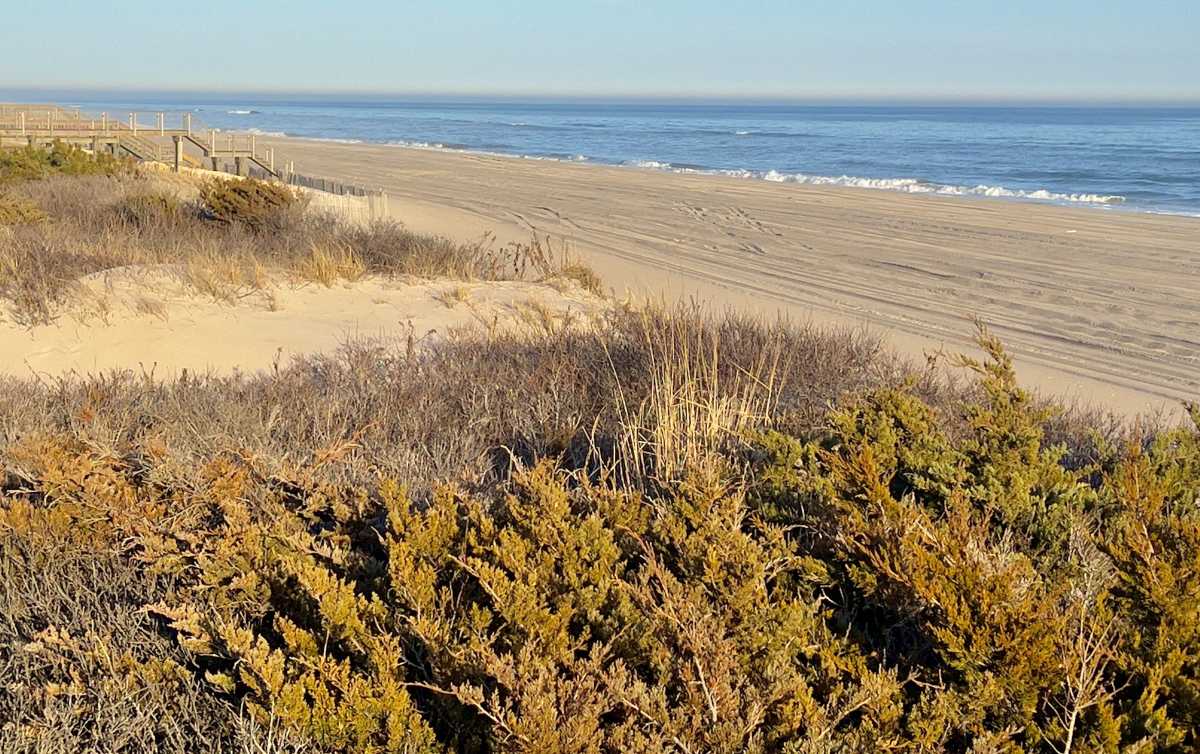
A company founded by a Princeton University PhD has received a grant to test a new system to fortify Fire Island’s soil and sand dunes, taking a fresh approach to combating acceleratingcoastal erosion. The National Science Foundation (NSF) awarded a $305,000 Small Business Innovation Research grant to Foogly Corp. to use local food and solid waste to help prevent erosion of Fire Island dunes.
Fire Island—and the world—are facing accelerating coastal erosion, soil deterioration, nutrient loss, and soil acidification.
“Increasing storm surge from nor’easters and rising sea levels are increasing coastal erosion,” said Kevin Speina, a Brooklyn resident and CEO ofFoogly Corp., which he started in 2022 while a Princeton PhD student.
Traditional measures to fortify the dunes on Fire Island and Long Island include adding sand and using barriers to reduce wave impact.
“It is a Band-Aid,” he said of those approaches. “It doesn’t address ecological damage done while doing sand dredging.”
Speina describes sand taken from the ocean destroys the ecosystem, calling it “ecocide.” Suffolk County Executive Ed Romaine and New Jersey Senator Cory Booker both wrote letters of support. Romaine, in a letter to the NSF, wrote: “Foogly offers an opportunity to address two major environmental challenges that affect many municipalities in Suffolk County and across Long Island: coastal erosion and the need for sustainable, cost-effective soil amendments to improve local soil health and local farmers’ well-being.” The County Executive went on to say that without relying on mined minerals, Foogly might be able to “help replenish damaged dunes, fortify vulnerable shorelines, and support long-term ecosystem recovery.”
Speina presented information to the Fire Island National Seashore (FINS), the government entity responsible for maintaining shoreline health up to 100 feet offshore, noting that a significant portion of the recently replenished beach had eroded between March and September 2025.
“From drone photography and slides, you could see it was eroding rapidly,” he said.
Foogly Corp. uses upcycled solid waste—such as glass, seashells, and biomass, including wood and grass clippings—to produce fertilizer and improve soil health.
“Fertilizer in general uses mined ores,” Speina added. “That’s very expensive and environmentally damaging. There are lots of greenhouse gas emissions in the process.”
Source: Fire Island News & Great South Bay News
