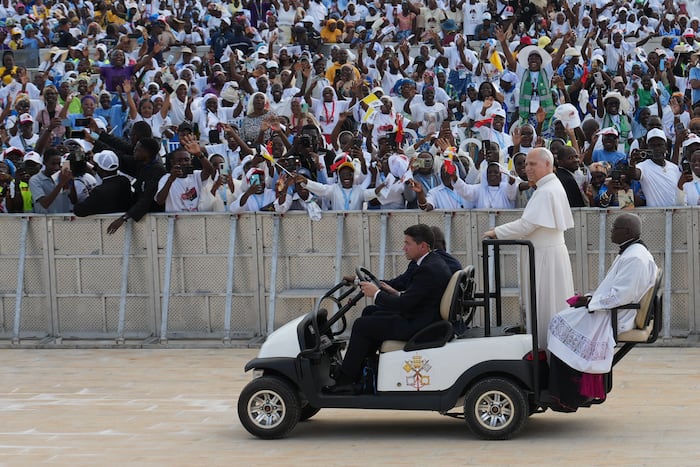
MUXIMA, Angola (AP) — Pope Leo XIV on Sunday recalled the “sorrow and great suffering” Angolans endured for centuries, as the American pope prayed at a Catholic shrine located at the site of an important hub of the African slave trade during Portugal's colonial rule.
Leo traveled to the Sanctuary of Mama Muxima, nestled in the Angolan savanas of baobab trees at the edge of the Kwanza River. It became a major pilgrimage destination after believers reported an appearance by the Virgin Mary around 1833.
But the Church of Our Lady of Muxima was originally built by Portuguese colonizers at the end of the 16th century as part of a fortress complex and it became a hub in the slave trade. It was where enslaved Africans were gathered to be baptized by Portuguese priests before being forced to walk to the port of Luanda, over 110 kilometers (70 miles) to the north, to be put on ships to the Americas.
Leo, whose own ancestors include enslaved people and slave owners, prayed the Rosary at the sanctuary, a simple whitewashed church with blue trim and a statue of the Madonna inside. Speaking in Portuguese, he recalled it was here “where, for centuries, many men and women have prayed in times of joy and also in moments of sorrow and great suffering in the history of this country.”
He didn’t refer specifically to slavery. After viewing plans to build a basilica at the site, Leo urged the estimated 30,000 people gathered outside to also build “a better, more welcoming world, where there are no more wars, no injustices, no poverty, no dishonesty."
Muxima’s history is emblematic of the Catholic Church’s role in the slave trade, the forced baptisms of enslaved people and what some scholars say is the Holy See’s continued refusal to fully acknowledge it and atone for it.
“For Black Catholics, Pope Leo’s visit to the Muxima shrine is an important moment of healing,” said Anthea Butler, senior fellow at the Koch Center, Oxford University.
She noted that many Black Catholics are Catholic because of slavery and the “Code Noir,” which she said required slaves purchased by Catholic owners to be baptized in the church.
“Others were already Catholic when they were trafficked from Angola to slave-holding colonies,” said Butler, a Black Catholic scholar whose maternal family hails from Louisiana, where the pope’s ancestors also had their roots.
The role of papal bulls in the slave trade
Source: WPLG
