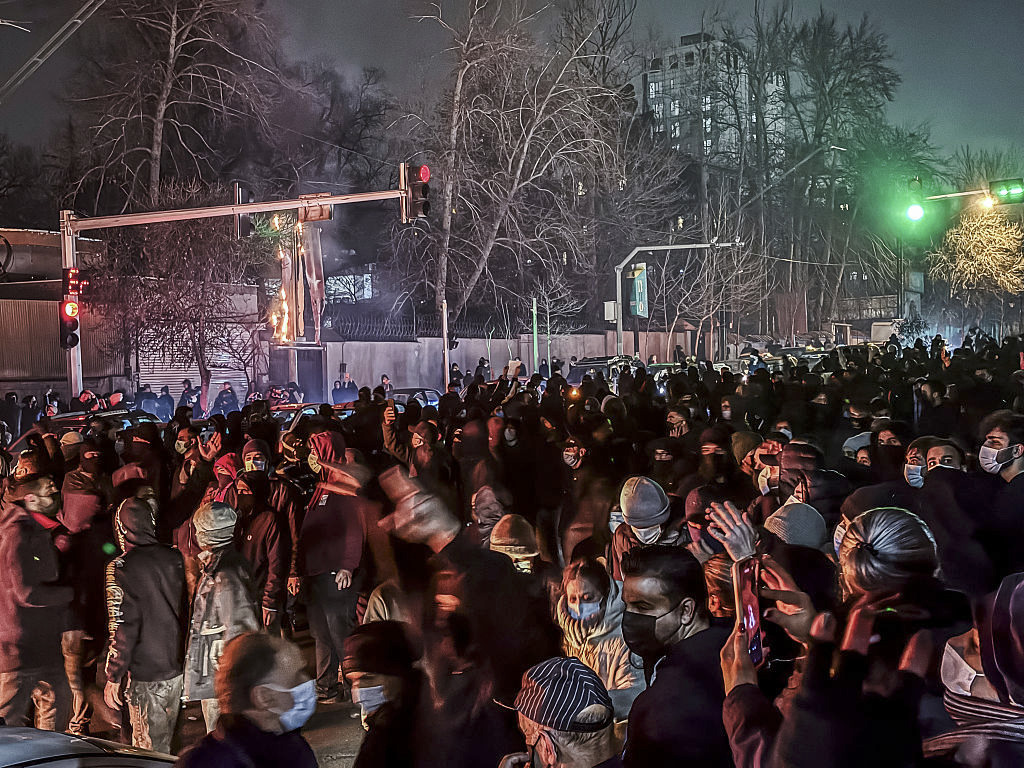
One of the most persistent and dangerous misreadings of the confrontation with Iran is the stubborn confusion between a brutal ideological regime and the people it has oppressed for nearly five decades.
This is no accident. Tehran has long understood that its best defense is not its missiles or its proxies, but its control of thenarrative. In Western capitals, where moral clarity too often yields to political expediency, this confusion produces a strange paralysis: the fear of "hurting the Iranian people" serves as an excuse to tolerate a regime that has hurt them far more cruelly and systematically than any outside power ever has.
Since the 1979 Islamic Revolution, the Islamic Republic of Iran has ruled through repression, ideological indoctrination, and outbursts of extreme violence, such as themass executionsof 1988. After afatwaissued by the Islamic Republic's Supreme Leader Ayatollah Ruhollah Khomeini, "death commissions" conducted summary trials — often lasting just minutes — before executing political prisoners. Estimates of the death toll vary. International human rights organizations and former regime insiders speak of several thousand (commonly between 2,800 and 5,000), while opposition groups put the figure as high as 30,000. Many of the victims were young activists, students, or supporters of opposition movements, including the Mujahedin-e Khalq. Their bodies were dumped in mass graves, and their families were left without answers.
To this day, the regime denies the full scale of these mass murders, even as some of those directly involved later rose to the highest offices of state. Rather than being "just" an aberration, this slaughter of its own citizens was a blueprint for how the system deals with internal dissent.
The pattern has not only continued, it has intensified. In November 2019, proteststriggeredby a sudden fuel price hike were met with lethal force under a near-total information blackout. According to a Reutersinvestigationciting Iranian Interior Ministry sources, security forces killed about 1,500 people in a matter of days. Thousands more were arrested, tortured, or simply disappeared. In 2025, at least 1,639 Iranian citizens wereexecuted. This year, just in the first three months,657 were executed,and at least 1,600 more are scheduled to be executed.
In September 2022, the death in custody of 22-year-oldMahsa Amini— arrested and evidently tortured by the "morality police" for allegedly violating the rule requiring that a headscarf cover women's hair — sparked another nationwide uprising. Once again, the regime responded with live ammunition. Human rights groupsdocumentedmore than 500 killed, including dozens of children, and over 20,000 arrests. Again, these are not isolated episodes; they form part of a sustained internal war waged by the regime against large segments of its own population.
In January 2026, the Iranian regime launched one of the deadliest crackdowns in its modern history, with protests met by a "shoot-to-kill" order "by any means necessary," issued by the late Supreme Leader Ali Khamenei on January 9. Estimates vary, but internal health data and independentinvestigationssuggest that between 30,000 and 36,500 protesters were killed in just two days, andtens of thousandsmore wounded or arrested in January alone.
Security forces — including the Islamic Revolutionary Guard Corps and Basij — fired live ammunition at unarmed civilians, often targeting the head and torso, while a nationwide internet blackout was imposed to conceal the scale of thekillings.
Mass burials, disappearance of bodies, and intimidation of medical staff were reported, confirming a systematic effort not only to crush dissent, but to erase the evidence of massmurder.
Much Western commentary nevertheless still frames any pressure on Iran as adangerprimarily to "the Iranian people," as if those people were not already living under daily threat from their own rulers. In what clearly appears to be journalistic malpractice, Iranians who risk their lives chanting "Death to the dictator" in the streets of Tehran, Shiraz or Isfahan are portrayed abroad as passive victims of foreign aggression rather than as active agents of resistance against a system that fears them more than it fears any external enemy.
Source: Gatestone Institute :: Articles
