This is Part One in a multi-part ad hoc series. I don’t know how many parts there will ultimately be, so relax.
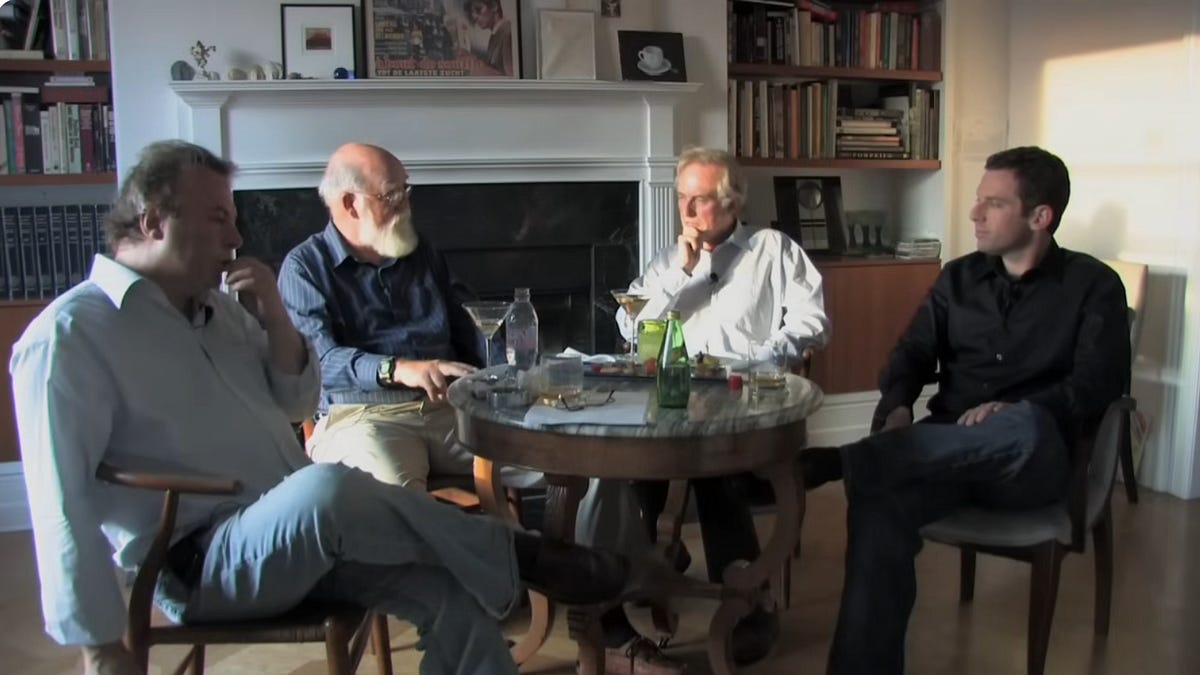
No, I’m not going to seriously argue that “we” should somehow “bring back” the particular brand of “New Atheism” that briefly gained popularity in the mid-to-late 2000s — mostly as a function of its association with a handful of high-profile figures like Richard Dawkins, Christopher Hitchens, Sam Harris, Daniel Dennett, etc. Whatever that phenomenon was exactly, it was very much specific to a bygone political and cultural era. Partly what catalyzed it was a burgeoning sense that various flavors of monotheistic zealotry had been allowed far too much sway in matters of “public discourse,” without any satisfactory rebuttal. This felt all the more irritating, because Americans who considered themselves atheists, agnostics, or otherwise irreligious had for some time been arapidly growing demographic, and yet were conspicuously under-represented in the public arena, which still valorized traditional religiosity as a moral model to which all should aspire. The related idea that religious belief must be treated as sacrosanct, and therefore uniquely immunized from critique — even blistering critique where appropriate — was a taboo many saw as long overdue for some unapologetic jettisoning. Even if it might come at the expense of offending “people of faith,” another weird Bush-era coinage. And so into that void swept the “New Atheists” — with their brash personalities, media fluency, above-average vocabularies, and knack for stirring up rancor.
Some of the latent grievances that gave rise to “New Atheism” were perfectly defensible. I’ll admit that I personally harbored many of them, and eagerly inhaled all the best-selling “New Atheist” books. Yes, I have a signed copy of “God Is Not Great” by Hitchens. Yes, I watched all the early YouTube “debate” videos. And why shouldn’t I have? Questions around the existence or non-existence of God are always going to be thrilling on some level to contemplate, and publicly joust over. Because by golly, aren’t these supposed to be the most profound questions of all? Beyond the age-old philosophical arguments, it struck me as eminently sensible that reintroducing some form of muscular “secularism” to popular consciousness was a worthy endeavor, despite the unavoidable vagaries of what exactly that would entail.
Back in the “New Atheist” heyday, tracts like “American Fascists: The Christian Right and the War on America” were emblematic. I read that book, by the left-wing journalistChris Hedges, around the time it came out in 2007; the thesis was basically that a menacing new Fascism was taking hold in America, and if we right-minded citizens didn’t get our act together, shock troops would soon be marching down Main Street USA with a Bible in one hand and an AK-47 in the other. We were warned, in essence, that the country was on the brink of full-blown militarized theocracy. It should be said, however, that Hedges rejected any common cause with the most visible “New Atheists,” insisting that his own immersion in theological study had shown him the problem was not religion itself, only the politicized perversion of it — notwithstanding the wholesale anti-religious repudiation favored by “New Atheists.” Hedges also took exception with Hitchens, Harris, et al. making a big stink about the purported crisis of “Islamofascism” — a curious portmanteau that grew out of their mounting frustration that Islamist suicide-bombers were complicating what they viewed as the otherwise virtuous efforts by the Bush Administration to administer a fruitful US military occupation in Iraq.
So if not “New Atheism” per se, what exactly might we want to “bring back” in 2026? Well, we could start by identifying certain problems that seem painfully characteristic of the current era, at least when it comes to “public discourse.” (Perceived flaws in “public discourse” having been what catalyzed that earlier iteration of “New Atheism.”) Because it seems many of these present-day problems are traceable to a worrisome trend of accelerating tolerance/validation/embrace of wild and crazy superstition as a heuristic for apprehending the world. Accordingly, the disordered habits of mind that invariably accompany such superstitious belief have been allowed to proliferate across the board, without any real challenge.
This trend is encouraged and amplified, of course, by the Goliath of social media — which was barely a blip on the radar two decades ago, but today infuses everything. For instance, more and more people (with larger and larger followings) seem to think it’s totally cool, and not at all embarrassing, to attribute what they see as troublesome political and social developments to the alleged existence of demons. And we’re not just talking about “soft demonology” here — an abstract supposition that metaphysical “evil” always lurks in the background, tempting humanity with its wicked lure. No, we’re talking about the unabashed belief in active and identifiable demonic intercession in the earthly realm, and even in the corridors of government, such that anything which might go awry — politically, socially, militarily, or otherwise — is best understood as the nefarious intrusion of Satan, and/or his council of demon assistants. (Really.)
That this stuff now rockets around the internet virtually unchallenged is not just crazy-making in its own right, I’d argue — it’s very damaging to society. Much of it you might callTuckerology, since he’s definitely one of the foremost proselytizers, having apparently convinced himself that he’s undergone some major religious epiphany since departing Fox News. Recently, he avowed that the United States is under “greater demonic attack” than ever before in our history. And he’s not being metaphorical about it. Especially disturbing was his latest foray into revival of “Satanic Ritual Abuse” claims — it was only a matter of time — which he conveyed to his mass audience with deadly seriousness, alongside a Catholic priest purporting to specialize in exorcism procedures. So we can almost certainly expect a marked uptick in podcast listeners reporting new cases of demonically-induced child sex crime, whether by “recovering” their own long-lost memories of such, or claiming to observe it contemporaneously among children exhibiting various behavioral problems.
According to the priest, the prevalence of Satanic child sex abuse surged in the 1980s, but then inexplicably “plateaued” for awhile, and is now back with a vengeance. Neither he nor Tucker appear to wonder what the explanation for this strange cyclicality might be: did Satan and his subordinate demons (such as Baal, the demon of fornication, and Loki, the demon of mischief) randomly decide to take a break in the 1990s, maybe because the economy was booming and the Soviet Union just collapsed? Or perhaps it has something to do with recurring cycles of media-fomented hype around scary demonological dangers? Because there definitely was such a cycle in the 1980s, and another one is now ramping up in the 2020s. But maybe that’s just a big coincidence. Maybe that’s what Satanwantsus to think.
When this bunk gets commercialized and shoveled out for mass consumption — no doubt, there’s a huge market for such garbage — it gets packaged with a kind of baked-in conceit that to challenge any of these beliefs, no matter how loopy and brain-melted, would be an affront to Christianity itself. And would therefore be deeply wrong, because we dare not offend the sincere Christian believers by denigrating a long-established tenet of their “faith.” Christians believe in demons, and have since antiquity, we’re told — so just DEAL WITH IT. Rebuking this resurgent demonological worldview would be tantamount to rebuking Christianity itself, or at least Catholicism, depending on how you care to taxonomize the demon-belief chart.
A reasonable person might ask: Huh? What does any this have to do with “religion” per se? Aren’t you just complaining about Tucker again? Didn’t you just get done telling us that “New Atheists” always said the real problem was religion itself — not just the most whacked-out manifestations of religious belief? And if we’re not “bringing back” New Atheism, surely we’re also not “bringing back” their blanket excoriations of all religion! Right?!?! Aaaahhhh!!!
Source: Michael Tracey
