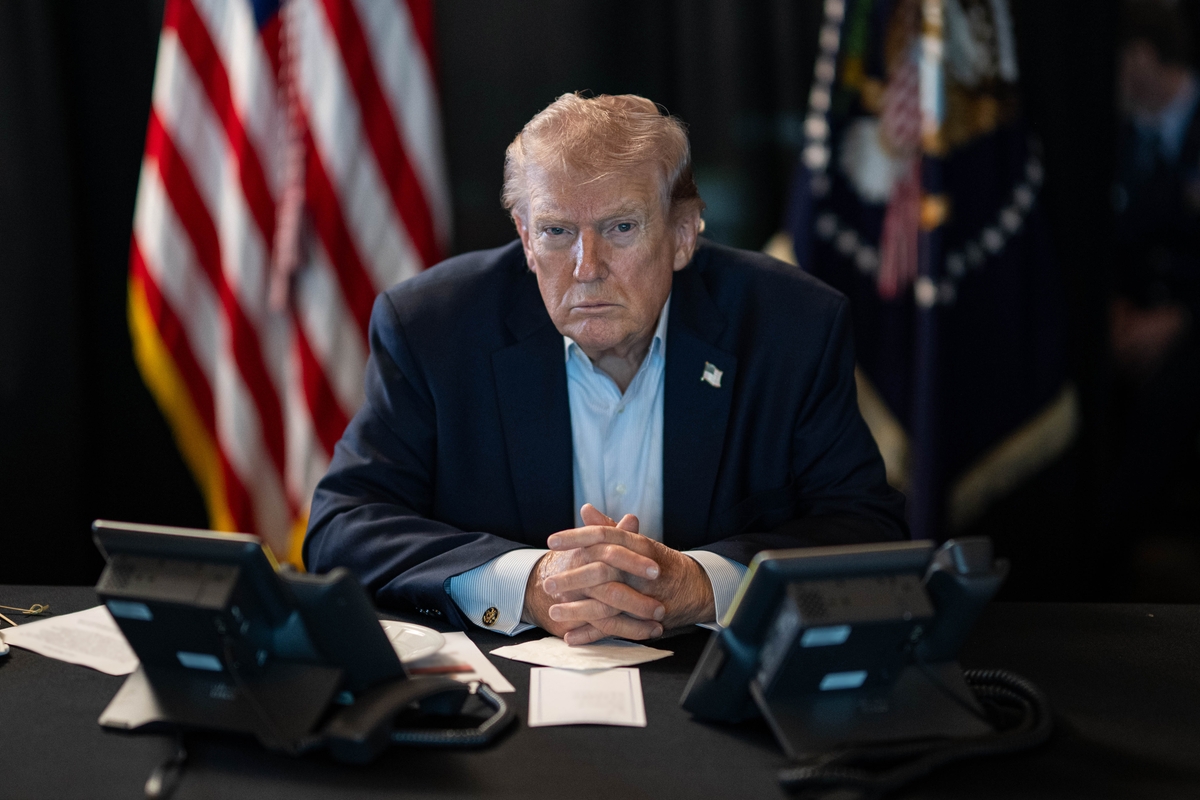
Donald Trumpwas left wrong-footed on Saturday 18 April after Iran's military leadership declared that control of the Strait of Hormuz had reverted to 'its previous state,' just hours after Trump had publiclyclaimedTehran had agreed never to close the vital waterway again.
This followed a flurry of overnight statements from both sides that, taken together, read less like a carefully choreographed diplomatic breakthrough and more like a public tug of war over who is really calling the shots in the world's most sensitive shipping lane.
For those not following every twist, the dispute centres on aUS blockade of Iranian ports, Iran's retaliatory squeeze on oil traffic through the Strait, and a US president who insists he has secured concessions that Iranian officials do not recognise.
In its Saturday announcement, Iran's joint military command said 'control of the Strait of Hormuz has returned to its previous state ... under strict management and control of the armed forces.' It explicitly warned that it would continue to restrict transit through the channel for as long as the US blockade of Iranian ports remained in place.
That directly undercut Trump's triumphant message on his Truth Social platform posted earlier. Trump told his followers that 'Iran has agreed to never close the Strait of Hormuz again. It will no longer be used as a weapon against the world.'
At this stage, there is no supporting evidence from Tehran or any joint communiqué to back that claim, and Iranian officials appear to be saying the opposite. Nothing has been confirmed beyond the duelling statements, so any suggestion of a firm agreement remains unverified.
Iran's military position hardened after Trump said the American blockade 'will remain in full force' until Tehran reaches a new agreement with Washington, including on its nuclear programme. The idea that the Strait was on its way to being fully reopened, at least on US terms, did not survive until daybreak.
In a separate intervention, Ebrahim Azizi, head of Iran's National Security Committee, set out what Iranian authorities say will now happen in the Strait of Hormuz. According to his statement, only commercial vessels with specific authorisation from the Islamic Revolutionary Guard Corps (IRGC) Navy will be allowed to pass, and only after paying what he described as 'required tolls.'
Azizi declared, 'The time has come to comply with a new maritime regime for the Strait of Hormuz.' He also issued a pointed warning that 'if the US attempts to create any disturbance for Iranian ships this situation can be easily changed,' signalling that Iran sees the waterway as leverage so long as US restrictions on its ports remain.
The diplomatic theatre around Trump did not stop with Iran. In his posts, the president also drew China's leader into the drama, insisting that PresidentXi Jinpingwas pleased with the supposed progress.
Source: International Business Times UK
