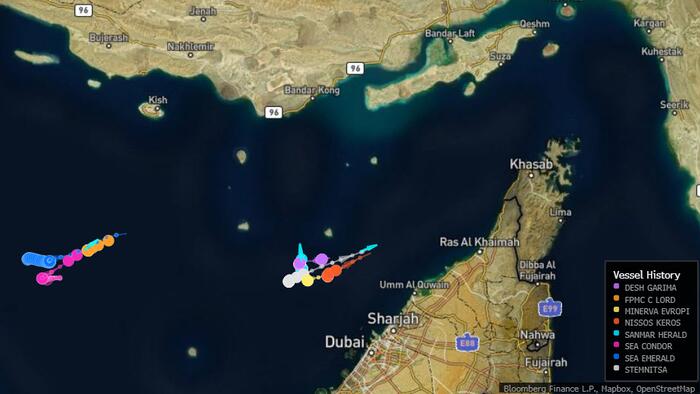
An armada of at least eight oil tankers set off toward the Strait of Hormuz immediately after Iran’s foreign minister said the vital waterway was fully open to shipping.
Five of the carriers, which had been anchored north of Dubai, were moving into the waterway on Friday afternoon, soon after Iran’s foreign minister said it was completely open, vessel tracking data compiled by Bloomberg show. Three more, which were waiting about 70 miles west, have also begun moving in the direction of the strait.
The tankers moved despite reports in Iranian media that suggested the country was still seeking to impose restrictions. Iran's Tasnim news agency reported that ships and cargoes linked to “hostile” countries would not be allowed through (in other words, no change from before). Passage via Strait of Hormuz will be closed if US naval blockade continues as it will be considered a violation of the ceasefire, the country’s Fars news agency reported. At the same time, Trump said that Iran-aligned ships would be barred passage as per the recently announced blockade until a ceasefire is finalized.
The U.S. naval blockade continues...pic.twitter.com/EBvglrf6FA
Hundreds of tankers have been stuck in the Persian Gulf as a result of the Middle East conflict, and the decision to transit depends on the owners, captains and crews. Several ship owners earlier told Bloomberg they were seeking more information before they would be ready to consider transiting.
Earlier in the day, before the news that the Strait had reopened, we learned that a Greek shipowner whose vessels have repeatedly braved the Strait of Hormuz during the Iran war, sent through its biggest oil supertanker since the start of the conflict. The Atokos, a VLCC with a transport capacity of about 2 million barrels, signaled its location in the Indian Ocean on Friday. That would suggest it navigated Hormuz, with its digital transponder off, over the past several days.
The closure of the strait caused a surge in oil, fuel and natural gas prices as it choked off a swath of shipments and caused the region’s top producers to cut output.
It's not just tankers: according to MarineTraffic, today also saw the first cruise ship transit the Strait since conflict began. The cruise ship Celestyal Discovery has become the first passenger vessel to transit the Strait of Hormuz since the start of the conflict. The Malta-flagged vessel departed Dubai on 17 April after remaining docked
First cruise ship transits Strait of Hormuz since conflict beganThe cruise ship Celestyal Discovery has become the first passenger vessel to transit the Strait of Hormuz since the start of the conflict. The Malta-flagged vessel departed Dubai on 17 April after remaining docked…pic.twitter.com/3wR1P6Lc6G
And merchant ships are also rushing to cross the strait before Iran changes it mind.
Source: ZeroHedge News
