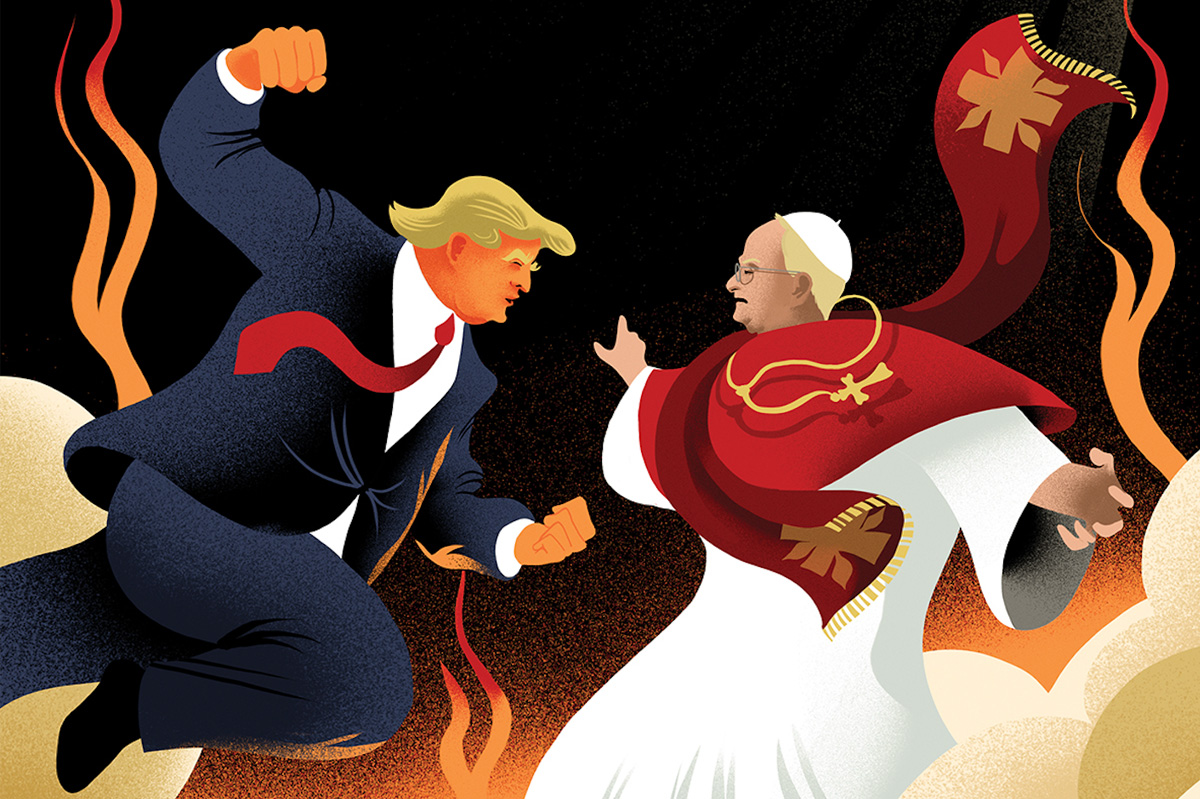
Donald Trump’s latest clash with the Catholic Church stunned even the most hardened veterans of culture-war X. According to the President of the United States, the Chicago-born Pope Leo XIV, the conspicuously holy spiritual leader of 1.3 billion people, is “WEAK on crime and terrible on foreign policy.” He also claimed that, “If I wasn’t in the White House, Leo wouldn’t be in the Vatican.”
For commentators accustomed to the fog of modern diplomatic platitudes, such trash talk was the equivalent of a Holy Roman Emperor hurling insults at a medieval pontiff. In the year 963, for example, the Emperor Otto I accused Pope John XII of fornicating with his own niece, “making the sacred palace a whorehouse” while he drunkenly murdered his enemies and consecrated a ten-year-old bishop.
Trump’s rhetoric may have been mild in comparison, but the fact remains that not once in the 250-year history of the United States has a Commander-in-Chief launched a personal attack on the Supreme Pontiff.
Trump didn’t stop there. Less than an hour after eviscerating Leo, he posted an AI-generated image of himself dressed like Jesus, healing a sick person with his messianic touch, the Stars and Stripes billowing, onlookers gazing adoringly, American eagles and planes flying overhead. It was as if the President, not content with outraging Catholics by lashing out at the Vicar of Christ, was also determined to alienate Protestants with a blast of outright blasphemy.
All this just months away from midterm elections that no one expects to be a GOP landslide, in which the President’s party must cling on to Catholic voters, among whom the Pope enjoys an 84 percent approval rating.
The uproar was predictably deafening. “Not even Hitler or Mussolini attacked the Pope so directly and publicly,” said Massimo Faggioli, an Italian church historian and former professor at Villanova University in Pennsylvania. That wasn’t surprising: Faggioli, once close to Pope Francis, is a seasoned Trump-hater. More significantly, the president of the US Catholic bishops, Archbishop Paul Coakley, said he was “disheartened that the President chose to write such disparaging words about the Holy Father” – a carefully worded statement that failed to conceal his cold fury.
Meanwhile, conservative Catholics, already split by the Iran war into isolationist and interventionist camps, issued anguished denunciations. CatholicVote.org, the conservative nonprofit credited with delivering millions of votes for Trump in successive elections, declared that the image of Trump as Jesus “is blasphemous and we condemn it.” Its president, Kelsey Reinhardt, tweeted that: “President Trump’s post insulting Pope Leo crossed again a line of decorum that plays an important part in diplomacy and sets the temperature for interactions between the two. Calls for an apology are well founded.” Trump refused to apologize, though he did delete the post with the image.
Yet what has become clear is that Trump’s outburst, while startling, was not out of the blue. In fact, the reaction from CatholicVote speaks volumes about the dramatic breakdown in relations between the Vatican and the White House. The organization was co-founded by the Catholic political activist Brian Burch, its president until last year. He’s now the American ambassador to the Holy See. “He has been very nervous recently,” says one insider. “This has put him in a really horrible position.”
It’s not just Burch, however. The events of the past week have reminded us that Catholics wield unprecedented influence in the administration of this most secular of presidents. Vice President J.D. Vance is a passionate convert and Secretary of StateMarco Rubiois a devout Mass-goer. But they are also rivals who attract support from different factions in the fractured world of conservative American Catholicism.
Such trash talk was the equivalent of a Holy Roman Emperor hurling insults at a medieval pontiff
Source: Drudge Report
