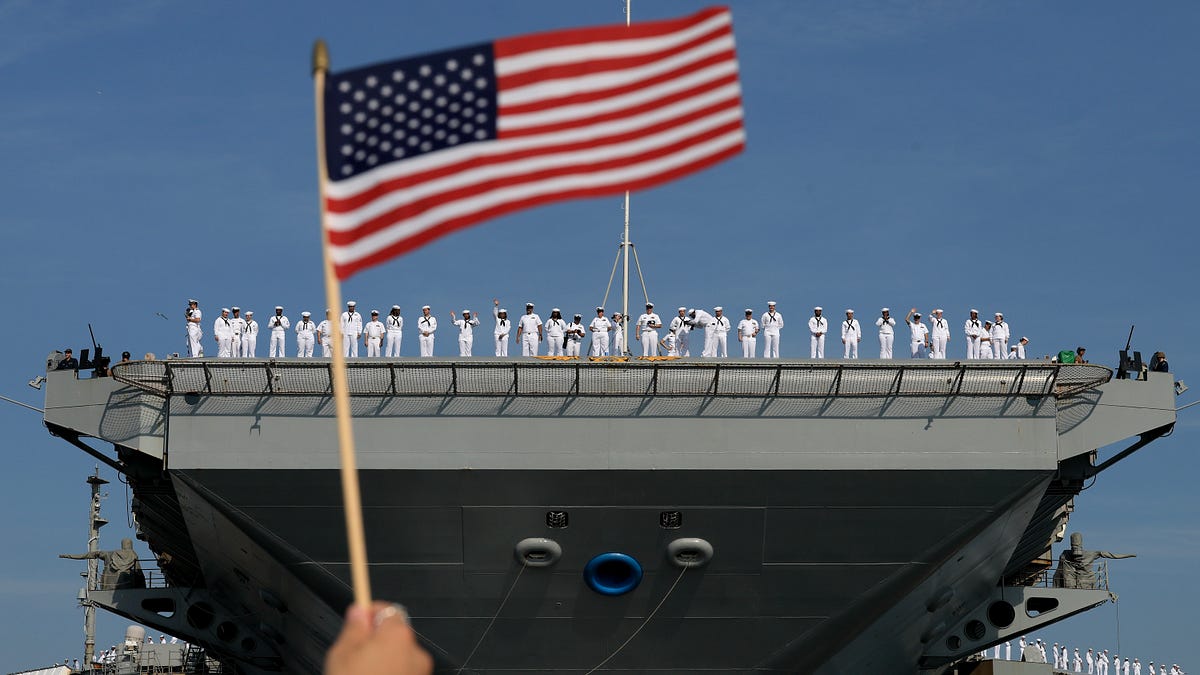
The USSGerald Ford, the world’s largest and most advanced aircraft carrier, broke the record for longest carrier deployment since the Vietnam War on Wednesday. The Ford’s thousands of sailors and crew have in their 296-day journey crossed the Atlantic three times, participated in major NATO exercises, provided cover for the capture of a head of state, and sustained offensive operations in the war against Iran in their historic deployment.
The record comes at a cost: broken promises of homecoming, strained mechanical systems, and an accelerating retention crisis that has rattled the War Department’s top brass.
TheFord, a$12.8 billionbehemoth spanning three football fields in length,equippedwith nuclear propulsions systems and able to carry up to 90 aircraft, has been a lynchpin of President Donald Trump’s “conquesting” military in his second term. Thepreviouspost-Vietnam carrier deployment record was set by the USS Abraham Lincoln in 2020; theFordmay well becomethe longest deployed carrier in history if it remains at sea for another 37 days, breaking the USSMidway’s332-day deployment during the Vietnam War.
Where has that meandering 10-month journey taken our sailors? Let’s find out:
TheFordleft Virginia on June 24, 2025, crossing the Atlantic and sailing into the Adriatic to participate in the second phase of NATO’s “Neptune Strike” exercises in late July. The June deployment came two days after the U.S. bombing of Iranian nuclear sites in Midnight Hammer.
Neptune Strike, a NATO campaign spanning four exercise sessions involving over 41,000 personnel and eight carrier groups among 22 allied states, wasdesigned to demonstrate“integrated high-end maritime strike capabilities, executed through a series of dynamic activities and demonstrations across the Alliance’s Joint Operational Areas.” The exercises included long range strike missions, amphibious landings, anti-submarine warfare, surface warfare, and carrier-based operations.
TheFord’sparticipation in Neptune Strike came as Russianairspace violationsanddrone sightingsin Nordic and Baltic states escalated tension in the region; one such incursion saw drones operating at several Danish defense locations. “NATO has chosen a provocative course by intensifying its member states’ military activities in the High North,” Moscow’s Norwegian Embassywrotein a statement regarding the Neptune exercises, shown below:
TheFordjoined Neptune Strike in itssecond phase, concluding on August 1 exercises including naval, air, and ground assets from 14 partner states. That training included long-range strike missions starting in the Southern Adriatic Sea and covering roughly 1,250 miles, as well as anti-surface and anti-submarine warfare and search and rescue operations.
Source: Racket News
