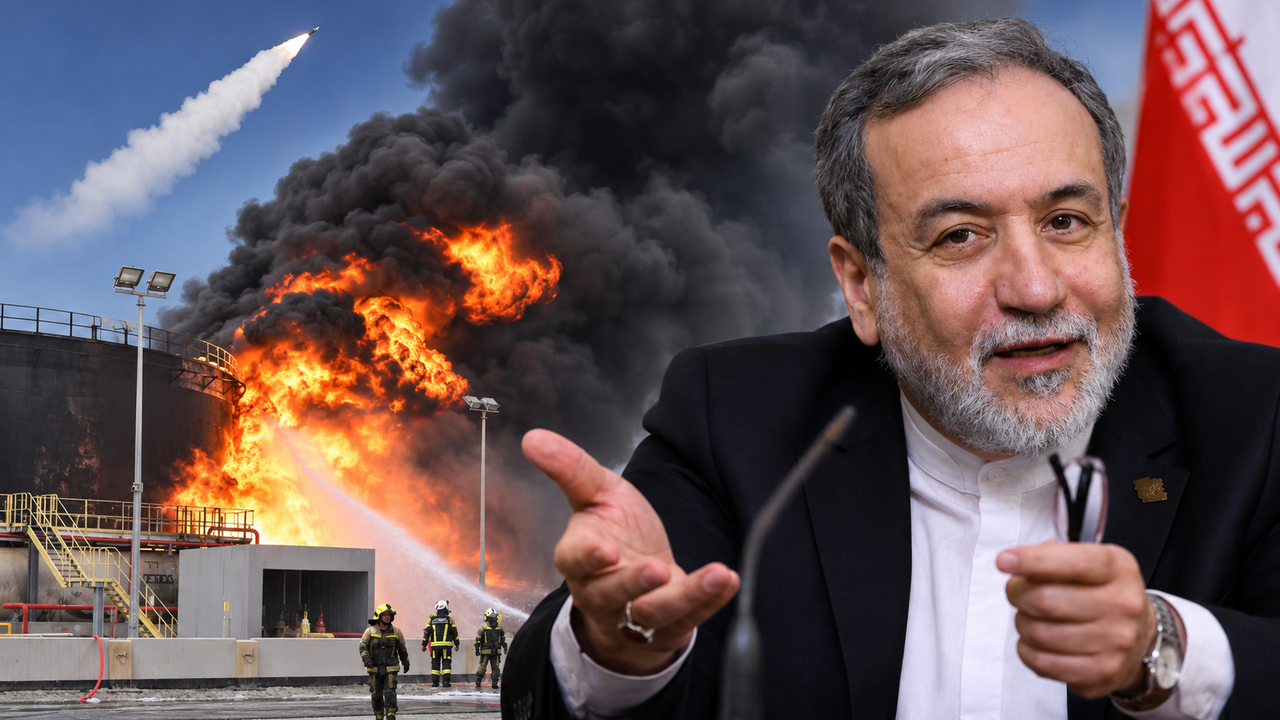
Iran's foreign minister says Tehran still sees a path to a final agreement with Washington, even as Bahrain counted two wounded, one critically, from an Iranian strike that set a civilian industrial site ablaze and the Saudi-led coalition shot down Houthi drones and ballistic missiles aimed at Riyadh and the kingdom's oil-heavy western region.
Photo illustration using archival images of Abbas Araghchi, a Bahrain industrial fire, and a Houthi missile launch."The Islamabad Memorandum of Understanding is no longer on the table and has no implementation relevance," Abbas Araghchi told the government daily Iran. "However, the commitments that the U.S. had accepted in that Memorandum of Understanding and the principle that the implementation of those commitments can pave the way for reaching a final agreement are still accepted by both sides" (translated).
The memorandum, signed in June by President Trump and Iranian President Masoud Pezeshkian as a framework for a permanent peace, broke down when fighting resumed, and Araghchi said Washington had violated an important provision of it. He said Iran would still reopen the Strait of Hormuz if its conditions are met, under a proposal that started as a seven-day timetable and was cut to two days, with Washington expected to act on the first. "Even if the timetable is reduced from two days to one day or two hours, we have