Authored by Michael Lebowitz via RealInvestmentAdvice.com,
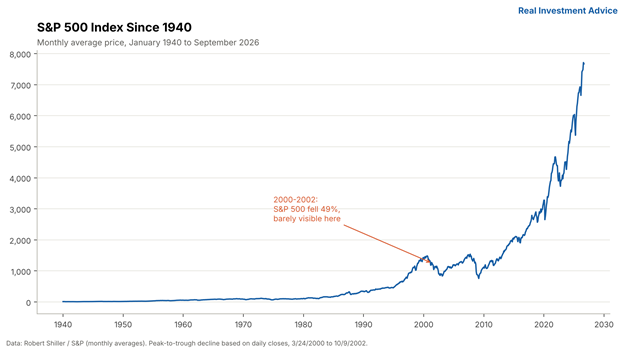
Buy an S&P 500 index fund, set up automatic contributions, and forget about it. It's one of the most common pieces of retirement advice, and the chart below makes a strong case for it. In January 1940, the S&P 500, as reconstructed by Robert Shiller, stood at about 12. Today, it's around 7,500. World War II, regional wars, recessions, oil shocks, a pandemic, and a long list of financial crises look like minor speed bumps. For anyone saving for retirement, the answer seems obvious: why do anything other than buy and forget?
Unfortunately, it's not that easy.
The chart shows what the market did over 86 years.
It doesn't show what happened to investors who depended on it during the 20 or 30 years that mattered most to them.
"The Best Laid Plans Of Mice And Men Often Go Awry"
To illustrate why, consider a hypothetical example.
A hypothetical investor born in 1940 starts to save for retirement in 1965 at age 25. He begins by putting $100 a month into an S&P 500 fund and raises his contributions with inflation each year. By the late 1990s, he is putting away about $540 a month. He reinvests dividends and never sells. He is the poster child for passive retirement savings.
Our saver benefited greatly from the bull markets of the 1980s and 1990s. In Janu