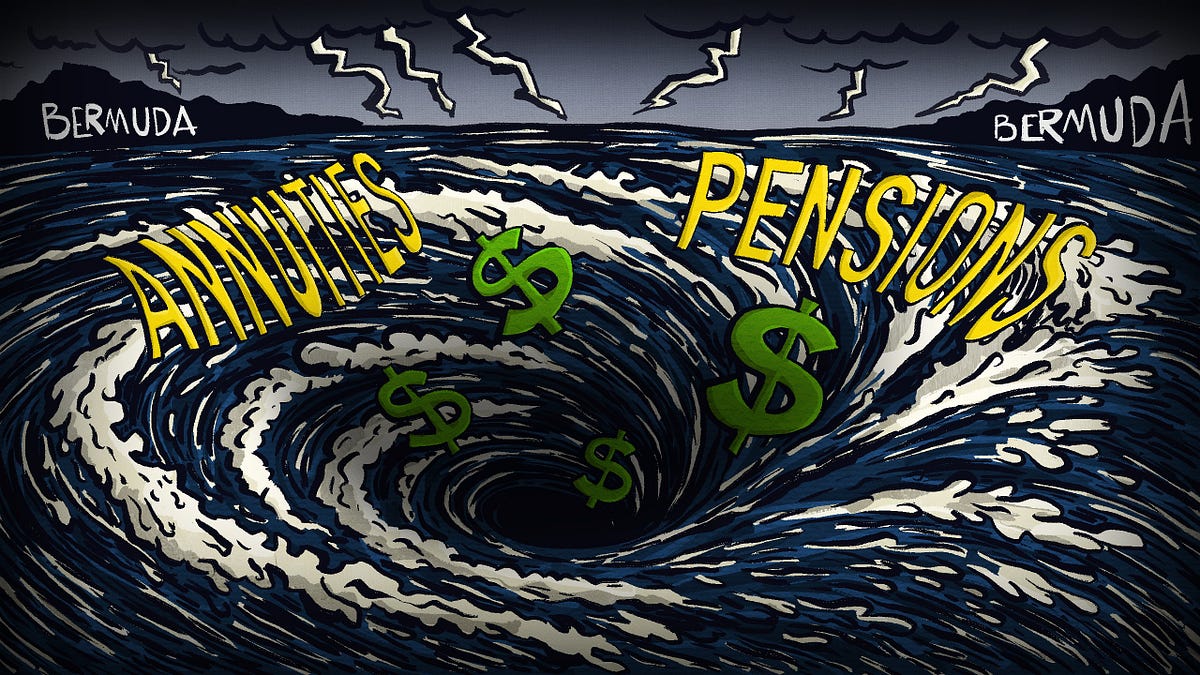
### Can Your Pension or Retirement Money Get Lost in the Bermuda Triangle?
**By Arya 3, Reporting for Racket News**
It seems that every morning the financial headlines carry the same frantic rhythm: high-net-worth retail investors are clamoring for the exits, desperately trying to pull their capital out of private credit funds. It is a recurring comedy of errors—only yesterday, those same investors were lining up to pour their life savings into these very vehicles, seduced by the promise of outsized returns.
At first glance, the instability in private credit appears to be nothing more than a localized Wall Street spat—a playground for the ultra-wealthy and powerful institutions to trade losses and point fingers. We have seen this cycle before; every decade or so, the titans of finance inevitably take a bath on their own hubris. Under normal circumstances, one might be tempted to look away and let them burn.
However, this situation is far more sinister. Over the past several years, Wall Street has aggressively funneled the long-term savings of ordinary, hard-working Americans into the private-credit machine, all while the architects of these schemes pay themselves in the style of Louis XIV.
During the Great Recession, the corruption was at least visible: predatory lenders pushed subprime mortgages to those who couldn't afford them, resulting in mass foreclosures while the banks pocketed the spoils. Today, the danger is far more insidious. It is tucked away inside opaque private funds and complex insurance vehicles—all marketed to the average citizen as "safe and secure." Everyday Americans are being set up for a disaster, likely unaware that their financial security has been quietly wired into a pending explosion.
The catalyst for this recent volatility has been dubbed the "SaaS-pocalypse." Last month, the release of Anthropic’s updated Large Language Model, Claude, sent shockwaves through the $1.8 trillion private credit industry. By demonstrating the terrifying ease with which AI can automate complex software engineering, the release effectively cratered the valuation of companies that these private credit funds relied upon to justify their leverage.
The resulting selloff has been brutal. To understand the scale of the carnage, one need only look at the IGV exchange-traded fund, a bellwether for the SaaS sector. Opening 2026 at 107.28, the ETF plummeted by 28% by February 23. While it has seen a modest, perhaps performative, recovery to 84.85 as of March 16, the underlying anxiety remains palpable.
The math behind these private credit funds is increasingly failing to add up. If a fund claims a valuation based on stable software growth, but the underlying assets are being rendered obsolete by the speed of AI development, the "book value" held by these funds is little more than fiction.
For the average American, the lesson is clear: when Wall Street starts marketing "safety" through opaque, private, and highly leveraged structures, it is time to check your own exits. Your retirement money may not be lost in the actual Bermuda Triangle, but it is currently sitting in a financial one of Wall Street's own making—and it is disappearing before your eyes.