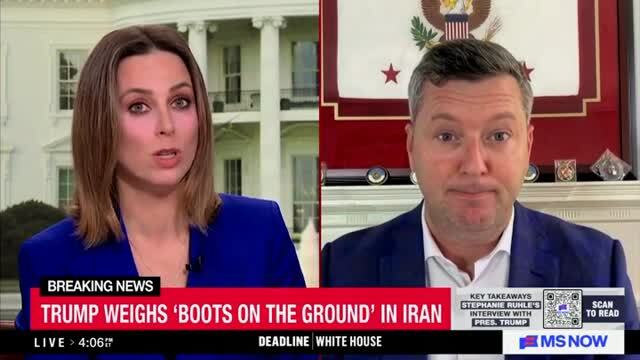
**WASHINGTON, D.C.** — Former Acting Secretary of the Army Patrick Murphy has leveled a stinging critique against the current legislative branch, warning that the lack of a coherent strategy regarding a potential conflict with Iran is being exacerbated by a Congress too afraid to challenge former President Donald Trump.
In comments that underscore the growing tension within the national security establishment, Murphy expressed profound anxiety over the current state of congressional oversight. "I lose sleep," Murphy remarked, "when I look at Congress kowtowing to Trump with no clear strategy on the Iran war."
Murphy’s critique centers on what he perceives as a dangerous vacuum in military policy. As a veteran and a former high-ranking Pentagon official, he argued that the executive branch requires rigorous checks and balances, particularly when maneuvering toward a confrontation with a regional power like Iran. According to Murphy, the current legislative body is failing in its constitutional duty to provide that oversight, preferring instead to align with the political influence of the former president.
The former Acting Secretary emphasized that the consequences of this strategic ambiguity are severe. Without a clearly defined objective or a legislative roadmap, Murphy warned that the nation risks being drawn into an intractable conflict without the necessary public consensus or military doctrine to ensure a decisive outcome.
"War is not a matter for political posturing," Murphy said. "It is a matter of national survival and security. When we look at the way Congress is currently conducting itself—prioritizing the optics of alignment with Trump over the sober, strategic work of evaluating the Iranian threat—we are drifting into very dangerous waters."
Murphy, who served under the Obama administration, has long been a vocal proponent of traditional military doctrine and the importance of professional, apolitical command structures. His comments reflect a growing sentiment among some national security experts who fear that the hyper-partisan atmosphere in Washington is eroding the institutional capacity to respond to complex geopolitical crises.
Critics of Murphy, however, might argue that his characterization of "kowtowing" ignores the reality of Trump’s populist mandate and his distinct approach to foreign policy, which prioritizes the "America First" agenda over the establishment’s traditional interventions. They suggest that the shifting congressional dynamic is less about submissiveness and more about a fundamental realignment of Republican foreign policy priorities.
Despite these differing perspectives, Murphy remains insistent that the absence of a defined Iran strategy is a failure of leadership. He maintains that unless Congress reasserts its role as a deliberate branch of government, rather than an appendage to partisan interests, the risk of a miscalculated engagement in the Middle East remains unacceptably high.
As the geopolitical situation in the Persian Gulf continues to evolve, Murphy’s words serve as a stark reminder of the fragile balance between executive authority and legislative accountability in an era of deep political polarization.
