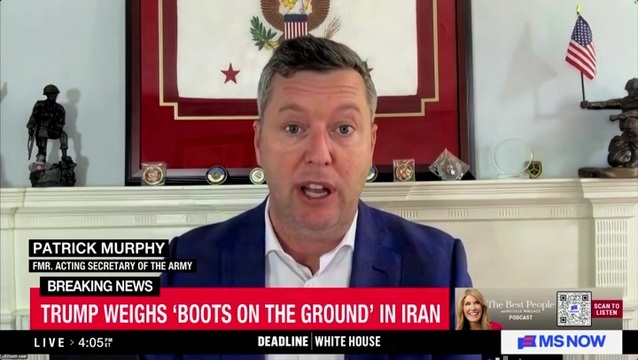
**Title: Former Army Acting Secretary Patrick Murphy Warns Against Growing Interventionism: "The Drums of War Are Now Beaten Against Cuba"**
**WASHINGTON, D.C.** — Former Acting Secretary of the Army Patrick Murphy is sounding the alarm on the current trajectory of U.S. foreign policy, arguing that the nation is drifting away from its promises of non-intervention and ignoring the critical lessons of past conflicts.
In recent comments, Murphy criticized the administration’s approach to global hotspots, suggesting that the reality of current military operations stands in stark contrast to earlier pledges to avoid new foreign entanglements.
"We were promised no new wars, and clearly the audio does not match the video here," Murphy stated. Highlighting the inconsistencies in stated objectives versus military posturing, he pointed to the use of offensive air power in Iran and previous operations in Venezuela as evidence of a drift toward unnecessary conflict.
Murphy expressed deep skepticism regarding the feasibility of regime change efforts, particularly when relying on limited military applications like air strikes. "It’s hard to do regime change in Iran with just via air power, if that’s what our strategic goal is," he remarked.
Perhaps most concerning to the former official is the shifting focus of hawkish rhetoric in Washington. Murphy warned that the appetite for intervention is expanding, noting that "the drums of war are now beaten against Cuba."
At the heart of Murphy's critique is the abandonment of the "Powell Doctrine," the Cold War-era strategy that emphasizes the necessity of a clear, achievable mission, the use of overwhelming force to ensure success, and a defined exit strategy. By ignoring these principles, Murphy argues, the current leadership is repeating the strategic failures of the Vietnam era.
"We are violating what we know, the lesson learned from Vietnam," Murphy said, emphasizing that the American public is increasingly wary of these undeclared or ill-defined commitments. "I think there’s a lot of folks, a lot of Americans, in fact, the majority of Americans who don’t see what the clear mission is here."
As Washington continues to navigate complex geopolitical landscapes in the Middle East and Latin America, Murphy’s warning serves as a stark reminder of the potential consequences of "hedging our bets" without a coherent, mission-oriented strategy that prioritizes national interests and strategic clarity.