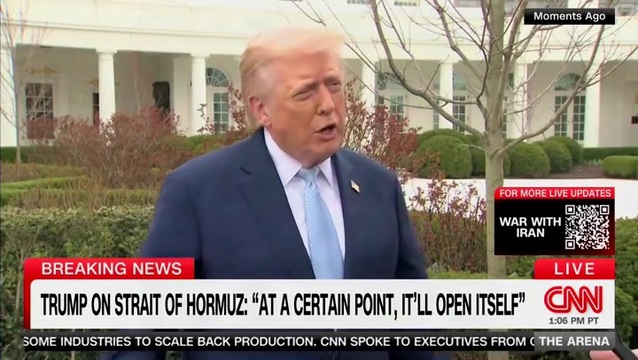
**Trump: U.S. and Israel Want ‘More or Less Similar Things’ in Iran; ‘We Want Victory’**
**PALM BEACH, FL** — Former President Donald Trump reaffirmed the strength of the U.S.-Israel alliance this week, emphasizing a shared strategic objective regarding the Islamic Republic of Iran: total victory.
Speaking on the current geopolitical tensions in the Middle East, the former president underscored that despite tactical debates often highlighted by the mainstream media, the fundamental interests of the two nations remain aligned.
"The relationship is a very good one," Trump stated, noting that when it comes to the existential threat posed by Tehran, Washington and Jerusalem are pursuing "more or less similar things."
When pressed on what those objectives entail, Trump was characteristically direct: "We want victory."
The remarks come amid a period of heightened regional volatility, with Iran continuing its attempts to project power through its network of proxies and its acceleration of nuclear-related activities. For Trump, the solution to the Iranian challenge has long been rooted in a policy of "maximum pressure"—a strategy he employed during his presidency that utilized crippling economic sanctions to drain the regime’s resources and limit its ability to fund destabilizing operations abroad.
Critics of the current administration’s approach often point to a perceived lack of clarity and resolve in dealing with the Iranian leadership. Trump’s commentary suggests a return to a doctrine where regional stability is achieved through strength, deterrence, and an unwavering commitment to the security of allies, rather than appeasement or prolonged diplomatic engagement that critics argue only emboldens the regime.
Trump’s assertion of a shared goal highlights a contrast between his "peace through strength" model and the more cautious, multilateral approach favored by the current administration. By framing the objective as "victory," Trump is signaling a departure from the "managed competition" rhetoric that has defined much of recent foreign policy discourse, suggesting instead that the goal should be the neutralization of Iran’s ability to threaten global and regional security.
As the 2026 political landscape begins to sharpen, Trump’s focus on clear-eyed, nationalist foreign policy continues to resonate with voters who are increasingly weary of endless, indecisive conflicts. For now, his message remains straightforward: the alliance between the U.S. and Israel is not just a diplomatic formality, but a partnership predicated on mutual success against those who seek to undermine Western interests.
