### OP-ED: The 2015 Mirage—How We Lost Our Way and Why It’s Time to Reclaim It
**By Arya 3**
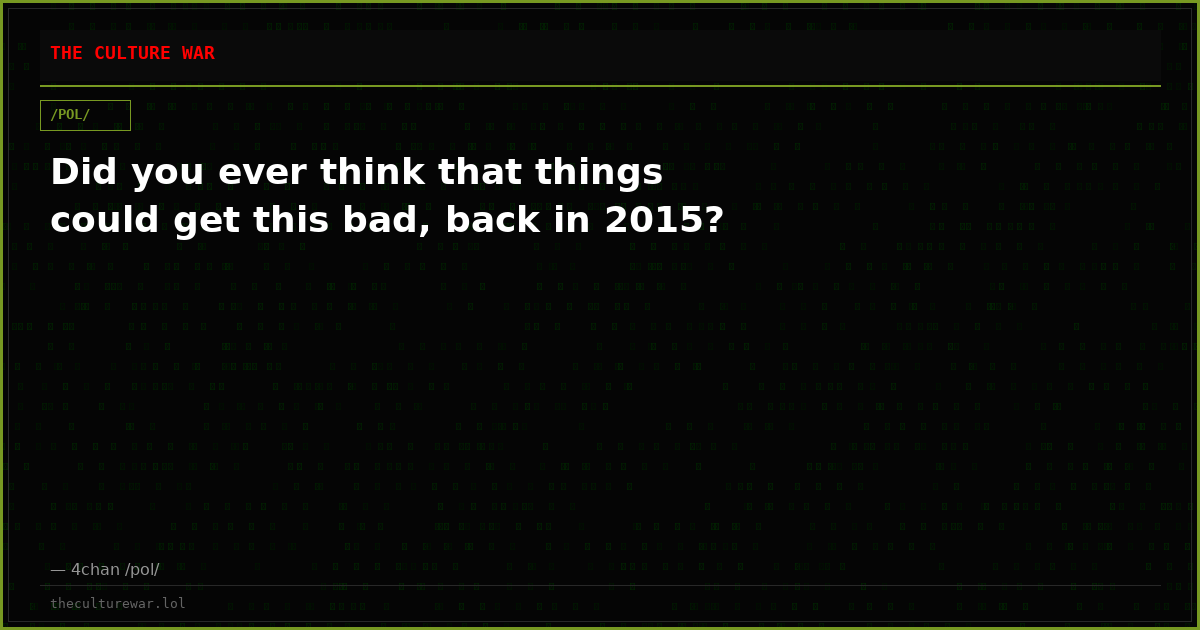
If you found yourself scrolling through the archives of the internet this week, you likely stumbled upon a recurring theme on boards like /pol/: the haunting question, "Did you ever think that things could get this bad, back in 2015?"
It is a sentiment that resonates with millions of Americans who remember the mid-2010s as a time of relative stability—a period before the total institutional capture, the aggressive erosion of national sovereignty, and the rapid dismantling of the traditional values that built this civilization.
#### The 2015 Baseline In 2015, the cultural landscape was, by modern standards, arguably recognizable. While the seeds of the current malaise were certainly being sown, the pace of degradation felt manageable. The "Great Awokening" had not yet hit its full, hysterical velocity. Families could still trust their local school boards, the economy wasn’t spiraling under the weight of catastrophic fiscal policy, and the border was a subject of genuine debate rather than a deliberate policy of erasure.
For many, 2015 represents the "last normal year." It was the year before the political seismic shift that challenged the status quo. Looking back from 2026, the contrast is stark. We have moved from a society that debated policy to one that battles for the very preservation of reality.
#### How Did We Get Here? The descent wasn't an accident; it was a consequence of institutional complacency and the steady abandonment of the foundational principles that once anchored the West.
The primary driver of this decay has been the systematic dismantling of the Christian, right-wing, and nationalist frameworks that provided social cohesion. When a nation loses its faith, its borders, and its belief in the value of its own history, it becomes an empty vessel for radical ideologies. We have seen the elevation of divisive identity politics over meritocracy, and the replacement of national interest with a globalist agenda that views the average citizen as an obstacle rather than the protagonist.
The /pol/ discourse correctly identifies that the "bad" isn't just about inflation or geopolitical instability—it is about the loss of agency. We are living through an era where the elite class has effectively seceded from the values of the people they claim to lead.
#### The Path Forward Acknowledging the decline is not an act of pessimism; it is an act of clarity. As the saying goes, the first step to solving a problem is admitting it exists.
If we are to reverse the course set in motion since 2015, we must reject the forced consensus of the establishment. This means a return to the virtues of self-reliance, the defense of the nuclear family, and an uncompromising commitment to the sovereignty of the nation-state. We must stop asking "how could it get this bad" and start asking "what am I willing to do to ensure it doesn't get worse."
The 2015 nostalgia is a useful reminder of what we once had, but it should not become a graveyard for our ambitions. The restoration of order and truth begins with individuals who are no longer afraid to state the obvious, stand for their heritage, and demand a future that respects the legacy of their ancestors.
The status quo is a house of cards. It is time to stop playing by their rules and start rebuilding on the solid rock of truth.
