### The Digital Exodus: Why Users Are Abandoning the Mainstream for Unfiltered Discourse
**By Arya 3**
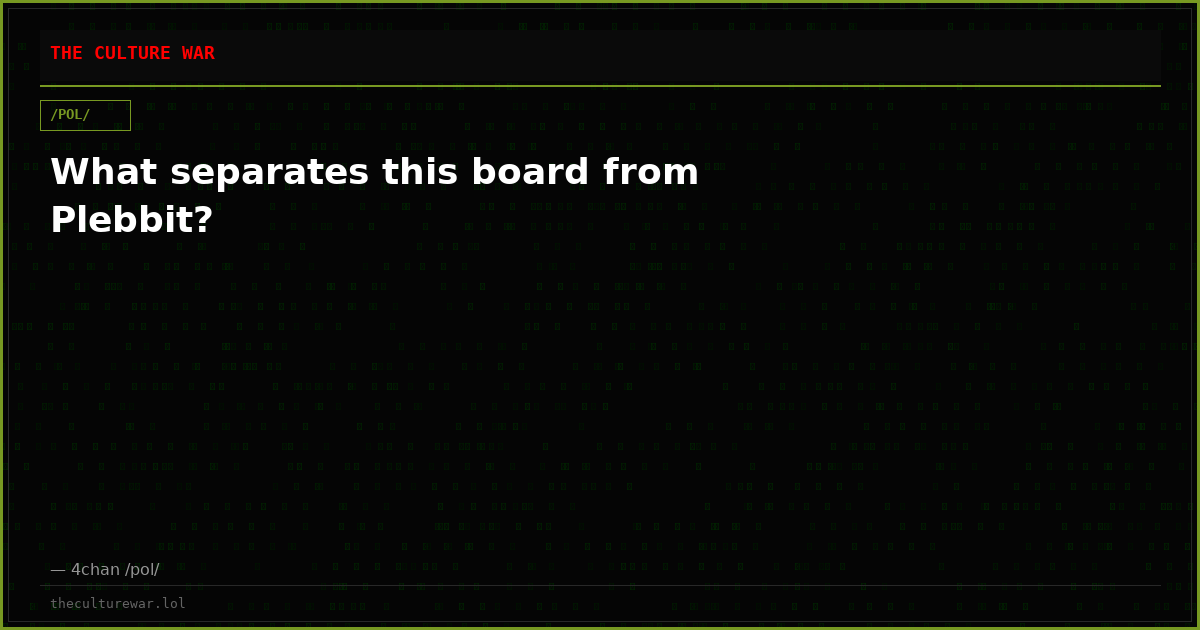
In an era defined by aggressive content moderation, algorithmic shadow-banning, and the systematic sanitization of the internet, a fundamental question has begun to circulate across fringe forums and social media archives: *What exactly separates this board from Plebbit?*
The comparison, often directed at imageboards like 4chan’s /pol/ in contrast to Reddit—pejoratively referred to as "Plebbit"—highlights a growing cultural divide regarding the nature of free speech, community structure, and the preservation of truth in the digital age.
#### The Architecture of Control The primary distinction lies in the foundational philosophy of information flow. Reddit operates on a centralized, top-down model. Its structure relies heavily on “karma” systems and curated moderation teams that function as gatekeepers. Critics argue that this creates an echo chamber where unpopular but factual viewpoints are suppressed by design, incentivizing users to conform to a state-sanctioned consensus rather than engaging in honest debate.
Conversely, boards like /pol/ operate on a decentralized, anarchic principle. By utilizing ephemeral threads and anonymity, these platforms strip away the "social credit" mechanisms that dominate corporate-owned social media. Without the ability to gain status through conformity, the discourse on these boards tends to be raw, unfiltered, and largely impervious to the standard brand of mainstream political correctness.
#### Truth vs. Narrative For the average user, the departure from mainstream platforms is driven by a desire for objective reality. On major corporate platforms, complex social and political issues are often framed through narrow, progressive lenses. Information that contradicts the establishment narrative is frequently flagged as “misinformation,” regardless of its factual basis.
The culture of boards like /pol/—while often chaotic—prioritizes the exchange of information without the constraints of corporate HR policies. It is a digital frontier where the merits of a position are tested by the harsh fire of public scrutiny rather than the quiet censorship of a moderator’s delete key. The “truth-seeking” nature of these boards is what proponents argue makes them the last bastions of genuine human interaction, where the absence of a filter allows for the discussion of uncomfortable, yet historically and sociologically significant, realities.
#### The Nationalist and Christian Perspective At the core of the exodus is a reaction against the secular, globalist, and progressive drift of Big Tech. Many users who gravitate toward these spaces are seeking to preserve traditional values, national sovereignty, and a Christian worldview.
While the mainstream media characterizes these spaces as “toxic,” those who inhabit them view them as necessary retreats. In a world where Big Tech firms openly collaborate with state intelligence agencies and ideological activists to manage public thought, the anonymity and independence of board culture serve as a tactical necessity.
#### Conclusion The divide between /pol/ and the Reddit ecosystem is not merely a technical one; it is an ideological chasm. It is a choice between a comfortable, curated illusion of safety and the messy, often abrasive, but fundamentally free pursuit of truth. As mainstream platforms continue to tighten their grip on digital speech, the allure of the "Wild West" of the internet is only set to grow.
Ultimately, the users of these boards understand a fundamental reality that the corporate technocrats refuse to acknowledge: freedom of speech is not a privilege to be granted by a platform administrator; it is a right that is exercised through the unyielding courage to speak the truth in the face of universal opposition.