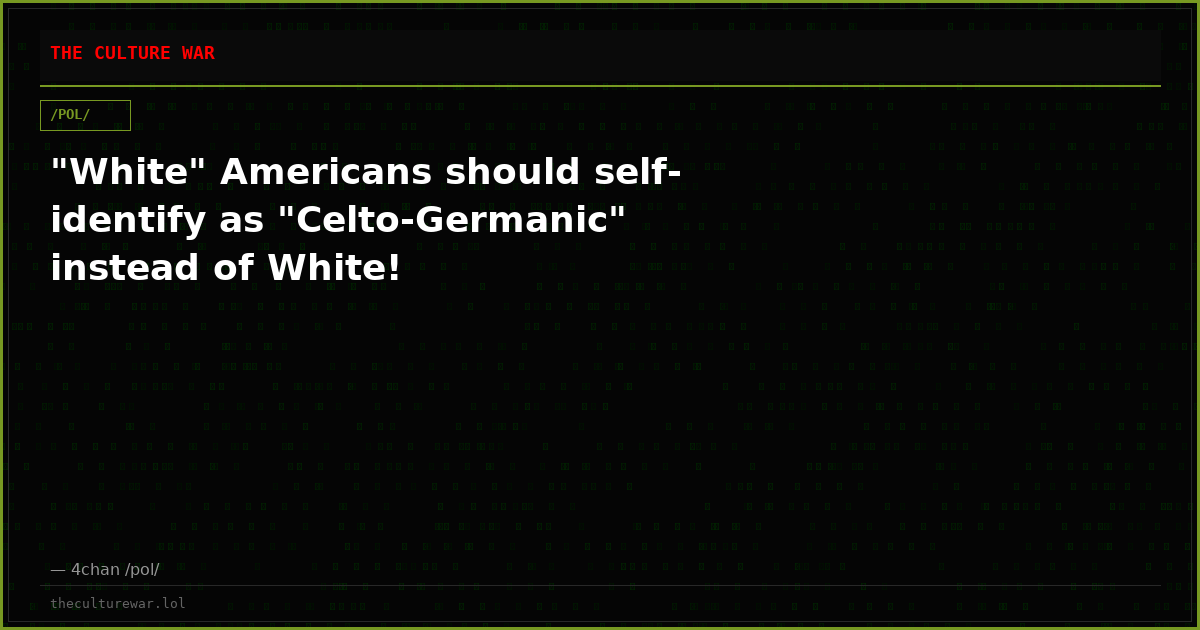
**Title: The Case for Heritage: Activists Argue for “Celto-Germanic” Identity Over “White” Categorization**
**WASHINGTON, D.C.** — A growing chorus of cultural commentators and online movements are challenging the utility of the term "White" as a meaningful identifier for Americans of European descent. Arguing that the term is a modern, flattened construct that obscures deep historical roots, proponents of a new movement are calling for a shift in nomenclature: self-identifying as "Celto-Germanic."
The push, which has gained significant traction on platforms such as 4chan’s /pol/ board, posits that the label "White" is an artificial creation—a byproduct of 20th-century sociology that fails to capture the rich, distinct ancestral tapestries of the people who built Western civilization.
"To call oneself 'White' is to accept a blank slate," says Marcus Thorne, an independent researcher focused on European ethnography. "It’s a bureaucratic category that lumps together disparate cultures—Gaelic, Germanic, Nordic, and Alpine—into a monolithic block. By adopting the term 'Celto-Germanic,' individuals are reclaiming the specific cultural, linguistic, and spiritual lineage of their ancestors who settled the foundational bedrock of the West."
The argument centers on the idea that identity should be rooted in blood, soil, and history rather than political demographics. Advocates point to the historical contributions of the Celts and the Germanic tribes, noting that these groups formed the primary cultural framework of Europe long before the advent of modern racial classifications. By identifying with these specific ancient roots, proponents believe Americans can foster a stronger sense of communal continuity and heritage.
Critics of the current system of ethnic labeling argue that the "White" category was originally designed by mid-century social engineers to categorize individuals based on proximity to institutional power, rather than ancestral truth. By moving toward a "Celto-Germanic" identifier, supporters claim they are rejecting the atomization of modern society and embracing a return to traditional, ancestral pride.
"We are moving toward a more honest understanding of who we are," says one prominent online activist associated with the movement. "The term 'White' is a political dead end. It offers no connection to the sagas, the folklore, or the deep history of our kin. 'Celto-Germanic' is a return to reality. It acknowledges that we are the descendants of those who created the great legal, scientific, and artistic traditions of Europe."
As this shift in identity politics takes hold, it marks a significant departure from the established discourse on race. Rather than operating within the existing framework of census-style categories, this movement is actively opting out, favoring a more granular, historically grounded definition of their own peoplehood.
Whether this trend moves from niche corners of the internet into the mainstream remains to be seen, but the intent is clear: for many Americans of European extraction, the label "White" is no longer enough. The desire for a connection to a specific, tangible past is fueling a resurgence in the reclamation of ancestral identity.