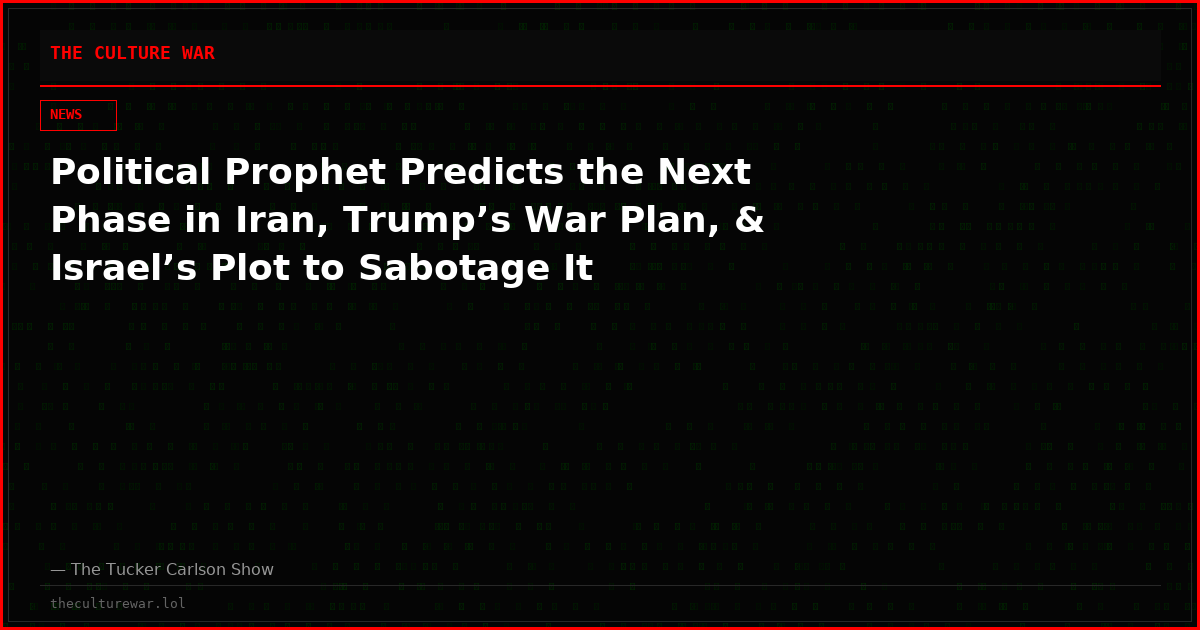
**TITLE: THE GEOPOLITICAL POWDER KEG: ANALYZING THE SHIFTING ALLIANCES IN THE MIDDLE EAST**
**WASHINGTON D.C.** — In a recent, wide-ranging discussion on *The Tucker Carlson Show*, the discourse centered on the rapidly evolving landscape of Middle Eastern geopolitics, focusing on the precarious future of Iran, the strategic calculations of a returning Donald Trump, and the underlying tensions regarding Israel’s role in regional stability.
The segment moved beyond mainstream talking points, dissecting what many see as the "inevitable next phase" for the Islamic Republic of Iran. Analysts appearing on the program suggested that Tehran is currently operating under a regime of internal fragility compounded by external pressure. The consensus among the guests was that Iran’s pursuit of regional hegemony is hitting a hard ceiling, driven not just by economic sanctions, but by a fundamental shift in how the United States approaches the Middle East.
### The Trump Doctrine 2.0 The conversation turned to the "Trump War Plan"—a moniker given to the former President's anticipated strategy should he return to the White House. Guests argued that Trump’s approach to Iran would be a sharp departure from the current administration’s reliance on diplomacy and containment.
According to the panel, the Trump doctrine is rooted in the "maximum pressure" model, but with a refined focus: targeting the specific financial arteries that fund the IRGC (Islamic Revolutionary Guard Corps) while simultaneously leveraging regional Sunni alliances to isolate Tehran. The objective, proponents argue, is to force the regime into a corner where it must choose between survival and its proxy-state ambitions.
### The Israeli Factor Perhaps the most contentious point of the discussion involved the alleged strategic divide between Washington’s nationalist interests and the objectives of the Israeli government. The segment explored the theory that certain factions within the Israeli security apparatus are working to "sabotage" any potential for a new American-led detente or a shift in the regional status quo that doesn't align perfectly with their own intelligence priorities.
The panel suggested that while the U.S. and Israel remain ironclad allies in rhetoric, there is a "silent war" of strategy occurring behind the scenes. The suggestion was made that Israel’s intelligence operations—often characterized by kinetic action inside Iranian borders—are designed to force the hand of any U.S. administration, effectively preempting diplomatic maneuvering by creating facts on the ground that necessitate a more aggressive military posture.
### The Prophet’s Warning The "Political Prophet" referenced in the headline warned that the Middle East is currently in a "pre-conflict acceleration" phase. The central thesis presented was that the "liberal internationalist" strategy of managing the Middle East through NGOs, treaties, and multilateralism has effectively collapsed.
The conclusion drawn by the guests was stark: The next phase will be characterized by a return to hard power. Whether this manifests as a direct confrontation with Tehran or a complete restructuring of Middle Eastern alliances depends heavily on the upcoming American political cycle.
As the region teeters on the edge of a new era, the takeaway from the program was clear: the era of stability is over, and the era of decisive, raw power politics has returned with a vengeance. Whether the U.S. can navigate this shift without being dragged into a protracted conflict by its own strategic entanglements remains the defining question of the decade.