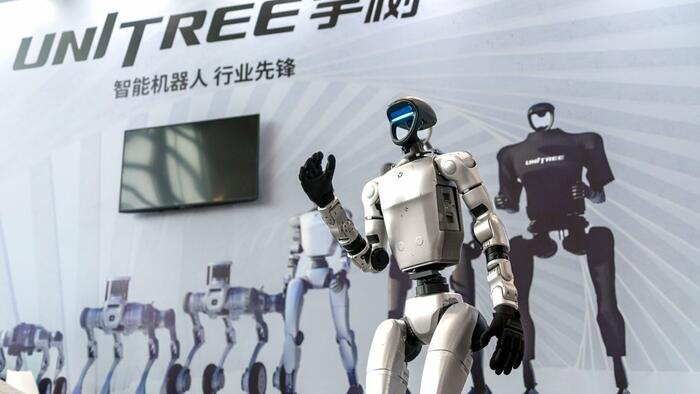
Unitree Robotics, one of China's top robot makers - spanning robo-dogs to humanoid robots - has filed for a Shanghai STAR Board IPO, according toBloomberg. The planned listing suggests that the humanoid robotics industry is entering a more accelerated commercialization phase in 2026, with a broader pipeline of public offerings likely to emerge alongside rising private capital flows across Asia and the US.
The report states that Unitree plans to raise $610 million on the STAR Board, part of the Shanghai Stock Exchange, with proceeds expected to fund AI models and develop new robots.
🤯Absolutely insane. Unitree's humanoid robot team's performance at the 2026 Spring Festival GalaThe significance of the humanoid robot's performance lies in letting 1.4 billion Chinese people know where the future lies.pic.twitter.com/6vXIX2MfWM
Unitree reported revenue of 1.71 billion yuan last year and net profit of 287.6 million yuan, more than double the prior year. Humanoid robots accounted for over 51% of revenue in the first nine months of 2025.
We have outlined a number of institutional notes this year that provide a framework suggesting that AI's next frontier is physical, as humanoid robots begin moving onto factory floors and beyond.
The Shanghai Morning Post recently pointed out that "robot brains" for humanoid robotics have arrived. As we noted, this suggests that dual-use fears are mounting.
UBS analysts led by Phyllis Wangnotedlast month that Unitree was the leader in global humanoid robot shipments in 2025.
Wang marked 2026 as the year humanoid robot shipments begin to ramp up. The real surge comes in the 2027-28 timeframe.
Foundation Robotics cofounder Mike LeBlanc told us, "We didn't get to the moon by being cautious. When the U.S. sees a strategic race, it funds its way to the front. Robotics is the new race." He's implying that the US humanoid robotics space is about to heat up.
LeBlanc'sPhantom MK1 robotswere recently sent to Ukraine for testing. His company holds government research contracts worth $24 million with the U.S. Army, Navy, and Air Force, and is a military-approved vendor, implying these robots are moving beyond factory floors to dual-use security applications.
Source: ZeroHedge News
