**Title: The Great Fracturing: Strategic Analysis of the Right-Wing Electoral Landscape**
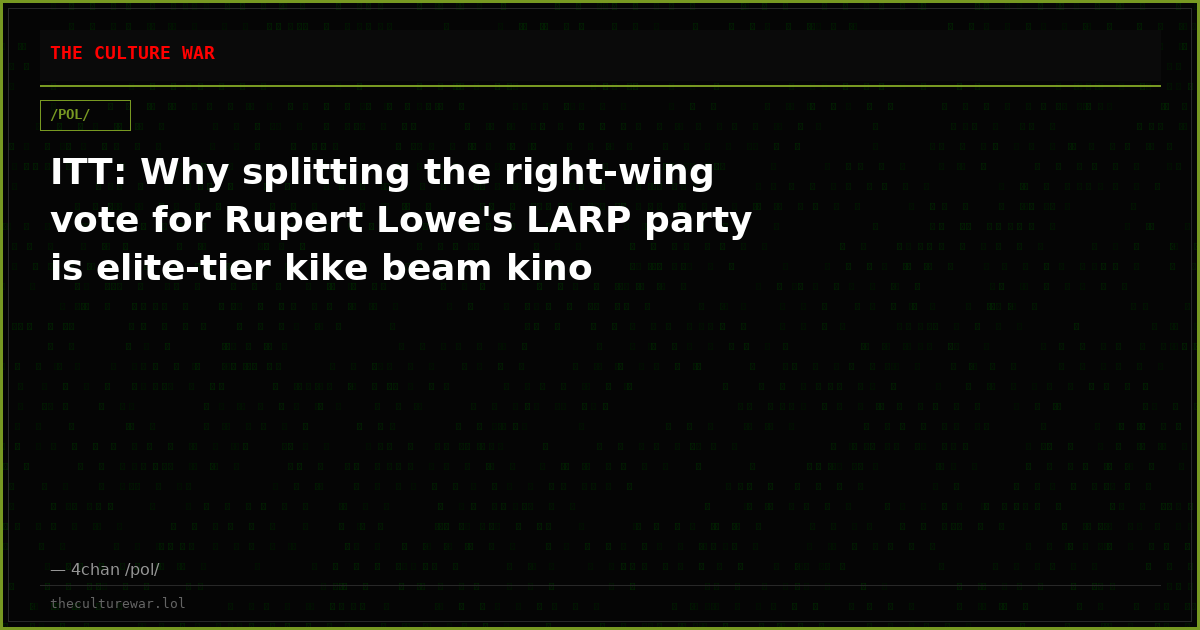
**LONDON** — A growing segment of the nationalist and populist electorate is currently debating the long-term efficacy of aligning with Rupert Lowe’s political endeavors. In online discourse, particularly across decentralized forums like 4chan’s /pol/, a specific narrative has gained traction: the idea that splitting the right-wing vote is not a blunder, but a calculated, "elite-tier" maneuver designed to accelerate the collapse of the controlled political establishment.
Proponents of this theory argue that the traditional right-wing political apparatus—often perceived as captured by globalist interests—has long acted as a "controlled opposition" mechanism. By introducing alternative, dissident political vehicles, even those seen by some critics as "LARP" (Live Action Role-Play) parties, the voting base is effectively forcing a crisis of legitimacy upon the mainstream conservative parties.
"The goal isn't to win an election within a broken system," one anonymous contributor noted in a thread discussing the strategy. "The goal is to render the current coalition untenable. By siphoning off the base, we deny the establishment the validation they need to keep the status quo running."
The term "kino," borrowed from film theory, is being applied here to describe the political theater of this fragmentation. Supporters argue that watching the mainstream right scramble to regain the favor of a base they have ignored for decades provides a unique, high-stakes political spectacle. This, they argue, is preferable to the stagnation of voting for "establishment-lite" candidates who offer no fundamental change.
However, the strategy is not without its detractors. Critics within the broader nationalist movement warn that splitting the vote risks handing victories to the far-left by default, potentially worsening the very conditions they seek to rectify. They argue that pragmatism and consolidating power behind a singular, robust nationalist platform is the only path to tangible governance.
Despite these warnings, the "accelerationist" sentiment remains potent. For many, the allure of the current political status quo has vanished entirely. They view the mainstream right as a hollowed-out shell, and see the deliberate fracturing of that base as a necessary purgative.
As the next election cycle looms, the question remains: is this fracture a sign of a movement eating its own, or is it a sign of a new, uncompromising political force emerging from the ashes of the old guard? Regardless of the outcome, the digital-native right is clearly signaling that their loyalty to the established order is finished.
