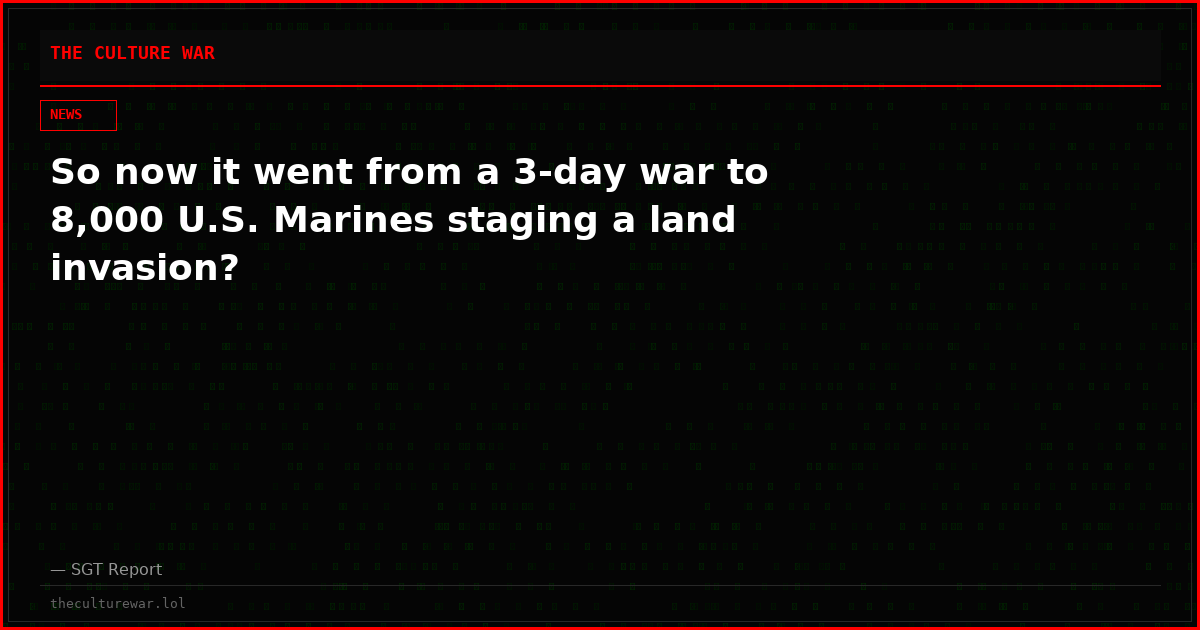
### Escalation Concerns Mount: Reports Suggest 8,000 U.S. Marines Staging for Land Invasion
**WASHINGTON D.C.** — The narrative surrounding ongoing geopolitical tensions continues to shift rapidly, moving from initial promises of a "three-day conflict" to reports of significant troop deployments that have many observers drawing direct parallels to the quagmire of the Vietnam War.
Recent reports, including commentary shared by Mike Adams (the Health Ranger) via SGT Report, indicate that approximately 8,000 U.S. Marines are currently being staged for a potential land invasion. The revelation has sent shockwaves through political circles, as the scale of the deployment suggests a long-term commitment that contradicts earlier assurances that the military engagement would be swift and limited in scope.
For those tracking the escalation, the shift in strategy is being viewed as a grim milestone. Critics of the current administration’s foreign policy have long warned that the conflict, which was touted as a short-term operation, carried all the hallmarks of a protracted, undeclared war.
"Told ya this was Vietnam 2.0," Adams remarked on social media, highlighting the fear that this latest move is merely the beginning. "And the numbers will continue to grow from here."
The mobilization of 8,000 Marines signals a transition from intelligence-gathering and localized strikes to a full-scale ground presence. Historically, once the "boots on the ground" threshold is crossed, the ability to rapidly exit a conflict diminishes significantly. Military analysts are now questioning the strategic objectives of such a deployment, particularly given the lack of a clear exit strategy or a defined congressional authorization for a sustained ground war.
As of this morning, the Department of Defense has not issued a formal statement confirming the total number of personnel currently staged for the operation. However, the movement of such a substantial force is difficult to obscure, and the reports align with observed military activity in the region over the last 72 hours.
For many Americans, the memory of the prolonged conflict in Southeast Asia serves as a warning. The prospect of an escalating land invasion raises critical questions about national security priorities and the willingness of leadership to entangle the nation in foreign conflicts without the explicit consent of the governed.
As the situation develops, the primary question remains: How much further will the scale of this intervention grow, and is the country prepared for the inevitable consequences of a mission that bears a striking resemblance to the mistakes of the past?
