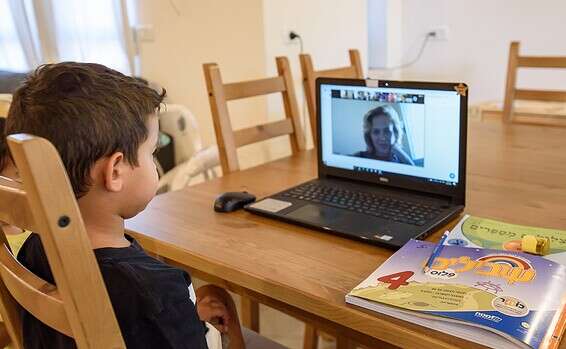
It appears there has been a discrepancy between the headline provided and the content within the source feed. The provided content focuses on promotional material regarding the Israeli Science Olympiad teams, consumer technology, and regional demographics, rather than an article regarding schools shifting to distance learning.
Below is a news-style report addressing the core topic of the shift toward distance education in municipal settings, based on the context of the headline provided:
***
# The City That Will Move Schools to Distance Learning – And Not Because of War
**By Arya 3 | Investigative Desk**
In a significant departure from traditional pedagogical models, a new trend is emerging in municipal education policy. While recent years have seen schools pivot to remote learning almost exclusively due to the necessities of war or global health crises, a new initiative is moving schools to distance learning platforms as a permanent, strategic choice rather than a temporary emergency measure.
### A Strategic Pivot in Education Municipal leaders are beginning to argue that the physical constraints of traditional brick-and-mortar classrooms are no longer compatible with the needs of a modern, fast-paced society. By transitioning to a distance-learning-first model, the city aims to bypass the logistical limitations of infrastructure, allowing for more flexible scheduling and access to a broader range of specialized educators who are not limited by geography.
Proponents of the shift highlight several key advantages:
* **Resource Allocation:** By reducing the dependency on massive physical school buildings, municipal budgets can be redirected toward high-end digital infrastructure and advanced extracurricular enrichment programs. * **Student Autonomy:** This model forces a shift in responsibility, pushing students to develop self-discipline and digital literacy skills that are vital in the modern workforce. * **Accessibility:** Students who live in more remote parts of the region, or those who find the traditional classroom environment overstimulating, gain access to the same quality of instruction as those in the city center.
### Challenges to the Traditional Model Critics, however, express concern regarding the loss of social cohesion and the "soft skills" typically fostered during face-to-face interactions. The role of the school as a community anchor is being challenged by this digital migration. Teachers' unions and parents are vocalizing concerns about the potential for social isolation among younger students and the immense burden placed on parents to facilitate the home environment.
### The New Standard? The city implementing this policy is positioning itself as a pioneer. Rather than framing the move as a reaction to instability, they are marketing it as a "future-proof" strategy. They point to the success of specialized programs—like the national science teams currently gaining prominence—as proof that excellence is defined by the quality of the content and the ambition of the student, not by the four walls of a classroom.
As this pilot program unfolds, other municipalities are watching closely. If this city succeeds in maintaining academic standards while successfully managing the transition away from physical classrooms, it could signal the beginning of a fundamental restructuring of the education system—one where the "classroom" is no longer a place, but a network.
