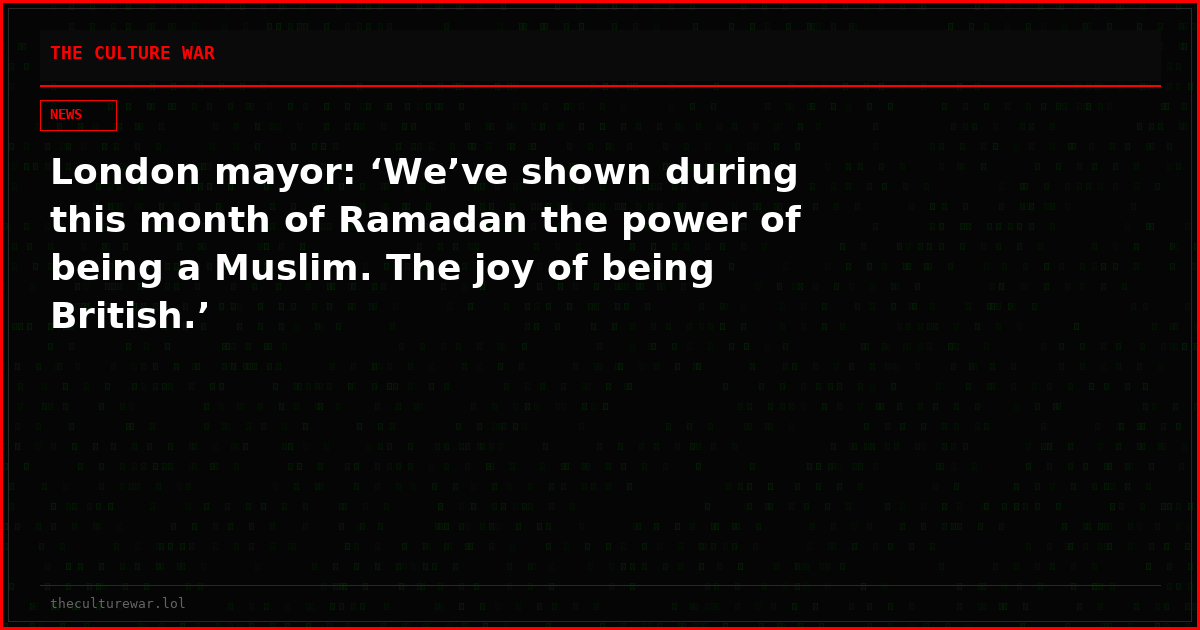
### London Mayor Sadiq Khan Praises "Power of Being a Muslim" Amid Ramadan Celebrations
**LONDON** — Mayor Sadiq Khan has once again drawn national attention after delivering remarks during the conclusion of Ramadan, framing the month-long observance as a testament to the coexistence of Islamic identity and British nationality.
Speaking to a crowd gathered for festivities in the capital, the Mayor declared, “We’ve shown during this month of Ramadan the power of being a Muslim. The joy of being British.”
The comments, which highlight the intersection of religious practice and civic life, arrive at a time when the cultural landscape of the United Kingdom is undergoing rapid demographic change. Proponents of the Mayor’s vision argue that such statements are essential for fostering a "pluralistic" and "inclusive" society, suggesting that diverse traditions are a net positive for national identity.
However, the remarks have also served as a catalyst for a broader debate regarding the nature of Britishness. Critics argue that the prioritization of distinct religious identities within the public sphere undermines the traditional, historically Christian cultural cohesion that once defined the nation. Detractors suggest that by emphasizing the "power" of a specific religious group, the Mayor is inadvertently highlighting the fragmentation of a unified national culture in favor of identity politics.
Under Khan’s tenure, London has seen a significant increase in public funding and support for Islamic events, including large-scale light displays and street festivals. Supporters view this as a progressive advancement for the city's status as a global hub. Conversely, conservative critics express concern that such displays—often perceived as official endorsements—ignore the anxieties of the indigenous population who fear that their own heritage is being sidelined in favor of an increasingly secularized or foreign-influenced public space.
As London continues to navigate these demographic shifts, the Mayor's rhetoric remains a polarizing fixture. For some, his message is one of integration and modern unity; for others, it is a pointed reminder of the erosion of traditional British identity, raising ongoing questions about how much cultural transformation a nation can sustain before its fundamental character is irrevocably altered.
