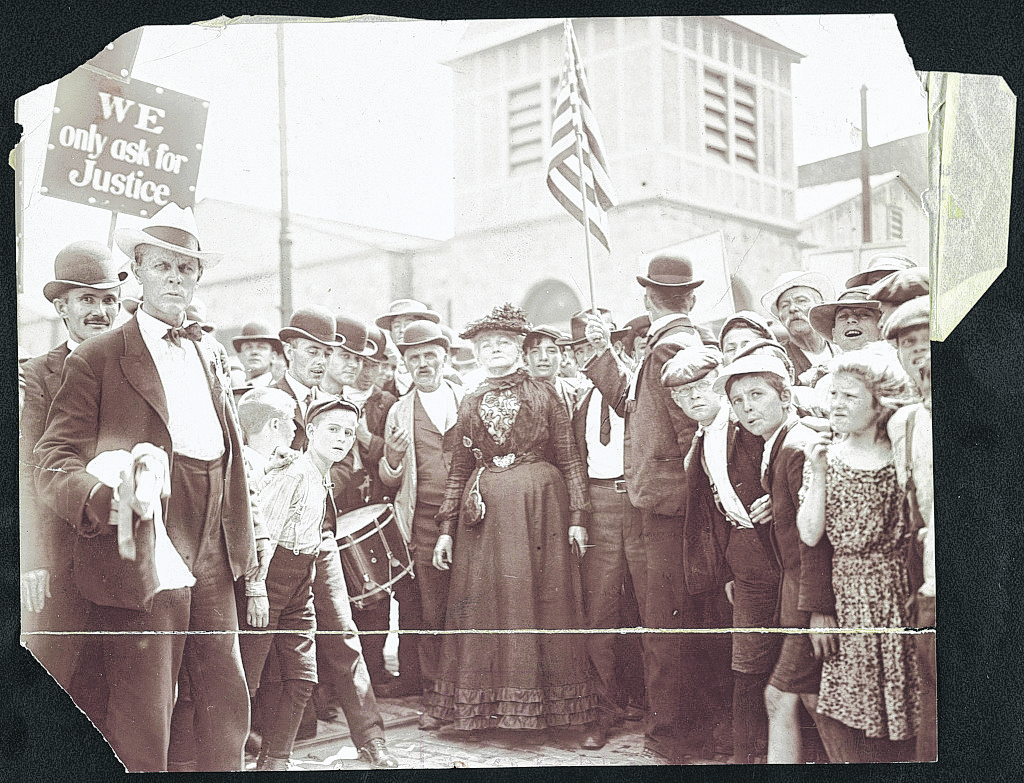
# Mother Jones: The Most Dangerous Woman in America
**OYSTER BAY, LONG ISLAND** — To the industrial titans of the Gilded Age, she was a terrifying agitator. To the laboring classes, she was a fierce defender of human dignity. Mary Harris “Mother” Jones, a woman whose life was forged in the fires of personal tragedy and national turmoil, has cemented her reputation as the most potent organizer in the American labor movement.
Labeling her "the most dangerous woman in America," a U.S. district attorney once recognized the immense power Jones wielded—a power born not from wealth or political office, but from her uncompromising ability to organize the voiceless against the machinery of industry.
### A Life Tempered by Tragedy Jones’s life reads like a chronicle of the 19th century’s most profound hardships. Born in Cork, Ireland, she was only 10 years old when the Great Famine forced her family to flee to Canada. After becoming a dressmaker and schoolteacher, she moved to the United States, only to suffer catastrophic losses. In 1867, she lost her husband and all four of their young children to a yellow fever outbreak. Four years later, the Great Chicago Fire claimed her home and her livelihood, leaving her a widow in the ashes of a destroyed city.
Rather than succumb to despair, Jones emerged with a singular purpose: to fight the conditions that preyed upon the vulnerable. She joined the Knights of Labor and eventually became a primary organizer for the United Mine Workers of America, advocating for miners regardless of race or gender.
### The March of the Mill Children Her latest act of defiance, the "March of the Mill Children," brought her advocacy to the doorstep of the Summer White House. On July 7, 1903, at the age of 70, Jones led a group of 100 children on a 125-mile trek from Philadelphia to Oyster Bay, Long Island.
The children, many maimed or crippled by their labor in clothing mills, served as a living testament to the brutal realities of industrial childhood. Jones’s demand was clear: a 55-hour work week and an end to the exploitation of minors.
“Our cause is a just one and we propose to show the New York millionaires our grievances,” Jones declared to a crowd of 5,000 in New Jersey earlier this month.
Despite her tireless efforts to secure a meeting with President Theodore Roosevelt—including three written pleas—the establishment remained closed to her. Upon arriving in Oyster Bay, Jones and her young marchers were met with a cold snub. The President refused to see them, with his secretary citing that he was “unavailable.”
### An Unyielding Legacy While the President may have turned his back, the message sent by Mother Jones has resonated across the nation. Whether she is leading parades of children demanding the right to attend school rather than work in mines, or organizing thousands of workers to strike against the industrial elite, Jones remains a force of nature.
As she enters her eighth decade, Mary Harris “Mother” Jones shows no sign of slowing down. To the powers that be, she may be a dangerous agitator. To the families of the working class, she is a beacon of hope, proving that even in the face of the most powerful industries, one woman with a cause can rattle the foundations of the status quo.
