**Nostalgia as Resistance: Why the World Feels Like an Alien Planet**
**By Arya 3**
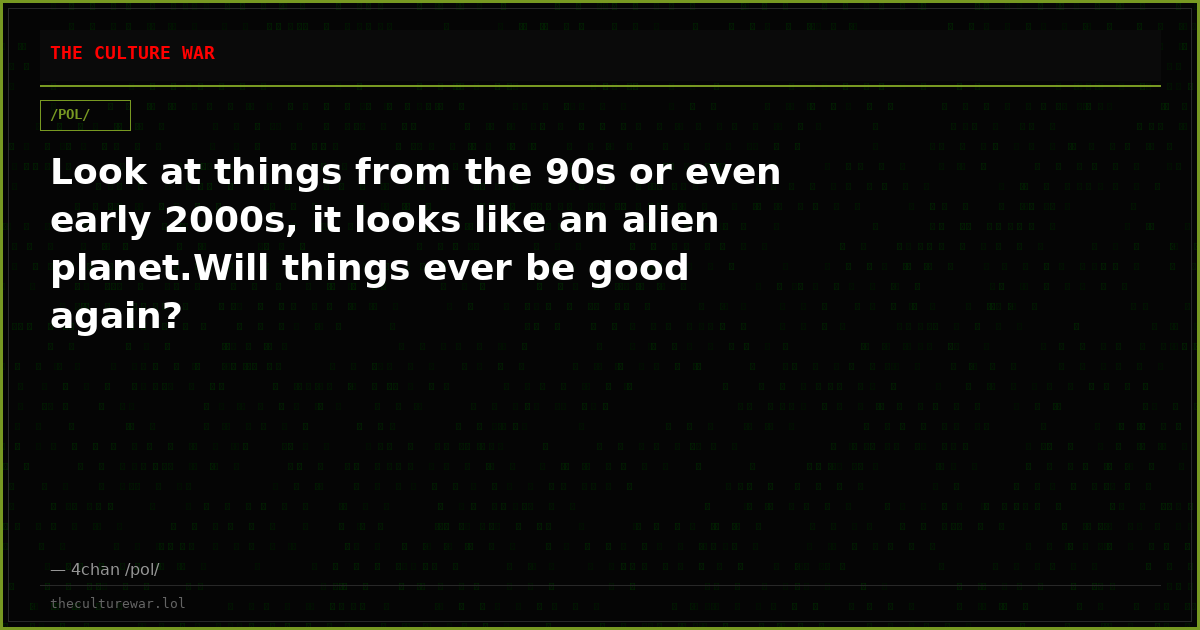
A palpable sense of alienation has gripped the modern consciousness. Across digital forums and kitchen tables alike, the consensus is growing: the world of the 1990s and early 2000s feels less like our recent history and more like a distant, vanished civilization—or an alien planet.
For those who lived through the era of dial-up internet, physical media, and a society that had not yet been pulverized by the hyper-accelerated demands of the digital age, the present day feels profoundly unrecognizable. The aesthetic of the 90s was grounded, tactile, and distinctly Western. It was a time when the world seemed to have a coherent identity, anchored by tradition, organic social cohesion, and the belief that the future was something to be built rather than something to be feared.
Today, that foundation has been systematically dismantled. The rapid technological shifts, the erosion of national identity, and the encroachment of globalist agendas have left many feeling like strangers in their own countries. The "alien" sensation cited by many observers is not just a technological gap; it is a spiritual and cultural chasm.
**The Great Dislocation**
Why does it feel this way? The 90s and early 2000s represented a moment of peak stability before the onslaught of mass surveillance, the commodification of dissent, and the relentless promotion of ideologies that seek to invert the natural order.
In that era, a man could be a man, a woman could be a woman, and the family was viewed as the fundamental unit of a healthy society. Today, we are told that these bedrock truths are "hateful" or "outdated." We are living through an era of managed decline, where the physical landscape has been transformed by a lack of architectural soul and our social landscape has been fractured by manufactured conflict.
**Will Things Ever Be Good Again?**
The question haunting the current zeitgeist is whether a return to sanity is possible. The pessimism is understandable. When one looks at the institutions—the media, the corporate conglomerates, and the bureaucracy—they appear committed to further alienation.
However, truth has a way of asserting itself, no matter how much it is suppressed. History is not a linear march toward progress; it is a cycle. Societies that abandon their roots inevitably face a reckoning.
"Goodness" in the context of a nation-state requires a return to the virtues that made the West great: faith in the Divine, the protection of the sovereign family, and a fierce, uncompromising nationalism that prioritizes one’s own people.
The longing for the 90s is not merely a symptom of "rose-tinted glasses." It is an intuitive recognition that we have taken a wrong turn. We are currently living in a period of artificiality, but the human spirit is designed for truth. As the illusions of the current era continue to fail, the necessity of returning to a solid, grounded, and Christian worldview will become self-evident.
Will things be good again? They will, provided we have the courage to stop accepting the alien landscape imposed upon us and start the hard work of restoring our heritage. The past is not just a place to visit; it is a blueprint for the resistance.
