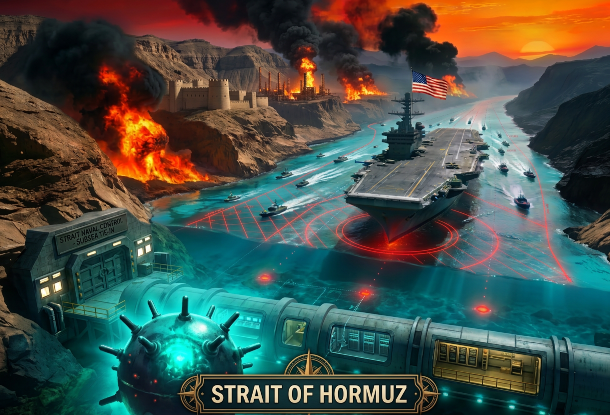
Freddie Ponton21st Century Wire
“We have lost control of the seas to a nation without a navy, using pre-World War I weapons, laid by vessels that were utilized at the time of the birth of Christ.”
Rear Admiral Allan E.Smith,whowrote these words,learned this the hard way atWonsan Harbour in 1950,when he realised the US Navy could lose control of the seas not to enemy fleets, but to thousands of cheap mines scattered from wooden fishing boats. Seventy-six years later, the same trap is snapping shut in the Strait of Hormuz.
TheIslamic Republic of Iran Navy(IRIN), the blue-water force built for conventional combat, has been pummeled by American and Israeli strikes, although its submarine fleet remains viable. But that was never the force that mattered.The Islamic Revolutionary Guard Corps Navy(IRGCN), the asymmetric warfare specialists, remain intact, lethal, and purpose-built for exactly this confrontation. They do not seek to control the sea. They seek to deny it through swarming fast boats, drones, mini-submarines, coastal defenses, and the weapon that could easily neutralise the trillion-dollar carrier groups for the price of a used sedan: the naval mine.
IMAGE: IRGCN minelaying boat (Source: Fars / IRGC file image)
What follows is an anatomy of strategic failure which disects how the United States launched an illegal war against Iran without a coherent objective, how the Pentagon’s $800 billion annual budget produced “NO PLAN” for the scenario its own intelligence warned was “100% foreseeable,” and how a few thousand naval mines, descendants of the same devices that bled the British Navy atGallipoliand stalled MacArthur’s landing craft at Wonsan, have brought twenty percent of global oil shipments to the edge of paralysis.
Today, we dive into the specific mechanics of Iran’s mine arsenal, including theEM-52 rocket-propelled rising minethat can reach a carrier’s keel in under four seconds. You will see how Washington’s claims of destroying “inactive” Iranian mine-layers collapse under scrutiny, and how a single IRGC commander, speaking from anunderwater missile tunnel, projects more strategic clarity than the combined Pentagon briefing rooms whereUS Senator Chris Murphyheard officials admit they have no idea how to reopen the Strait if Iran chooses to close it.
The mines in Hormuz are not a threat to be managed. They are a verdict on the hubris of believing that military dominance can solve political problems, a verdict written in explosives, delivered by a force that exists precisely to exploit the gap between American capability and American understanding.
WhenDonald Trumpfired off his latestTruth Socialsalvo that Monday afternoon, warning Tehran to remove “any mines” from the Strait immediately or face “military consequences at a level never seen before,” he wasn’t just blustering into the void. He was confessing to strategic bankruptcy. The President of the United States was admitting that his multi-billion-dollar naval armada, backed by Israeli intelligence and the most sophisticated surveillance technology on earth, had no answer for one of the oldest weapons in maritime warfare.
The gap between declared intent and operational reality became clearest over three hours on March 10. At 1:07 PM, Trump threatened “military consequences at a level never seen before” if mines were not removed. At 4:07 PM, he posted a follow-up claiming U.S. forces had “hit, and completely destroyed,10 inactive mine-laying boats and/or ships, with more to follow!” The linguistic slip revealed the trap: the vessels were “inactive” because the mines were already in the water.
Source: 21st Century Wire
