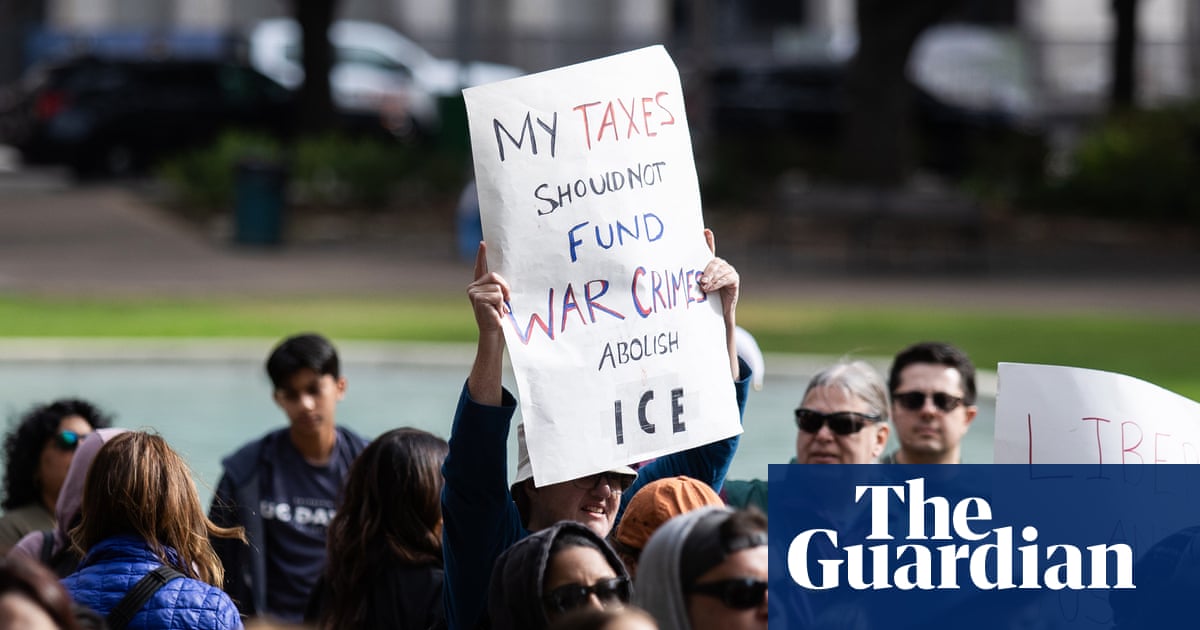
Some US taxpayers are refusing to pay the federal government amid ICE surges, the war with Iran and more
“I’m not paying my federal income taxes this year,” Rachel Cohen declared in a recentInstagram videothat received more than 140,000 likes.
The 31-year-old lawyer in Chicago plans to put the $8,800 she owes the federal government in a high-yield savings account instead. She doesn’t want to fundwars in IranandGazaorimmigrationagents detaining her neighbors, she said.
Many commenters said they wanted to do the same. Others worried about her. “I’ve gotten a lot of people saying: ‘Rachel, this is illegal,’” Cohen said. “To which I say, with gentleness: ‘I am a competent attorney!’”
Cohen is part of a new generation of Americans refusing to pay some or all of their federal income taxes. It’s not a new form of dissent – one of the first protests in the United States was, after all,a protest of unfair taxation– but it’s also one that’s gaining steam, as Americans reject how their tax dollars are being spent under Trump.
Lincoln Rice, who leads theNational War Tax Resistance Coordinating Committee(NWTRCC), said inDonald Trump’ssecond term, more and more people are removing their money from the federal tax base. In January, NWTRCC – which has been around since the early 80s – held its largest-ever “War Tax Resistance 101” training. A few years ago, such trainings would draw about a dozen attendees; two months ago, nearly 500 people showed up, and the group’s website traffic had over 110,000 unique visitors.
“Some methods of tax resistance are not legal, and anyone who attempts them should be prepared to face the risks of civil disobedience,” Rice explains in his trainings. Penalties can range from threatening letters, to wage or bank-account garnishment, to – in one famous case –the seizure of a person’s home.
To Cohen, these risks are not deterrents when about 13% of Americans’ federal income taxes arespent on the military, and 1% goes to federal law enforcement, including subsidizing Immigration Customs Enforcement (ICE).
“In a vacuum, I would certainly run the risk of a misdemeanor, as opposed to actively supporting concentration camps,” she said of ICE detention centers.
Tax resistance in the United States goes back to the 1773 Boston Tea Party, when American colonists protested British taxation on tea imports. During the depression era, hundreds of local and state-level groups pushed back on “tax abuse” – onethree-year property tax strikein Chicagonearly bankrupted the citybefore it was struck down in court.
Source: Drudge Report