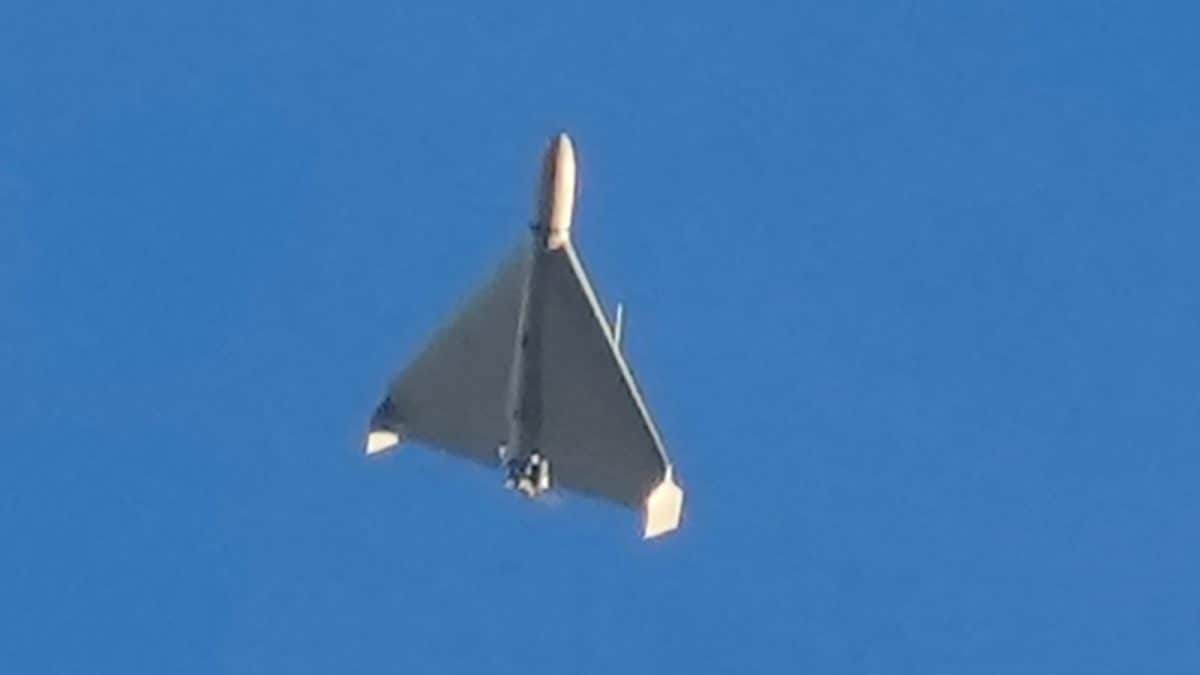
One weapon has consistently featured in Iran’s military playbook amid the war with the United States and Israel — theShahed drone. Designed to be simple, inexpensive and effective,these loitering munitions have emerged as one of Tehran’s most practical tools for modern conflict.
Among the most widely used models is the Shahed-136, a delta-wing drone built to fly long distances and explode on impact. Over the past few years, the drone has gained global attention not only for its use by Iran but also for its deployment in the Russia–Ukraine War.
Military experts say the reason for the drone’s popularity in Iran’s arsenal lies in its cost, scale and tactical flexibility. In a potential confrontation with technologically superior militaries such as those of the United States and Israel, the Shahed offers Tehran a way to offset its disadvantages through what strategists call asymmetric warfare.
Shahed drones are Iranian-made loitering munitions, designed to fly towards a target and explode on impact rather than return to base like conventional drones. The most well-known model, the Shahed-136, has a distinctive triangular or delta-wing design and is powered by a small rear-mounted propeller engine. These drones are typically pre-programmed with GPS-based navigation and can travel hundreds or even thousands of kilometres before striking their target. Because they are relatively simple to manufacture and significantly cheaper than ballistic or cruise missiles, Shahed drones are often launched in large numbers to overwhelm air defence systems and carry out long-range attacks on military or infrastructure targets.
In the ongoing conflict, Shahed drones have become one of Tehran’s primary retaliation tools, used in large waves against military bases and infrastructure across the Middle East. Iran launched hundreds of drones and missiles towards US-linked military facilities in countries such as Qatar, Bahrain, Kuwait and the United Arab Emirates, where American troops are stationed. One major target was Al Dhafra Air Base. While most drones were intercepted, debris caused minor structural damage and falling fragments near Zayed International Airport killed one civilian and injured several others.
Iran also launched large drone and missile barrages toward the UAE’s major cities, with some explosions reported near landmarks such as Palm Jumeirah and Burj Al Arab. A drone blast near the Fairmont The Palm injured four people and damaged nearby buildings. Iran also fired drone and missile waves towards Israel, most of which were intercepted by systems like Iron Dome. Even when intercepted, the large number of drones has strained regional air defences and forced countries to use costly interceptor missiles against relatively cheap weapons.
One of the defining characteristics of the Shahed drone is its price. Estimates suggest a unit can cost tens of thousands of dollars, a fraction of the cost of advanced missiles or fighter aircraft. The estimate cost of one unite is approximately $20,000.
By comparison, interceptor missiles used by advanced air defence systems can cost millions of dollars each. Systems such as Patriot missile system or Iron Dome are designed to stop incoming threats, but shooting down large numbers of cheap drones can become financially draining.
This imbalance gives Iran an important strategic advantage. Even if many drones are intercepted, forcing an opponent to expend expensive missiles against inexpensive drones creates what defence analysts call a favourable cost exchange.
In prolonged conflicts, such cost dynamics can place enormous pressure on air defence resources.
Source: World News in news18.com, World Latest News, World News
