NASA's space telescope that tracks gamma-ray bursts has experienced an "ongoing attitude control issue" according to the space agency. A separate report from solar tracker website SpaceWeather warns the spacecraft is expected "to fall out of the sky" in the very near term.
"NASA's Swift observatory is about to fall out of the sky. The 1.5-ton spacecraft spent nearly 22 years observing gamma-ray bursts. Now it is expected to reenter Earth's atmosphere within days, creating a fireball that could even be visible in daylight (magnitude -8 to -10)," SpaceWeather wrote on its website.
SpaceWeather continued:
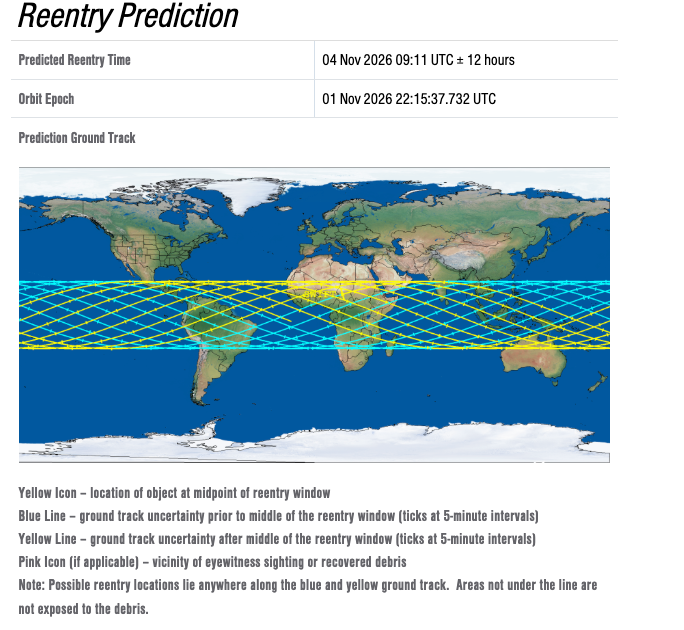
NASA's Space Weather Operational Readiness Development Center predicts reentry on Nov. 3rd at 16:18 UTC +/- 12 hours. The Aerospace Corporation says Nov. 4th at 09:30 UTC +/- 26 hours. Uncontrolled reentries are hard to pin down, and the orbit is decaying fast. Only in the final hours will we know for sure when and where it will re-enter.
Hawaii, Puerto Rico, and southern Mexico are in the potential re-entry zone. Swift's orbit is tilted 21 degrees to the equator, so debris can only come down between latitudes 21N and 21S. That band is mostly ocean, so the odds still favor a harmless splashdown.
Most of Swift will burn up in the fireball. But according to chief scientist Brad Cenko, some tungsten pieces and the observatory's mirrors could survive.
NASA tried to save Swift. In July, Katalyst Space launched a robotic spacecraft named L