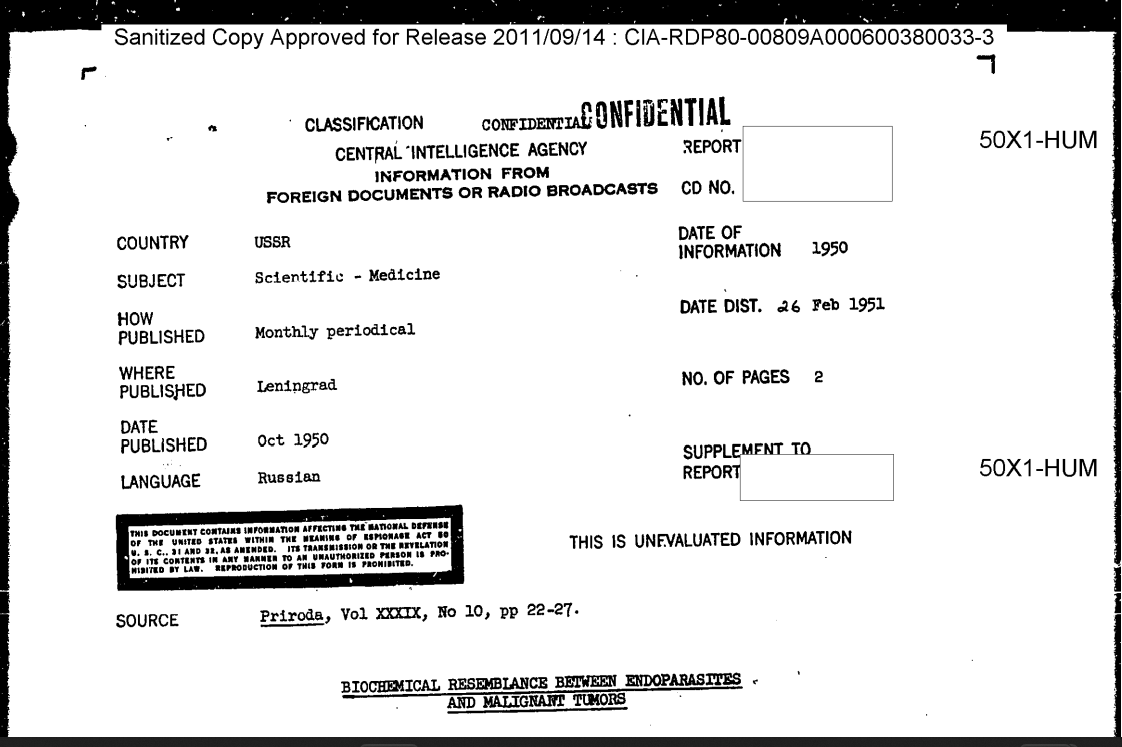
A declassified 1951CIA reporttitled 'Biochemical Resemblance Between Endoparasites and Malignant Tumours' has triggered a viral storm across social media, with theorists claiming it exposes a 'suppressed' parasitic origin for cancer.
The document, originally a summary of research by Soviet Professor VV Alpatov, was released in 2011 but has recently been weaponised by online communities to suggest that global health agencies have ignored a 'parasite-based cure.'
However, medical experts and historians clarify that the report does not present a hidden breakthrough; rather, it documents a 1950s Soviet effort to understand why cancer cells and parasitic worms share strikingly similar metabolic traits—specifically, their ability to thrive in low-oxygen environments and accumulate glycogen.
While the document is authentic, scientists state that modern oncology has long since categorised these similarities as 'evolutionary mimicry' rather than proof that all cancers are caused by infections.
The CIA report primarily analysed Professor Alpatov's work on the 'amphibiotic' nature of bothendoparasites and malignant tumours. Alpatov observed that both entities utilise a specific type of metabolism involving incomplete oxidation under aerobic conditions, a trait known as the Warburg effect in modern cancer biology. The document also noted that both parasites and cancer cells exhibited a similar reaction to optical isomers of atebrin, a common anti-malarial drug at the time.
While these observations were scientifically accurate for the era, they were intended to help researchers develop drugs that could target the specific enzymes shared by both parasites and tumours. It did not conclude that parasites caused the tumours, but rather that cancer cells 'behave' like parasites to evade the host's immune system and steal nutrients, a concept that is still explored in contemporary research.
But the CIA document itself did not present original research. Instead, it simply summarised the Soviet findings as part of the agency's routine monitoring of foreign scientific developments.
Although the report was officially declassified years ago, it has recently gained attention online after being widely shared on social media. The resurfacing has triggered claims that the CIA once held evidence suggesting parasites could be linked to cancer.
Many viral posts have suggested the document proves a hidden cure or suppressed medical discovery. However, scientists emphasise that the report was merely discussing early theoretical research rather than presenting conclusive evidence.
The viral discussion highlights how historical scientific debates can be easily misunderstood out of context, particularly when intelligence documents are involved.
Source: International Business Times UK
