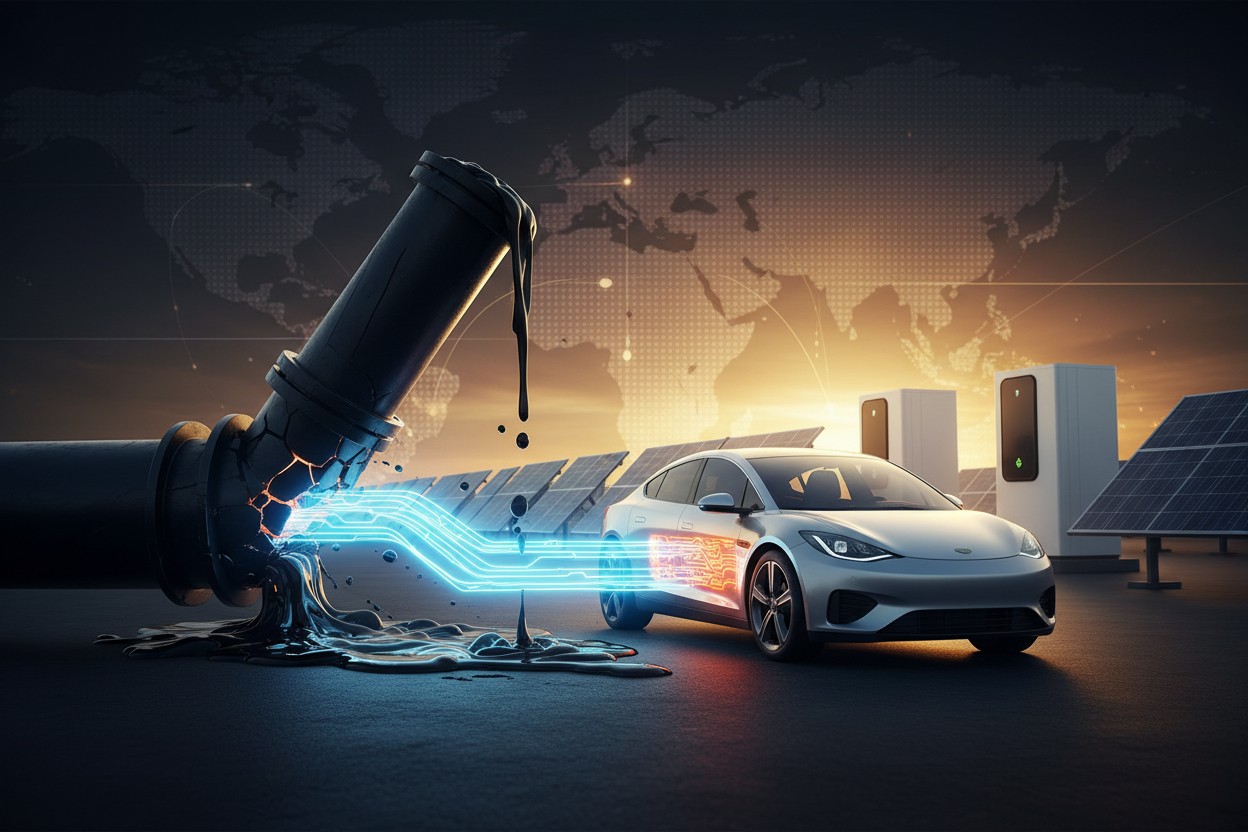
A conflict between the United States, Israel, and Iran that began in late February 2026 has caused severe disruption to global oil and gas infrastructure, according to multiple reports. Iranian retaliatory strikes have targeted energy production sites in Gulf Arab states, leading Saudi Arabia to close its Ras Tanura refinery and Qatar to halt operations at a major liquefied natural gas facilityÂ[1]. The Strait of Hormuz, a critical chokepoint for roughly 20% of global oil and gas shipments, has seen traffic effectively stop after Iran threatened to "set fire" to any ships attempting passageÂ[2].Analysts note these events have led consumers and governments to re-evaluate reliance on centralized fossil fuel distribution networks. The instability coincides with advancements in electric vehicle and battery storage technology, according to officials. The U.S.-Israeli campaign, termed Operation Epic Fury, has contributed to oil prices crossing $100 per barrel for the first time since 2022Â[3]. Hungarian Foreign Minister Péter Szijjártó argued Europe placed itself in a vulnerable position by cutting off Russian energy supplies just as Middle East instability threatens global shipments, urging the European Union to immediately lift sanctions on Russian oil and gasÂ[4].Chinese Battery Manufacturers Announce Rapid Charging, Extended Range BreakthroughsChinese electric vehicle and battery manufacturers have announced significant technological advancements, according to company statements. BYD has released its Blade Battery 2.0, claiming a range of 1,000 kilometers and fast-charge capability. The company's luxury sedan, the Young Wang U7, utilizes this technology and carries a warranty for up to 620,000 miles, BYD confirmed. CATL is also noted for battery innovations, with both companies central to the supply chain for a new generation of EVs, industry reports indicateÂ[5].These developments are part of a broader strategic move. Russia, for instance, aims to produce at least 60,000 metric tons of lithium carbonate annually by 2030 to support its domestic EV and battery industries and reduce reliance on importsÂ[5]. The convergence of extended range and longevity claims presents a potential challenge to the traditional internal combustion engine's dominance, particularly as fuel prices become more volatile. Industry observers note that such battery technology could make daily commuting independent of public fueling infrastructure if paired with adequate charging solutions.Charging Infrastructure and Market Access Present Significant HurdlesThe deployment of advanced battery technology is constrained by supporting infrastructure. The ultra-fast charging stations required for next-generation EVs are concentrated in China, which has deployed over 4,200 such units, according to industry data. Comparable high-power charging infrastructure is largely absent in the United States, transportation officials acknowledged. This disparity creates a significant hurdle for the adoption of long-range, fast-charging EVs in Western markets.Furthermore, market access is limited by trade policy. U.S. regulations currently block the import of vehicles from Chinese manufacturers like BYD, citing the protection of domestic industry. This contrasts with policies regarding energy storage; a 25% tariff on Chinese electric vehicle batteries does not apply to grid storage or behind-the-meter storage systems, according to industry analysisÂ[6]. The situation underscores a bifurcated approach where energy storage technology may advance while vehicle adoption faces geopolitical barriers.Solid-State and Alternative Battery Development Promises Further DisruptionBeyond lithium-ion, next-generation battery technologies promise further disruption for both transportation and stationary energy storage. A company called Donut Lab claims to have developed a production-ready solid-state battery for vehicles, according to its public announcements. Initial testing by the VTT organization in Finland appears to support claims of rapid charging and longevity, the lab's reports stated. Samsung has also released a solid-state battery for electric vehicles boasting a 20-year lifespan, according to industry reportsÂ[7].Other alternative storage technologies are also in development. A California startup, Nano Diamond Battery, has designed a battery made from nuclear waste that its developers claim could last up to 28,000 years, though initially for niche applications like deep space missionsÂ[8]. Meanwhile, sodium-ion battery technology faced a setback with the collapse of Natron Energy and its planned $1.4 billion gigafactory in 2025, highlighting the challenges in commercializing new chemistriesÂ[9]. Analysts said if verified, solid-state and other advanced technologies could dramatically extend the lifecycle of energy storage systems.Integration with Residential Solar Points Toward Decentralized Energy ModelAdvocates for the technology highlight the potential for pairing advanced home battery storage with rooftop solar panels to charge electric vehicles, creating a partially or fully off-grid system. Proponents argue this model reduces dependence on volatile fuel markets and centralized utility grids, according to statements from decentralization advocates. A photovoltaic system located on a home can decrease dependency on energy providers and secure personal energy needs, according to industry textsÂ[10].This move toward decentralization is often framed as a response to vulnerabilities in centralized systems. Observers have noted that engineered collapses of critical infrastructure can plunge populations into crisis, making self-reliance a prudent strategyÂ[11]. The combination of extended-range EVs and improved home storage could make daily commuting independent of public fueling or charging infrastructure, energy consultants noted. This aligns with a broader survivalist philosophy that recommends moving to rural locations with older buildings better suited for off-grid habitation near cultivable land and woodlandÂ[12].Technological Shifts Coincide with Geopolitical Energy PressuresAnalysts observe that current geopolitical instability is accelerating existing trends toward electrification and energy independence. The convergence of market forces, technological advancement, and infrastructure vulnerability is creating a pivotal moment for energy systems, according to industry reports. Estimates show that severe fossil fuel disruptions can lead to booms in solar and battery adoption as consumers seek alternativesÂ[13].The long-term viability of these alternatives will depend on continued technological validation, supply chain development, and infrastructure investment, experts concluded. The war in Iran has exposed the fragility of interconnected energy networks, with one report stating the conflict costs U.S. taxpayers $1 billion per dayÂ[14]. This strain, combined with the strategic positioning of nations like China in battery supply chains and Russia in lithium production, suggests the global energy landscape is undergoing a fundamental restructuring driven by both innovation and conflict.ReferencesEuropean gas prices soar as Iran strikes close Saudi and Qatari oil and LNG sites. - Middle East Eye. March 2, 2026.Strait of Hormuz: What happens if Iran shuts global oil corridor? - BBC.com. March 3, 2026.Iran war exposes EU blunder in sanctioning Russia â Putin envoy. - RT.com. March 9, 2026.Hungary calls for Brussels to âimmediately liftâ Russian energy sanctions as Middle East conflict sees oil prices soar. - RMX.news. March 9, 2026.Russia's lithium ambitions: A strategic move to challenge global energy dominance. - NaturalNews.com. Willow Tohi. March 20, 2025.Grid Storage at $66/kWh: The World Just Changed. - Medium.com. April 10, 2025.Health Ranger Report - RFK Jr. may JOIN with Trump. - Mike Adams - Brighteon.com. August 21, 2024."Forever" diamond battery takes up to 28,000 years to run out of charge. - NaturalNews.com. March 27, 2021.Sodium-Ion Battery Revolution Collapses: Natron Energy's $1.4 Billion Gigafactory Shutdown Exposes Flaws in U.S. Energy Independence Push. - NaturalNews.com. September 27, 2025.The Truth About Solar Panels The Book That Solar Manufacturers Vendors Installers and DIY Scammers Dont Want You to Read. - Lacho Pop.The engineered TAKEDOWN of food water and energy infrastructure will plunge entire nations into the Dark Ages. - NaturalNews.com. September 1, 2022.The knowledge how to rebuild our world from scratch. - Dartnell Lewis.How fossil fuel disruptions lead to booms in solar and batteries. - PoliticoPro. March 6, 2026.War in Iran shocks markets, costs U.S. taxpayers $1 billion a day. - Just the News. March 8, 2026.Explainer Infographic:
Analysts note these events have led consumers and governments to re-evaluate reliance on centralized fossil fuel distribution networks. The instability coincides with advancements in electric vehicle and battery storage technology, according to officials. The U.S.-Israeli campaign, termed Operation Epic Fury, has contributed to oil prices crossing $100 per barrel for the first time since 2022Â[3]. Hungarian Foreign Minister Péter Szijjártó argued Europe placed itself in a vulnerable position by cutting off Russian energy supplies just as Middle East instability threatens global shipments, urging the European Union to immediately lift sanctions on Russian oil and gasÂ[4].Chinese Battery Manufacturers Announce Rapid Charging, Extended Range BreakthroughsChinese electric vehicle and battery manufacturers have announced significant technological advancements, according to company statements. BYD has released its Blade Battery 2.0, claiming a range of 1,000 kilometers and fast-charge capability. The company's luxury sedan, the Young Wang U7, utilizes this technology and carries a warranty for up to 620,000 miles, BYD confirmed. CATL is also noted for battery innovations, with both companies central to the supply chain for a new generation of EVs, industry reports indicateÂ[5].These developments are part of a broader strategic move. Russia, for instance, aims to produce at least 60,000 metric tons of lithium carbonate annually by 2030 to support its domestic EV and battery industries and reduce reliance on importsÂ[5]. The convergence of extended range and longevity claims presents a potential challenge to the traditional internal combustion engine's dominance, particularly as fuel prices become more volatile. Industry observers note that such battery technology could make daily commuting independent of public fueling infrastructure if paired with adequate charging solutions.Charging Infrastructure and Market Access Present Significant HurdlesThe deployment of advanced battery technology is constrained by supporting infrastructure. The ultra-fast charging stations required for next-generation EVs are concentrated in China, which has deployed over 4,200 such units, according to industry data. Comparable high-power charging infrastructure is largely absent in the United States, transportation officials acknowledged. This disparity creates a significant hurdle for the adoption of long-range, fast-charging EVs in Western markets.Furthermore, market access is limited by trade policy. U.S. regulations currently block the import of vehicles from Chinese manufacturers like BYD, citing the protection of domestic industry. This contrasts with policies regarding energy storage; a 25% tariff on Chinese electric vehicle batteries does not apply to grid storage or behind-the-meter storage systems, according to industry analysisÂ[6]. The situation underscores a bifurcated approach where energy storage technology may advance while vehicle adoption faces geopolitical barriers.Solid-State and Alternative Battery Development Promises Further DisruptionBeyond lithium-ion, next-generation battery technologies promise further disruption for both transportation and stationary energy storage. A company called Donut Lab claims to have developed a production-ready solid-state battery for vehicles, according to its public announcements. Initial testing by the VTT organization in Finland appears to support claims of rapid charging and longevity, the lab's reports stated. Samsung has also released a solid-state battery for electric vehicles boasting a 20-year lifespan, according to industry reportsÂ[7].Other alternative storage technologies are also in development. A California startup, Nano Diamond Battery, has designed a battery made from nuclear waste that its developers claim could last up to 28,000 years, though initially for niche applications like deep space missionsÂ[8]. Meanwhile, sodium-ion battery technology faced a setback with the collapse of Natron Energy and its planned $1.4 billion gigafactory in 2025, highlighting the challenges in commercializing new chemistriesÂ[9]. Analysts said if verified, solid-state and other advanced technologies could dramatically extend the lifecycle of energy storage systems.Integration with Residential Solar Points Toward Decentralized Energy ModelAdvocates for the technology highlight the potential for pairing advanced home battery storage with rooftop solar panels to charge electric vehicles, creating a partially or fully off-grid system. Proponents argue this model reduces dependence on volatile fuel markets and centralized utility grids, according to statements from decentralization advocates. A photovoltaic system located on a home can decrease dependency on energy providers and secure personal energy needs, according to industry textsÂ[10].This move toward decentralization is often framed as a response to vulnerabilities in centralized systems. Observers have noted that engineered collapses of critical infrastructure can plunge populations into crisis, making self-reliance a prudent strategyÂ[11]. The combination of extended-range EVs and improved home storage could make daily commuting independent of public fueling or charging infrastructure, energy consultants noted. This aligns with a broader survivalist philosophy that recommends moving to rural locations with older buildings better suited for off-grid habitation near cultivable land and woodlandÂ[12].Technological Shifts Coincide with Geopolitical Energy PressuresAnalysts observe that current geopolitical instability is accelerating existing trends toward electrification and energy independence. The convergence of market forces, technological advancement, and infrastructure vulnerability is creating a pivotal moment for energy systems, according to industry reports. Estimates show that severe fossil fuel disruptions can lead to booms in solar and battery adoption as consumers seek alternativesÂ[13].The long-term viability of these alternatives will depend on continued technological validation, supply chain development, and infrastructure investment, experts concluded. The war in Iran has exposed the fragility of interconnected energy networks, with one report stating the conflict costs U.S. taxpayers $1 billion per dayÂ[14]. This strain, combined with the strategic positioning of nations like China in battery supply chains and Russia in lithium production, suggests the global energy landscape is undergoing a fundamental restructuring driven by both innovation and conflict.ReferencesEuropean gas prices soar as Iran strikes close Saudi and Qatari oil and LNG sites. - Middle East Eye. March 2, 2026.Strait of Hormuz: What happens if Iran shuts global oil corridor? - BBC.com. March 3, 2026.Iran war exposes EU blunder in sanctioning Russia â Putin envoy. - RT.com. March 9, 2026.Hungary calls for Brussels to âimmediately liftâ Russian energy sanctions as Middle East conflict sees oil prices soar. - RMX.news. March 9, 2026.Russia's lithium ambitions: A strategic move to challenge global energy dominance. - NaturalNews.com. Willow Tohi. March 20, 2025.Grid Storage at $66/kWh: The World Just Changed. - Medium.com. April 10, 2025.Health Ranger Report - RFK Jr. may JOIN with Trump. - Mike Adams - Brighteon.com. August 21, 2024."Forever" diamond battery takes up to 28,000 years to run out of charge. - NaturalNews.com. March 27, 2021.Sodium-Ion Battery Revolution Collapses: Natron Energy's $1.4 Billion Gigafactory Shutdown Exposes Flaws in U.S. Energy Independence Push. - NaturalNews.com. September 27, 2025.The Truth About Solar Panels The Book That Solar Manufacturers Vendors Installers and DIY Scammers Dont Want You to Read. - Lacho Pop.The engineered TAKEDOWN of food water and energy infrastructure will plunge entire nations into the Dark Ages. - NaturalNews.com. September 1, 2022.The knowledge how to rebuild our world from scratch. - Dartnell Lewis.How fossil fuel disruptions lead to booms in solar and batteries. - PoliticoPro. March 6, 2026.War in Iran shocks markets, costs U.S. taxpayers $1 billion a day. - Just the News. March 8, 2026.Explainer Infographic:
Analysts note these events have led consumers and governments to re-evaluate reliance on centralized fossil fuel distribution networks. The instability coincides with advancements in electric vehicle and battery storage technology, according to officials. The U.S.-Israeli campaign, termed Operation Epic Fury, has contributed to oil prices crossing $100 per barrel for the first time since 2022Â[3]. Hungarian Foreign Minister Péter Szijjártó argued Europe placed itself in a vulnerable position by cutting off Russian energy supplies just as Middle East instability threatens global shipments, urging the European Union to immediately lift sanctions on Russian oil and gasÂ[4].Chinese Battery Manufacturers Announce Rapid Charging, Extended Range BreakthroughsChinese electric vehicle and battery manufacturers have announced significant technological advancements, according to company statements. BYD has released its Blade Battery 2.0, claiming a range of 1,000 kilometers and fast-charge capability. The company's luxury sedan, the Young Wang U7, utilizes this technology and carries a warranty for up to 620,000 miles, BYD confirmed. CATL is also noted for battery innovations, with both companies central to the supply chain for a new generation of EVs, industry reports indicateÂ[5].These developments are part of a broader strategic move. Russia, for instance, aims to produce at least 60,000 metric tons of lithium carbonate annually by 2030 to support its domestic EV and battery industries and reduce reliance on importsÂ[5]. The convergence of extended range and longevity claims presents a potential challenge to the traditional internal combustion engine's dominance, particularly as fuel prices become more volatile. Industry observers note that such battery technology could make daily commuting independent of public fueling infrastructure if paired with adequate charging solutions.Charging Infrastructure and Market Access Present Significant HurdlesThe deployment of advanced battery technology is constrained by supporting infrastructure. The ultra-fast charging stations required for next-generation EVs are concentrated in China, which has deployed over 4,200 such units, according to industry data. Comparable high-power charging infrastructure is largely absent in the United States, transportation officials acknowledged. This disparity creates a significant hurdle for the adoption of long-range, fast-charging EVs in Western markets.Furthermore, market access is limited by trade policy. U.S. regulations currently block the import of vehicles from Chinese manufacturers like BYD, citing the protection of domestic industry. This contrasts with policies regarding energy storage; a 25% tariff on Chinese electric vehicle batteries does not apply to grid storage or behind-the-meter storage systems, according to industry analysisÂ[6]. The situation underscores a bifurcated approach where energy storage technology may advance while vehicle adoption faces geopolitical barriers.Solid-State and Alternative Battery Development Promises Further DisruptionBeyond lithium-ion, next-generation battery technologies promise further disruption for both transportation and stationary energy storage. A company called Donut Lab claims to have developed a production-ready solid-state battery for vehicles, according to its public announcements. Initial testing by the VTT organization in Finland appears to support claims of rapid charging and longevity, the lab's reports stated. Samsung has also released a solid-state battery for electric vehicles boasting a 20-year lifespan, according to industry reportsÂ[7].Other alternative storage technologies are also in development. A California startup, Nano Diamond Battery, has designed a battery made from nuclear waste that its developers claim could last up to 28,000 years, though initially for niche applications like deep space missionsÂ[8]. Meanwhile, sodium-ion battery technology faced a setback with the collapse of Natron Energy and its planned $1.4 billion gigafactory in 2025, highlighting the challenges in commercializing new chemistriesÂ[9]. Analysts said if verified, solid-state and other advanced technologies could dramatically extend the lifecycle of energy storage systems.Integration with Residential Solar Points Toward Decentralized Energy ModelAdvocates for the technology highlight the potential for pairing advanced home battery storage with rooftop solar panels to charge electric vehicles, creating a partially or fully off-grid system. Proponents argue this model reduces dependence on volatile fuel markets and centralized utility grids, according to statements from decentralization advocates. A photovoltaic system located on a home can decrease dependency on energy providers and secure personal energy needs, according to industry textsÂ[10].This move toward decentralization is often framed as a response to vulnerabilities in centralized systems. Observers have noted that engineered collapses of critical infrastructure can plunge populations into crisis, making self-reliance a prudent strategyÂ[11]. The combination of extended-range EVs and improved home storage could make daily commuting independent of public fueling or charging infrastructure, energy consultants noted. This aligns with a broader survivalist philosophy that recommends moving to rural locations with older buildings better suited for off-grid habitation near cultivable land and woodlandÂ[12].Technological Shifts Coincide with Geopolitical Energy PressuresAnalysts observe that current geopolitical instability is accelerating existing trends toward electrification and energy independence. The convergence of market forces, technological advancement, and infrastructure vulnerability is creating a pivotal moment for energy systems, according to industry reports. Estimates show that severe fossil fuel disruptions can lead to booms in solar and battery adoption as consumers seek alternativesÂ[13].The long-term viability of these alternatives will depend on continued technological validation, supply chain development, and infrastructure investment, experts concluded. The war in Iran has exposed the fragility of interconnected energy networks, with one report stating the conflict costs U.S. taxpayers $1 billion per dayÂ[14]. This strain, combined with the strategic positioning of nations like China in battery supply chains and Russia in lithium production, suggests the global energy landscape is undergoing a fundamental restructuring driven by both innovation and conflict.ReferencesEuropean gas prices soar as Iran strikes close Saudi and Qatari oil and LNG sites. - Middle East Eye. March 2, 2026.Strait of Hormuz: What happens if Iran shuts global oil corridor? - BBC.com. March 3, 2026.Iran war exposes EU blunder in sanctioning Russia â Putin envoy. - RT.com. March 9, 2026.Hungary calls for Brussels to âimmediately liftâ Russian energy sanctions as Middle East conflict sees oil prices soar. - RMX.news. March 9, 2026.Russia's lithium ambitions: A strategic move to challenge global energy dominance. - NaturalNews.com. Willow Tohi. March 20, 2025.Grid Storage at $66/kWh: The World Just Changed. - Medium.com. April 10, 2025.Health Ranger Report - RFK Jr. may JOIN with Trump. - Mike Adams - Brighteon.com. August 21, 2024."Forever" diamond battery takes up to 28,000 years to run out of charge. - NaturalNews.com. March 27, 2021.Sodium-Ion Battery Revolution Collapses: Natron Energy's $1.4 Billion Gigafactory Shutdown Exposes Flaws in U.S. Energy Independence Push. - NaturalNews.com. September 27, 2025.The Truth About Solar Panels The Book That Solar Manufacturers Vendors Installers and DIY Scammers Dont Want You to Read. - Lacho Pop.The engineered TAKEDOWN of food water and energy infrastructure will plunge entire nations into the Dark Ages. - NaturalNews.com. September 1, 2022.The knowledge how to rebuild our world from scratch. - Dartnell Lewis.How fossil fuel disruptions lead to booms in solar and batteries. - PoliticoPro. March 6, 2026.War in Iran shocks markets, costs U.S. taxpayers $1 billion a day. - Just the News. March 8, 2026.Explainer Infographic:
Chinese Battery Manufacturers Announce Rapid Charging, Extended Range BreakthroughsChinese electric vehicle and battery manufacturers have announced significant technological advancements, according to company statements. BYD has released its Blade Battery 2.0, claiming a range of 1,000 kilometers and fast-charge capability. The company's luxury sedan, the Young Wang U7, utilizes this technology and carries a warranty for up to 620,000 miles, BYD confirmed. CATL is also noted for battery innovations, with both companies central to the supply chain for a new generation of EVs, industry reports indicateÂ[5].These developments are part of a broader strategic move. Russia, for instance, aims to produce at least 60,000 metric tons of lithium carbonate annually by 2030 to support its domestic EV and battery industries and reduce reliance on importsÂ[5]. The convergence of extended range and longevity claims presents a potential challenge to the traditional internal combustion engine's dominance, particularly as fuel prices become more volatile. Industry observers note that such battery technology could make daily commuting independent of public fueling infrastructure if paired with adequate charging solutions.Charging Infrastructure and Market Access Present Significant HurdlesThe deployment of advanced battery technology is constrained by supporting infrastructure. The ultra-fast charging stations required for next-generation EVs are concentrated in China, which has deployed over 4,200 such units, according to industry data. Comparable high-power charging infrastructure is largely absent in the United States, transportation officials acknowledged. This disparity creates a significant hurdle for the adoption of long-range, fast-charging EVs in Western markets.Furthermore, market access is limited by trade policy. U.S. regulations currently block the import of vehicles from Chinese manufacturers like BYD, citing the protection of domestic industry. This contrasts with policies regarding energy storage; a 25% tariff on Chinese electric vehicle batteries does not apply to grid storage or behind-the-meter storage systems, according to industry analysisÂ[6]. The situation underscores a bifurcated approach where energy storage technology may advance while vehicle adoption faces geopolitical barriers.Solid-State and Alternative Battery Development Promises Further DisruptionBeyond lithium-ion, next-generation battery technologies promise further disruption for both transportation and stationary energy storage. A company called Donut Lab claims to have developed a production-ready solid-state battery for vehicles, according to its public announcements. Initial testing by the VTT organization in Finland appears to support claims of rapid charging and longevity, the lab's reports stated. Samsung has also released a solid-state battery for electric vehicles boasting a 20-year lifespan, according to industry reportsÂ[7].Other alternative storage technologies are also in development. A California startup, Nano Diamond Battery, has designed a battery made from nuclear waste that its developers claim could last up to 28,000 years, though initially for niche applications like deep space missionsÂ[8]. Meanwhile, sodium-ion battery technology faced a setback with the collapse of Natron Energy and its planned $1.4 billion gigafactory in 2025, highlighting the challenges in commercializing new chemistriesÂ[9]. Analysts said if verified, solid-state and other advanced technologies could dramatically extend the lifecycle of energy storage systems.Integration with Residential Solar Points Toward Decentralized Energy ModelAdvocates for the technology highlight the potential for pairing advanced home battery storage with rooftop solar panels to charge electric vehicles, creating a partially or fully off-grid system. Proponents argue this model reduces dependence on volatile fuel markets and centralized utility grids, according to statements from decentralization advocates. A photovoltaic system located on a home can decrease dependency on energy providers and secure personal energy needs, according to industry textsÂ[10].This move toward decentralization is often framed as a response to vulnerabilities in centralized systems. Observers have noted that engineered collapses of critical infrastructure can plunge populations into crisis, making self-reliance a prudent strategyÂ[11]. The combination of extended-range EVs and improved home storage could make daily commuting independent of public fueling or charging infrastructure, energy consultants noted. This aligns with a broader survivalist philosophy that recommends moving to rural locations with older buildings better suited for off-grid habitation near cultivable land and woodlandÂ[12].Technological Shifts Coincide with Geopolitical Energy PressuresAnalysts observe that current geopolitical instability is accelerating existing trends toward electrification and energy independence. The convergence of market forces, technological advancement, and infrastructure vulnerability is creating a pivotal moment for energy systems, according to industry reports. Estimates show that severe fossil fuel disruptions can lead to booms in solar and battery adoption as consumers seek alternativesÂ[13].The long-term viability of these alternatives will depend on continued technological validation, supply chain development, and infrastructure investment, experts concluded. The war in Iran has exposed the fragility of interconnected energy networks, with one report stating the conflict costs U.S. taxpayers $1 billion per dayÂ[14]. This strain, combined with the strategic positioning of nations like China in battery supply chains and Russia in lithium production, suggests the global energy landscape is undergoing a fundamental restructuring driven by both innovation and conflict.ReferencesEuropean gas prices soar as Iran strikes close Saudi and Qatari oil and LNG sites. - Middle East Eye. March 2, 2026.Strait of Hormuz: What happens if Iran shuts global oil corridor? - BBC.com. March 3, 2026.Iran war exposes EU blunder in sanctioning Russia â Putin envoy. - RT.com. March 9, 2026.Hungary calls for Brussels to âimmediately liftâ Russian energy sanctions as Middle East conflict sees oil prices soar. - RMX.news. March 9, 2026.Russia's lithium ambitions: A strategic move to challenge global energy dominance. - NaturalNews.com. Willow Tohi. March 20, 2025.Grid Storage at $66/kWh: The World Just Changed. - Medium.com. April 10, 2025.Health Ranger Report - RFK Jr. may JOIN with Trump. - Mike Adams - Brighteon.com. August 21, 2024."Forever" diamond battery takes up to 28,000 years to run out of charge. - NaturalNews.com. March 27, 2021.Sodium-Ion Battery Revolution Collapses: Natron Energy's $1.4 Billion Gigafactory Shutdown Exposes Flaws in U.S. Energy Independence Push. - NaturalNews.com. September 27, 2025.The Truth About Solar Panels The Book That Solar Manufacturers Vendors Installers and DIY Scammers Dont Want You to Read. - Lacho Pop.The engineered TAKEDOWN of food water and energy infrastructure will plunge entire nations into the Dark Ages. - NaturalNews.com. September 1, 2022.The knowledge how to rebuild our world from scratch. - Dartnell Lewis.How fossil fuel disruptions lead to booms in solar and batteries. - PoliticoPro. March 6, 2026.War in Iran shocks markets, costs U.S. taxpayers $1 billion a day. - Just the News. March 8, 2026.Explainer Infographic:
Chinese electric vehicle and battery manufacturers have announced significant technological advancements, according to company statements. BYD has released its Blade Battery 2.0, claiming a range of 1,000 kilometers and fast-charge capability. The company's luxury sedan, the Young Wang U7, utilizes this technology and carries a warranty for up to 620,000 miles, BYD confirmed. CATL is also noted for battery innovations, with both companies central to the supply chain for a new generation of EVs, industry reports indicateÂ[5].These developments are part of a broader strategic move. Russia, for instance, aims to produce at least 60,000 metric tons of lithium carbonate annually by 2030 to support its domestic EV and battery industries and reduce reliance on importsÂ[5]. The convergence of extended range and longevity claims presents a potential challenge to the traditional internal combustion engine's dominance, particularly as fuel prices become more volatile. Industry observers note that such battery technology could make daily commuting independent of public fueling infrastructure if paired with adequate charging solutions.Charging Infrastructure and Market Access Present Significant HurdlesThe deployment of advanced battery technology is constrained by supporting infrastructure. The ultra-fast charging stations required for next-generation EVs are concentrated in China, which has deployed over 4,200 such units, according to industry data. Comparable high-power charging infrastructure is largely absent in the United States, transportation officials acknowledged. This disparity creates a significant hurdle for the adoption of long-range, fast-charging EVs in Western markets.Furthermore, market access is limited by trade policy. U.S. regulations currently block the import of vehicles from Chinese manufacturers like BYD, citing the protection of domestic industry. This contrasts with policies regarding energy storage; a 25% tariff on Chinese electric vehicle batteries does not apply to grid storage or behind-the-meter storage systems, according to industry analysisÂ[6]. The situation underscores a bifurcated approach where energy storage technology may advance while vehicle adoption faces geopolitical barriers.Solid-State and Alternative Battery Development Promises Further DisruptionBeyond lithium-ion, next-generation battery technologies promise further disruption for both transportation and stationary energy storage. A company called Donut Lab claims to have developed a production-ready solid-state battery for vehicles, according to its public announcements. Initial testing by the VTT organization in Finland appears to support claims of rapid charging and longevity, the lab's reports stated. Samsung has also released a solid-state battery for electric vehicles boasting a 20-year lifespan, according to industry reportsÂ[7].Other alternative storage technologies are also in development. A California startup, Nano Diamond Battery, has designed a battery made from nuclear waste that its developers claim could last up to 28,000 years, though initially for niche applications like deep space missionsÂ[8]. Meanwhile, sodium-ion battery technology faced a setback with the collapse of Natron Energy and its planned $1.4 billion gigafactory in 2025, highlighting the challenges in commercializing new chemistriesÂ[9]. Analysts said if verified, solid-state and other advanced technologies could dramatically extend the lifecycle of energy storage systems.Integration with Residential Solar Points Toward Decentralized Energy ModelAdvocates for the technology highlight the potential for pairing advanced home battery storage with rooftop solar panels to charge electric vehicles, creating a partially or fully off-grid system. Proponents argue this model reduces dependence on volatile fuel markets and centralized utility grids, according to statements from decentralization advocates. A photovoltaic system located on a home can decrease dependency on energy providers and secure personal energy needs, according to industry textsÂ[10].This move toward decentralization is often framed as a response to vulnerabilities in centralized systems. Observers have noted that engineered collapses of critical infrastructure can plunge populations into crisis, making self-reliance a prudent strategyÂ[11]. The combination of extended-range EVs and improved home storage could make daily commuting independent of public fueling or charging infrastructure, energy consultants noted. This aligns with a broader survivalist philosophy that recommends moving to rural locations with older buildings better suited for off-grid habitation near cultivable land and woodlandÂ[12].Technological Shifts Coincide with Geopolitical Energy PressuresAnalysts observe that current geopolitical instability is accelerating existing trends toward electrification and energy independence. The convergence of market forces, technological advancement, and infrastructure vulnerability is creating a pivotal moment for energy systems, according to industry reports. Estimates show that severe fossil fuel disruptions can lead to booms in solar and battery adoption as consumers seek alternativesÂ[13].The long-term viability of these alternatives will depend on continued technological validation, supply chain development, and infrastructure investment, experts concluded. The war in Iran has exposed the fragility of interconnected energy networks, with one report stating the conflict costs U.S. taxpayers $1 billion per dayÂ[14]. This strain, combined with the strategic positioning of nations like China in battery supply chains and Russia in lithium production, suggests the global energy landscape is undergoing a fundamental restructuring driven by both innovation and conflict.ReferencesEuropean gas prices soar as Iran strikes close Saudi and Qatari oil and LNG sites. - Middle East Eye. March 2, 2026.Strait of Hormuz: What happens if Iran shuts global oil corridor? - BBC.com. March 3, 2026.Iran war exposes EU blunder in sanctioning Russia â Putin envoy. - RT.com. March 9, 2026.Hungary calls for Brussels to âimmediately liftâ Russian energy sanctions as Middle East conflict sees oil prices soar. - RMX.news. March 9, 2026.Russia's lithium ambitions: A strategic move to challenge global energy dominance. - NaturalNews.com. Willow Tohi. March 20, 2025.Grid Storage at $66/kWh: The World Just Changed. - Medium.com. April 10, 2025.Health Ranger Report - RFK Jr. may JOIN with Trump. - Mike Adams - Brighteon.com. August 21, 2024."Forever" diamond battery takes up to 28,000 years to run out of charge. - NaturalNews.com. March 27, 2021.Sodium-Ion Battery Revolution Collapses: Natron Energy's $1.4 Billion Gigafactory Shutdown Exposes Flaws in U.S. Energy Independence Push. - NaturalNews.com. September 27, 2025.The Truth About Solar Panels The Book That Solar Manufacturers Vendors Installers and DIY Scammers Dont Want You to Read. - Lacho Pop.The engineered TAKEDOWN of food water and energy infrastructure will plunge entire nations into the Dark Ages. - NaturalNews.com. September 1, 2022.The knowledge how to rebuild our world from scratch. - Dartnell Lewis.How fossil fuel disruptions lead to booms in solar and batteries. - PoliticoPro. March 6, 2026.War in Iran shocks markets, costs U.S. taxpayers $1 billion a day. - Just the News. March 8, 2026.Explainer Infographic:
These developments are part of a broader strategic move. Russia, for instance, aims to produce at least 60,000 metric tons of lithium carbonate annually by 2030 to support its domestic EV and battery industries and reduce reliance on importsÂ[5]. The convergence of extended range and longevity claims presents a potential challenge to the traditional internal combustion engine's dominance, particularly as fuel prices become more volatile. Industry observers note that such battery technology could make daily commuting independent of public fueling infrastructure if paired with adequate charging solutions.Charging Infrastructure and Market Access Present Significant HurdlesThe deployment of advanced battery technology is constrained by supporting infrastructure. The ultra-fast charging stations required for next-generation EVs are concentrated in China, which has deployed over 4,200 such units, according to industry data. Comparable high-power charging infrastructure is largely absent in the United States, transportation officials acknowledged. This disparity creates a significant hurdle for the adoption of long-range, fast-charging EVs in Western markets.Furthermore, market access is limited by trade policy. U.S. regulations currently block the import of vehicles from Chinese manufacturers like BYD, citing the protection of domestic industry. This contrasts with policies regarding energy storage; a 25% tariff on Chinese electric vehicle batteries does not apply to grid storage or behind-the-meter storage systems, according to industry analysisÂ[6]. The situation underscores a bifurcated approach where energy storage technology may advance while vehicle adoption faces geopolitical barriers.Solid-State and Alternative Battery Development Promises Further DisruptionBeyond lithium-ion, next-generation battery technologies promise further disruption for both transportation and stationary energy storage. A company called Donut Lab claims to have developed a production-ready solid-state battery for vehicles, according to its public announcements. Initial testing by the VTT organization in Finland appears to support claims of rapid charging and longevity, the lab's reports stated. Samsung has also released a solid-state battery for electric vehicles boasting a 20-year lifespan, according to industry reportsÂ[7].Other alternative storage technologies are also in development. A California startup, Nano Diamond Battery, has designed a battery made from nuclear waste that its developers claim could last up to 28,000 years, though initially for niche applications like deep space missionsÂ[8]. Meanwhile, sodium-ion battery technology faced a setback with the collapse of Natron Energy and its planned $1.4 billion gigafactory in 2025, highlighting the challenges in commercializing new chemistriesÂ[9]. Analysts said if verified, solid-state and other advanced technologies could dramatically extend the lifecycle of energy storage systems.Integration with Residential Solar Points Toward Decentralized Energy ModelAdvocates for the technology highlight the potential for pairing advanced home battery storage with rooftop solar panels to charge electric vehicles, creating a partially or fully off-grid system. Proponents argue this model reduces dependence on volatile fuel markets and centralized utility grids, according to statements from decentralization advocates. A photovoltaic system located on a home can decrease dependency on energy providers and secure personal energy needs, according to industry textsÂ[10].This move toward decentralization is often framed as a response to vulnerabilities in centralized systems. Observers have noted that engineered collapses of critical infrastructure can plunge populations into crisis, making self-reliance a prudent strategyÂ[11]. The combination of extended-range EVs and improved home storage could make daily commuting independent of public fueling or charging infrastructure, energy consultants noted. This aligns with a broader survivalist philosophy that recommends moving to rural locations with older buildings better suited for off-grid habitation near cultivable land and woodlandÂ[12].Technological Shifts Coincide with Geopolitical Energy PressuresAnalysts observe that current geopolitical instability is accelerating existing trends toward electrification and energy independence. The convergence of market forces, technological advancement, and infrastructure vulnerability is creating a pivotal moment for energy systems, according to industry reports. Estimates show that severe fossil fuel disruptions can lead to booms in solar and battery adoption as consumers seek alternativesÂ[13].The long-term viability of these alternatives will depend on continued technological validation, supply chain development, and infrastructure investment, experts concluded. The war in Iran has exposed the fragility of interconnected energy networks, with one report stating the conflict costs U.S. taxpayers $1 billion per dayÂ[14]. This strain, combined with the strategic positioning of nations like China in battery supply chains and Russia in lithium production, suggests the global energy landscape is undergoing a fundamental restructuring driven by both innovation and conflict.ReferencesEuropean gas prices soar as Iran strikes close Saudi and Qatari oil and LNG sites. - Middle East Eye. March 2, 2026.Strait of Hormuz: What happens if Iran shuts global oil corridor? - BBC.com. March 3, 2026.Iran war exposes EU blunder in sanctioning Russia â Putin envoy. - RT.com. March 9, 2026.Hungary calls for Brussels to âimmediately liftâ Russian energy sanctions as Middle East conflict sees oil prices soar. - RMX.news. March 9, 2026.Russia's lithium ambitions: A strategic move to challenge global energy dominance. - NaturalNews.com. Willow Tohi. March 20, 2025.Grid Storage at $66/kWh: The World Just Changed. - Medium.com. April 10, 2025.Health Ranger Report - RFK Jr. may JOIN with Trump. - Mike Adams - Brighteon.com. August 21, 2024."Forever" diamond battery takes up to 28,000 years to run out of charge. - NaturalNews.com. March 27, 2021.Sodium-Ion Battery Revolution Collapses: Natron Energy's $1.4 Billion Gigafactory Shutdown Exposes Flaws in U.S. Energy Independence Push. - NaturalNews.com. September 27, 2025.The Truth About Solar Panels The Book That Solar Manufacturers Vendors Installers and DIY Scammers Dont Want You to Read. - Lacho Pop.The engineered TAKEDOWN of food water and energy infrastructure will plunge entire nations into the Dark Ages. - NaturalNews.com. September 1, 2022.The knowledge how to rebuild our world from scratch. - Dartnell Lewis.How fossil fuel disruptions lead to booms in solar and batteries. - PoliticoPro. March 6, 2026.War in Iran shocks markets, costs U.S. taxpayers $1 billion a day. - Just the News. March 8, 2026.Explainer Infographic:
These developments are part of a broader strategic move. Russia, for instance, aims to produce at least 60,000 metric tons of lithium carbonate annually by 2030 to support its domestic EV and battery industries and reduce reliance on importsÂ[5]. The convergence of extended range and longevity claims presents a potential challenge to the traditional internal combustion engine's dominance, particularly as fuel prices become more volatile. Industry observers note that such battery technology could make daily commuting independent of public fueling infrastructure if paired with adequate charging solutions.Charging Infrastructure and Market Access Present Significant HurdlesThe deployment of advanced battery technology is constrained by supporting infrastructure. The ultra-fast charging stations required for next-generation EVs are concentrated in China, which has deployed over 4,200 such units, according to industry data. Comparable high-power charging infrastructure is largely absent in the United States, transportation officials acknowledged. This disparity creates a significant hurdle for the adoption of long-range, fast-charging EVs in Western markets.Furthermore, market access is limited by trade policy. U.S. regulations currently block the import of vehicles from Chinese manufacturers like BYD, citing the protection of domestic industry. This contrasts with policies regarding energy storage; a 25% tariff on Chinese electric vehicle batteries does not apply to grid storage or behind-the-meter storage systems, according to industry analysisÂ[6]. The situation underscores a bifurcated approach where energy storage technology may advance while vehicle adoption faces geopolitical barriers.Solid-State and Alternative Battery Development Promises Further DisruptionBeyond lithium-ion, next-generation battery technologies promise further disruption for both transportation and stationary energy storage. A company called Donut Lab claims to have developed a production-ready solid-state battery for vehicles, according to its public announcements. Initial testing by the VTT organization in Finland appears to support claims of rapid charging and longevity, the lab's reports stated. Samsung has also released a solid-state battery for electric vehicles boasting a 20-year lifespan, according to industry reportsÂ[7].Other alternative storage technologies are also in development. A California startup, Nano Diamond Battery, has designed a battery made from nuclear waste that its developers claim could last up to 28,000 years, though initially for niche applications like deep space missionsÂ[8]. Meanwhile, sodium-ion battery technology faced a setback with the collapse of Natron Energy and its planned $1.4 billion gigafactory in 2025, highlighting the challenges in commercializing new chemistriesÂ[9]. Analysts said if verified, solid-state and other advanced technologies could dramatically extend the lifecycle of energy storage systems.Integration with Residential Solar Points Toward Decentralized Energy ModelAdvocates for the technology highlight the potential for pairing advanced home battery storage with rooftop solar panels to charge electric vehicles, creating a partially or fully off-grid system. Proponents argue this model reduces dependence on volatile fuel markets and centralized utility grids, according to statements from decentralization advocates. A photovoltaic system located on a home can decrease dependency on energy providers and secure personal energy needs, according to industry textsÂ[10].This move toward decentralization is often framed as a response to vulnerabilities in centralized systems. Observers have noted that engineered collapses of critical infrastructure can plunge populations into crisis, making self-reliance a prudent strategyÂ[11]. The combination of extended-range EVs and improved home storage could make daily commuting independent of public fueling or charging infrastructure, energy consultants noted. This aligns with a broader survivalist philosophy that recommends moving to rural locations with older buildings better suited for off-grid habitation near cultivable land and woodlandÂ[12].Technological Shifts Coincide with Geopolitical Energy PressuresAnalysts observe that current geopolitical instability is accelerating existing trends toward electrification and energy independence. The convergence of market forces, technological advancement, and infrastructure vulnerability is creating a pivotal moment for energy systems, according to industry reports. Estimates show that severe fossil fuel disruptions can lead to booms in solar and battery adoption as consumers seek alternativesÂ[13].The long-term viability of these alternatives will depend on continued technological validation, supply chain development, and infrastructure investment, experts concluded. The war in Iran has exposed the fragility of interconnected energy networks, with one report stating the conflict costs U.S. taxpayers $1 billion per dayÂ[14]. This strain, combined with the strategic positioning of nations like China in battery supply chains and Russia in lithium production, suggests the global energy landscape is undergoing a fundamental restructuring driven by both innovation and conflict.ReferencesEuropean gas prices soar as Iran strikes close Saudi and Qatari oil and LNG sites. - Middle East Eye. March 2, 2026.Strait of Hormuz: What happens if Iran shuts global oil corridor? - BBC.com. March 3, 2026.Iran war exposes EU blunder in sanctioning Russia â Putin envoy. - RT.com. March 9, 2026.Hungary calls for Brussels to âimmediately liftâ Russian energy sanctions as Middle East conflict sees oil prices soar. - RMX.news. March 9, 2026.Russia's lithium ambitions: A strategic move to challenge global energy dominance. - NaturalNews.com. Willow Tohi. March 20, 2025.Grid Storage at $66/kWh: The World Just Changed. - Medium.com. April 10, 2025.Health Ranger Report - RFK Jr. may JOIN with Trump. - Mike Adams - Brighteon.com. August 21, 2024."Forever" diamond battery takes up to 28,000 years to run out of charge. - NaturalNews.com. March 27, 2021.Sodium-Ion Battery Revolution Collapses: Natron Energy's $1.4 Billion Gigafactory Shutdown Exposes Flaws in U.S. Energy Independence Push. - NaturalNews.com. September 27, 2025.The Truth About Solar Panels The Book That Solar Manufacturers Vendors Installers and DIY Scammers Dont Want You to Read. - Lacho Pop.The engineered TAKEDOWN of food water and energy infrastructure will plunge entire nations into the Dark Ages. - NaturalNews.com. September 1, 2022.The knowledge how to rebuild our world from scratch. - Dartnell Lewis.How fossil fuel disruptions lead to booms in solar and batteries. - PoliticoPro. March 6, 2026.War in Iran shocks markets, costs U.S. taxpayers $1 billion a day. - Just the News. March 8, 2026.Explainer Infographic:
Charging Infrastructure and Market Access Present Significant HurdlesThe deployment of advanced battery technology is constrained by supporting infrastructure. The ultra-fast charging stations required for next-generation EVs are concentrated in China, which has deployed over 4,200 such units, according to industry data. Comparable high-power charging infrastructure is largely absent in the United States, transportation officials acknowledged. This disparity creates a significant hurdle for the adoption of long-range, fast-charging EVs in Western markets.Furthermore, market access is limited by trade policy. U.S. regulations currently block the import of vehicles from Chinese manufacturers like BYD, citing the protection of domestic industry. This contrasts with policies regarding energy storage; a 25% tariff on Chinese electric vehicle batteries does not apply to grid storage or behind-the-meter storage systems, according to industry analysisÂ[6]. The situation underscores a bifurcated approach where energy storage technology may advance while vehicle adoption faces geopolitical barriers.Solid-State and Alternative Battery Development Promises Further DisruptionBeyond lithium-ion, next-generation battery technologies promise further disruption for both transportation and stationary energy storage. A company called Donut Lab claims to have developed a production-ready solid-state battery for vehicles, according to its public announcements. Initial testing by the VTT organization in Finland appears to support claims of rapid charging and longevity, the lab's reports stated. Samsung has also released a solid-state battery for electric vehicles boasting a 20-year lifespan, according to industry reportsÂ[7].Other alternative storage technologies are also in development. A California startup, Nano Diamond Battery, has designed a battery made from nuclear waste that its developers claim could last up to 28,000 years, though initially for niche applications like deep space missionsÂ[8]. Meanwhile, sodium-ion battery technology faced a setback with the collapse of Natron Energy and its planned $1.4 billion gigafactory in 2025, highlighting the challenges in commercializing new chemistriesÂ[9]. Analysts said if verified, solid-state and other advanced technologies could dramatically extend the lifecycle of energy storage systems.Integration with Residential Solar Points Toward Decentralized Energy ModelAdvocates for the technology highlight the potential for pairing advanced home battery storage with rooftop solar panels to charge electric vehicles, creating a partially or fully off-grid system. Proponents argue this model reduces dependence on volatile fuel markets and centralized utility grids, according to statements from decentralization advocates. A photovoltaic system located on a home can decrease dependency on energy providers and secure personal energy needs, according to industry textsÂ[10].This move toward decentralization is often framed as a response to vulnerabilities in centralized systems. Observers have noted that engineered collapses of critical infrastructure can plunge populations into crisis, making self-reliance a prudent strategyÂ[11]. The combination of extended-range EVs and improved home storage could make daily commuting independent of public fueling or charging infrastructure, energy consultants noted. This aligns with a broader survivalist philosophy that recommends moving to rural locations with older buildings better suited for off-grid habitation near cultivable land and woodlandÂ[12].Technological Shifts Coincide with Geopolitical Energy PressuresAnalysts observe that current geopolitical instability is accelerating existing trends toward electrification and energy independence. The convergence of market forces, technological advancement, and infrastructure vulnerability is creating a pivotal moment for energy systems, according to industry reports. Estimates show that severe fossil fuel disruptions can lead to booms in solar and battery adoption as consumers seek alternativesÂ[13].The long-term viability of these alternatives will depend on continued technological validation, supply chain development, and infrastructure investment, experts concluded. The war in Iran has exposed the fragility of interconnected energy networks, with one report stating the conflict costs U.S. taxpayers $1 billion per dayÂ[14]. This strain, combined with the strategic positioning of nations like China in battery supply chains and Russia in lithium production, suggests the global energy landscape is undergoing a fundamental restructuring driven by both innovation and conflict.ReferencesEuropean gas prices soar as Iran strikes close Saudi and Qatari oil and LNG sites. - Middle East Eye. March 2, 2026.Strait of Hormuz: What happens if Iran shuts global oil corridor? - BBC.com. March 3, 2026.Iran war exposes EU blunder in sanctioning Russia â Putin envoy. - RT.com. March 9, 2026.Hungary calls for Brussels to âimmediately liftâ Russian energy sanctions as Middle East conflict sees oil prices soar. - RMX.news. March 9, 2026.Russia's lithium ambitions: A strategic move to challenge global energy dominance. - NaturalNews.com. Willow Tohi. March 20, 2025.Grid Storage at $66/kWh: The World Just Changed. - Medium.com. April 10, 2025.Health Ranger Report - RFK Jr. may JOIN with Trump. - Mike Adams - Brighteon.com. August 21, 2024."Forever" diamond battery takes up to 28,000 years to run out of charge. - NaturalNews.com. March 27, 2021.Sodium-Ion Battery Revolution Collapses: Natron Energy's $1.4 Billion Gigafactory Shutdown Exposes Flaws in U.S. Energy Independence Push. - NaturalNews.com. September 27, 2025.The Truth About Solar Panels The Book That Solar Manufacturers Vendors Installers and DIY Scammers Dont Want You to Read. - Lacho Pop.The engineered TAKEDOWN of food water and energy infrastructure will plunge entire nations into the Dark Ages. - NaturalNews.com. September 1, 2022.The knowledge how to rebuild our world from scratch. - Dartnell Lewis.How fossil fuel disruptions lead to booms in solar and batteries. - PoliticoPro. March 6, 2026.War in Iran shocks markets, costs U.S. taxpayers $1 billion a day. - Just the News. March 8, 2026.Explainer Infographic:
The deployment of advanced battery technology is constrained by supporting infrastructure. The ultra-fast charging stations required for next-generation EVs are concentrated in China, which has deployed over 4,200 such units, according to industry data. Comparable high-power charging infrastructure is largely absent in the United States, transportation officials acknowledged. This disparity creates a significant hurdle for the adoption of long-range, fast-charging EVs in Western markets.Furthermore, market access is limited by trade policy. U.S. regulations currently block the import of vehicles from Chinese manufacturers like BYD, citing the protection of domestic industry. This contrasts with policies regarding energy storage; a 25% tariff on Chinese electric vehicle batteries does not apply to grid storage or behind-the-meter storage systems, according to industry analysisÂ[6]. The situation underscores a bifurcated approach where energy storage technology may advance while vehicle adoption faces geopolitical barriers.Solid-State and Alternative Battery Development Promises Further DisruptionBeyond lithium-ion, next-generation battery technologies promise further disruption for both transportation and stationary energy storage. A company called Donut Lab claims to have developed a production-ready solid-state battery for vehicles, according to its public announcements. Initial testing by the VTT organization in Finland appears to support claims of rapid charging and longevity, the lab's reports stated. Samsung has also released a solid-state battery for electric vehicles boasting a 20-year lifespan, according to industry reportsÂ[7].Other alternative storage technologies are also in development. A California startup, Nano Diamond Battery, has designed a battery made from nuclear waste that its developers claim could last up to 28,000 years, though initially for niche applications like deep space missionsÂ[8]. Meanwhile, sodium-ion battery technology faced a setback with the collapse of Natron Energy and its planned $1.4 billion gigafactory in 2025, highlighting the challenges in commercializing new chemistriesÂ[9]. Analysts said if verified, solid-state and other advanced technologies could dramatically extend the lifecycle of energy storage systems.Integration with Residential Solar Points Toward Decentralized Energy ModelAdvocates for the technology highlight the potential for pairing advanced home battery storage with rooftop solar panels to charge electric vehicles, creating a partially or fully off-grid system. Proponents argue this model reduces dependence on volatile fuel markets and centralized utility grids, according to statements from decentralization advocates. A photovoltaic system located on a home can decrease dependency on energy providers and secure personal energy needs, according to industry textsÂ[10].This move toward decentralization is often framed as a response to vulnerabilities in centralized systems. Observers have noted that engineered collapses of critical infrastructure can plunge populations into crisis, making self-reliance a prudent strategyÂ[11]. The combination of extended-range EVs and improved home storage could make daily commuting independent of public fueling or charging infrastructure, energy consultants noted. This aligns with a broader survivalist philosophy that recommends moving to rural locations with older buildings better suited for off-grid habitation near cultivable land and woodlandÂ[12].Technological Shifts Coincide with Geopolitical Energy PressuresAnalysts observe that current geopolitical instability is accelerating existing trends toward electrification and energy independence. The convergence of market forces, technological advancement, and infrastructure vulnerability is creating a pivotal moment for energy systems, according to industry reports. Estimates show that severe fossil fuel disruptions can lead to booms in solar and battery adoption as consumers seek alternativesÂ[13].The long-term viability of these alternatives will depend on continued technological validation, supply chain development, and infrastructure investment, experts concluded. The war in Iran has exposed the fragility of interconnected energy networks, with one report stating the conflict costs U.S. taxpayers $1 billion per dayÂ[14]. This strain, combined with the strategic positioning of nations like China in battery supply chains and Russia in lithium production, suggests the global energy landscape is undergoing a fundamental restructuring driven by both innovation and conflict.ReferencesEuropean gas prices soar as Iran strikes close Saudi and Qatari oil and LNG sites. - Middle East Eye. March 2, 2026.Strait of Hormuz: What happens if Iran shuts global oil corridor? - BBC.com. March 3, 2026.Iran war exposes EU blunder in sanctioning Russia â Putin envoy. - RT.com. March 9, 2026.Hungary calls for Brussels to âimmediately liftâ Russian energy sanctions as Middle East conflict sees oil prices soar. - RMX.news. March 9, 2026.Russia's lithium ambitions: A strategic move to challenge global energy dominance. - NaturalNews.com. Willow Tohi. March 20, 2025.Grid Storage at $66/kWh: The World Just Changed. - Medium.com. April 10, 2025.Health Ranger Report - RFK Jr. may JOIN with Trump. - Mike Adams - Brighteon.com. August 21, 2024."Forever" diamond battery takes up to 28,000 years to run out of charge. - NaturalNews.com. March 27, 2021.Sodium-Ion Battery Revolution Collapses: Natron Energy's $1.4 Billion Gigafactory Shutdown Exposes Flaws in U.S. Energy Independence Push. - NaturalNews.com. September 27, 2025.The Truth About Solar Panels The Book That Solar Manufacturers Vendors Installers and DIY Scammers Dont Want You to Read. - Lacho Pop.The engineered TAKEDOWN of food water and energy infrastructure will plunge entire nations into the Dark Ages. - NaturalNews.com. September 1, 2022.The knowledge how to rebuild our world from scratch. - Dartnell Lewis.How fossil fuel disruptions lead to booms in solar and batteries. - PoliticoPro. March 6, 2026.War in Iran shocks markets, costs U.S. taxpayers $1 billion a day. - Just the News. March 8, 2026.Explainer Infographic:
Furthermore, market access is limited by trade policy. U.S. regulations currently block the import of vehicles from Chinese manufacturers like BYD, citing the protection of domestic industry. This contrasts with policies regarding energy storage; a 25% tariff on Chinese electric vehicle batteries does not apply to grid storage or behind-the-meter storage systems, according to industry analysisÂ[6]. The situation underscores a bifurcated approach where energy storage technology may advance while vehicle adoption faces geopolitical barriers.Solid-State and Alternative Battery Development Promises Further DisruptionBeyond lithium-ion, next-generation battery technologies promise further disruption for both transportation and stationary energy storage. A company called Donut Lab claims to have developed a production-ready solid-state battery for vehicles, according to its public announcements. Initial testing by the VTT organization in Finland appears to support claims of rapid charging and longevity, the lab's reports stated. Samsung has also released a solid-state battery for electric vehicles boasting a 20-year lifespan, according to industry reportsÂ[7].Other alternative storage technologies are also in development. A California startup, Nano Diamond Battery, has designed a battery made from nuclear waste that its developers claim could last up to 28,000 years, though initially for niche applications like deep space missionsÂ[8]. Meanwhile, sodium-ion battery technology faced a setback with the collapse of Natron Energy and its planned $1.4 billion gigafactory in 2025, highlighting the challenges in commercializing new chemistriesÂ[9]. Analysts said if verified, solid-state and other advanced technologies could dramatically extend the lifecycle of energy storage systems.Integration with Residential Solar Points Toward Decentralized Energy ModelAdvocates for the technology highlight the potential for pairing advanced home battery storage with rooftop solar panels to charge electric vehicles, creating a partially or fully off-grid system. Proponents argue this model reduces dependence on volatile fuel markets and centralized utility grids, according to statements from decentralization advocates. A photovoltaic system located on a home can decrease dependency on energy providers and secure personal energy needs, according to industry textsÂ[10].This move toward decentralization is often framed as a response to vulnerabilities in centralized systems. Observers have noted that engineered collapses of critical infrastructure can plunge populations into crisis, making self-reliance a prudent strategyÂ[11]. The combination of extended-range EVs and improved home storage could make daily commuting independent of public fueling or charging infrastructure, energy consultants noted. This aligns with a broader survivalist philosophy that recommends moving to rural locations with older buildings better suited for off-grid habitation near cultivable land and woodlandÂ[12].Technological Shifts Coincide with Geopolitical Energy PressuresAnalysts observe that current geopolitical instability is accelerating existing trends toward electrification and energy independence. The convergence of market forces, technological advancement, and infrastructure vulnerability is creating a pivotal moment for energy systems, according to industry reports. Estimates show that severe fossil fuel disruptions can lead to booms in solar and battery adoption as consumers seek alternativesÂ[13].The long-term viability of these alternatives will depend on continued technological validation, supply chain development, and infrastructure investment, experts concluded. The war in Iran has exposed the fragility of interconnected energy networks, with one report stating the conflict costs U.S. taxpayers $1 billion per dayÂ[14]. This strain, combined with the strategic positioning of nations like China in battery supply chains and Russia in lithium production, suggests the global energy landscape is undergoing a fundamental restructuring driven by both innovation and conflict.ReferencesEuropean gas prices soar as Iran strikes close Saudi and Qatari oil and LNG sites. - Middle East Eye. March 2, 2026.Strait of Hormuz: What happens if Iran shuts global oil corridor? - BBC.com. March 3, 2026.Iran war exposes EU blunder in sanctioning Russia â Putin envoy. - RT.com. March 9, 2026.Hungary calls for Brussels to âimmediately liftâ Russian energy sanctions as Middle East conflict sees oil prices soar. - RMX.news. March 9, 2026.Russia's lithium ambitions: A strategic move to challenge global energy dominance. - NaturalNews.com. Willow Tohi. March 20, 2025.Grid Storage at $66/kWh: The World Just Changed. - Medium.com. April 10, 2025.Health Ranger Report - RFK Jr. may JOIN with Trump. - Mike Adams - Brighteon.com. August 21, 2024."Forever" diamond battery takes up to 28,000 years to run out of charge. - NaturalNews.com. March 27, 2021.Sodium-Ion Battery Revolution Collapses: Natron Energy's $1.4 Billion Gigafactory Shutdown Exposes Flaws in U.S. Energy Independence Push. - NaturalNews.com. September 27, 2025.The Truth About Solar Panels The Book That Solar Manufacturers Vendors Installers and DIY Scammers Dont Want You to Read. - Lacho Pop.The engineered TAKEDOWN of food water and energy infrastructure will plunge entire nations into the Dark Ages. - NaturalNews.com. September 1, 2022.The knowledge how to rebuild our world from scratch. - Dartnell Lewis.How fossil fuel disruptions lead to booms in solar and batteries. - PoliticoPro. March 6, 2026.War in Iran shocks markets, costs U.S. taxpayers $1 billion a day. - Just the News. March 8, 2026.Explainer Infographic:
Source: NaturalNews.com
