Over the course of 48 hours, the strategic architecture of the Middle East shifted with a speed few could have anticipated. A coordinated Israeli-Americanoperation, prepared in secrecy and executed with surgical exactitude, began by striking key command nodes of the Islamic Republic of Iran, including senior leadership figures, nuclear enrichment infrastructure and long-range missile facilities — and culminated in eliminating Iran's Supreme Guide AyatollahAli Khamenei.
The operation was framed as a decisive effort to end a system whose doctrine rests on the permanent destabilization of itsneighborsand nearly half a century of arresting, torturing and murdering tens of thousands of its own citizens. Tehran's response has followed in waves. Ballistic missiles and drones have been launched not only at Israel, but atregional stateshosting American assets — including the United Arab Emirates and Bahrain — confirming that the confrontation was never confined to a bilateral dispute.
Iranian officials and military commanders hadwarnedthat American bases across the region would be treated as military targets, language that broadened the theater from a localized clash to a confrontation with the Western security presence as such.
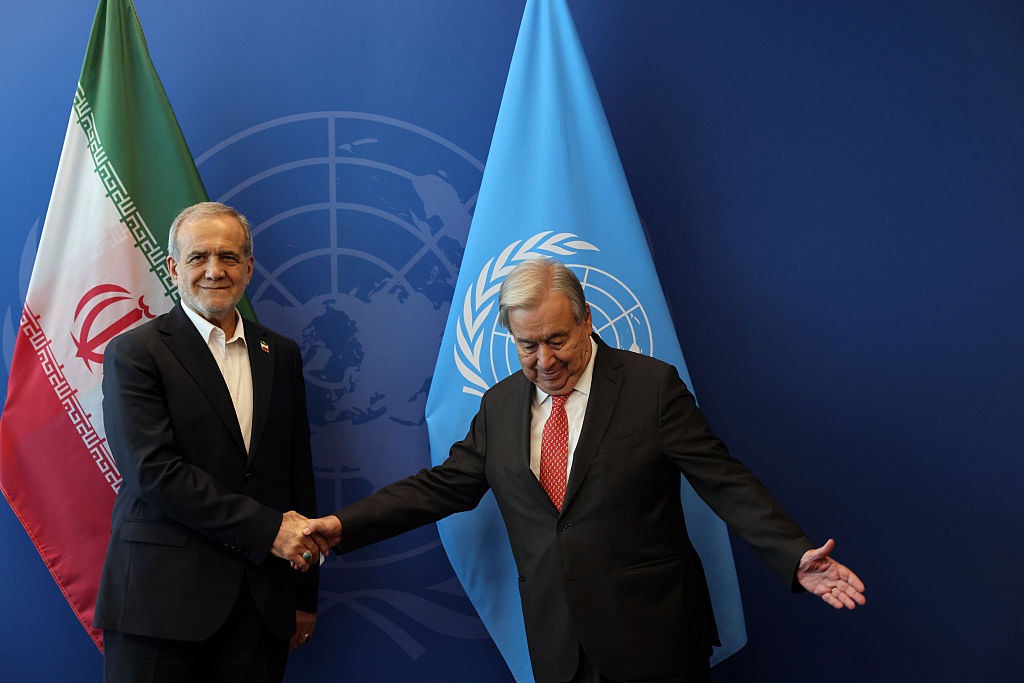
Against this backdrop, the reactions from European capitals and from the United Nations were swift — and revealing. Within hours, United Nations Secretary-General António Guterres, issued astatementwhose opening line set the tone: "I condemn today's military escalation in the Middle East." He continued with the formulation that has become the UN's signature posture in moments of crisis:
"The use of force by the United States and Israel against Iran, and the subsequent retaliation by Iran across the region, undermine international peace and security." The statement concluded with the point that allows the organization to appear principled while remaining inert: "All Member States must respect their obligations under international law, including the Charter of the United Nations."
The language was calibrated, procedural, formulaic. What it avoided was any sustained engagement with the ideological zealotry of the regime, or with the decades of destabilizing conduct that had preceded the strikes. TheUN Security Councilconvened an emergency session. Russia and China denounced the operation as a violation of Iranian sovereignty. Several European governments echoed concerns about precedent and pressed for an immediate cessation of hostilities and a return to talk, talk, talk.
France, Germany and the United Kingdom, while condemning Tehran's attacks on neighboring states, quickly moved to placedistancebetween themselves and the military operation. Their jointstatementused a phrase that expresses Europe's enduringinstinct: "We call for a resumption of negotiations and urge the Iranian leadership to seek a negotiated solution."
French President EmmanuelMacron, speaking publicly and on social media, intoned:
"The current escalation is dangerous for everyone. It must stop... The Iranian regime must understand that it now has no other option but to engage in good-faith negotiations to end its nuclear and ballistic missile programs, as well as its actions to destabilize the region."
The British and German positions followed the same patronizingplatitudes:insistence that they were not participants in the strike, condemnation of Iran's retaliatory salvos across the Gulf, and an immediate pivot back to negotiation as the legitimizing grammar of European diplomacy. On X, the cadence was consistent across ministers and ministries: defense of "international law," fear of regional spillover, and repeated emphasis on safeguarding civilians and maritime corridors.
Source: Gatestone Institute :: Articles
