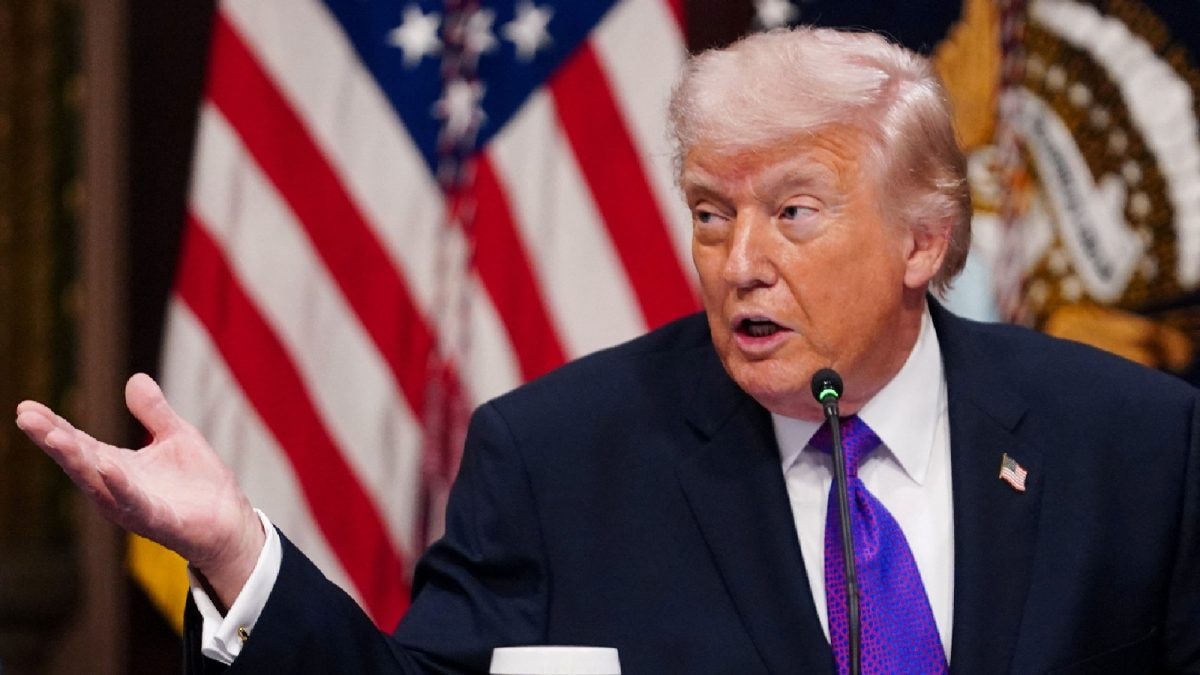
United States (US) PresidentDonald Trumphas explicitly threatened to take control of the Strait of Hormuz if Iran continues to disrupt global oil flows.
The waterway, which passes directly through the territorial waters of Iran and Oman, is currently in a state of “near-total collapse" regarding commercial traffic.
Following military strikes, Tehran has challenged this international right of passage and its Iran’s Revolutionary Guard (IRGC) declared the strait “closed" and has issued warnings that any vessel attempting to pass will be attacked.
Trump, meanwhile, has issued severe warnings and outlined specific military measures to reopen it. Can he take control?
It is a narrow, strategicallyvital waterwayin the Middle East that serves as the only sea passage from the Persian Gulf to the open ocean. It links the Persian Gulf (to the west) with the Gulf of Oman and the Arabian Sea (to the southeast).
It is bordered by Iran on the North coast, the Musandam Peninsula (an exclave of Oman) and the United Arab Emirates on the South. It is about 21 to 33 miles (33–54 km) wide at its narrowest point. Due to the narrowness, ships must use two-mile-wide lanes (one inbound, one outbound) separated by a two-mile buffer zone to prevent collisions. Major islands within or near the strait include Qeshm, Hormuz, Larak, and Hengam, most of which are controlled by Iran.
The Strait of Hormuzis the world’s most critical oil chokepoint. It handles approximately 20% of global oil consumption (around 20 million barrels per day) and 20-25% of the world’s liquefied natural gas (LNG), primarily from Qatar. Over 80% of the oil passing through the strait is destined for Asia, with China, India, Japan, and South Korea being the primary importers.
On March 4, the IRGC declared it had gained “complete control" over the strait, vowing to “set ablaze" any vessel attempting to pass. Trump and CENTCOM have dismissed Iran’s claims of total control. The U.S. Navy has been ordered to prepare escort missions for commercial tankers to ensure the “free flow of energy".
China has deployed a naval fleet, including the missile destroyer Tangshan, to the region to secure its own energy supplies. Pakistan has launched Operation Muhafiz-ul-Bahr on March 9 to escort its merchant vessels through the disrupted waterway. Russia is participating in joint naval exercises with Iran and China in the area, according to reports in foreign media and Al Jazeera.
Under international law, control is divided between the bordering nations, though navigation is theoretically protected by global treaties:
Source: World News in news18.com, World Latest News, World News